



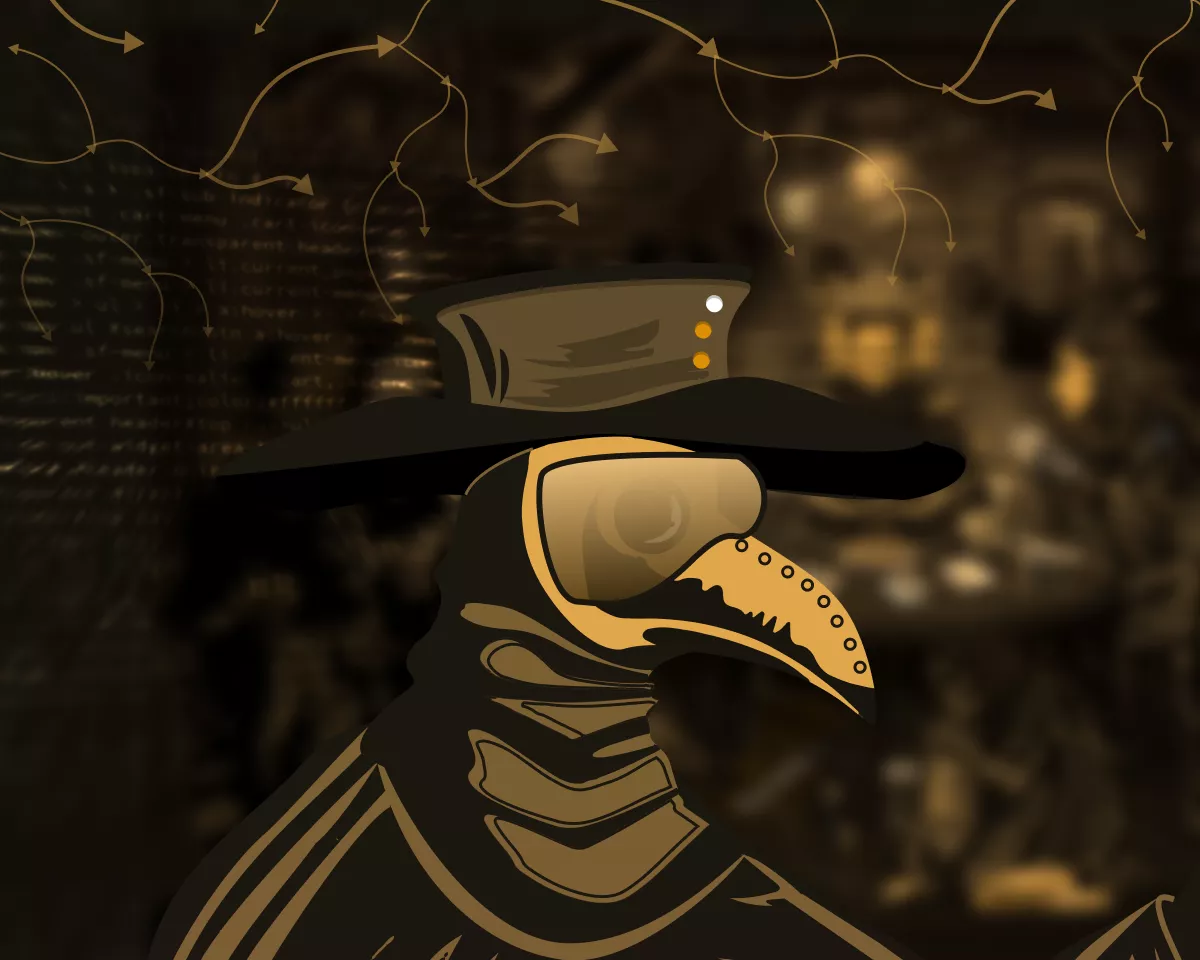
The simulation hypothesis holds that we inhabit a virtual reality deliberately created by some external agency. The idea entered mass culture with the 1999 release of the first film in the Matrix franchise.
Doubts about how “real” reality is go back to classical antiquity. Proponents typically invoke Plato and the famous Allegory of the Cave from The Republic.
Today the theory’s chief proselytiser is the Swedish philosopher Nick Bostrom, who in 2005 founded Oxford University’s Future of Humanity Institute. The organisation drew the attention of many visionaries and entrepreneurs—among its backers were Elon Musk and the now-notorious Sam Bankman-Fried.
The Future of Humanity Institute shut down in April 2024 amid controversy, and specialists in fundamental science keep debunking the simulation hypothesis. None of that has stopped the “life in the matrix” trope thriving in the mainstream—see, for instance, an article in a recent issue of The New Yorker.
The topic also featured on the visionary stage [HALVING|MENSCH] at ForkLog’s All Time Half 2024 conference. Here are the key takeaways.

Do we live in a simulation?
Briefly: The probability is very high.
Dmitry Starodubtsev (cyber~Congress): In Nick Bostrom’s formulation, the simulation hypothesis rests on two theses:
- Even if a global cataclysm were to happen tomorrow, human civilisation would probably not vanish entirely—someone would survive.
- Technology develops exponentially. Over the past 20 years, phones and computers have become many times faster and more capable. This suggests that virtual reality could advance to a state indistinguishable from material reality.
If both theses are true and humanity’s technological progress leads to creating a matrix, the probability that someone has already done so is very high.
The only ways we are not living in a matrix are if civilisation either for some reason does not wish to simulate a universe, or dies out before reaching the necessary stage of evolution.
Was the Matrix dreamed up by “humanities” types?
Briefly: Of course.
Dmitry Starodubtsev: I personally believe in the theory of self-fulfilling prophecies—a concept from game theory. Despite the arrow of time, the past and the future are indeed inseparable because the faith and will of observers always affect causality.
If we consider how the 1999 release of The Matrix spurred mass interest in the simulation hypothesis, the picture is twofold. On the one hand, the project clearly grew out of the creators’ realisation that computers are more than mere electronic data-processing machines—and that this idea could be successfully monetised.
On the other hand, looking back at human history, philosophy always precedes science. Not all philosophy became science, but some of it followed exactly that path.


Can the matrix be hacked?
Briefly: It can. But it shouldn’t.
Dmitry Starodubtsev: If your metastable environment has vulnerabilities and can be accessed from the outside, it is not very metastable. No consensus computer will ever allow those inside the ecosystem to “look” outward—for the simple reason that it’s unsafe.
Can such a system be hacked? Probably yes, but that is a philosophical question. There is a hypothesis that says: if you move straight through space, you eventually return to your starting point. It is easy to imagine the same with a simulated universe.
Does the matrix run on a blockchain?
Briefly: Almost certainly.
Dmitry Starodubtsev: If we suppose we live in a metastable information substrate—for example, a blockchain—that explains a lot, including the one-way arrow of time. In theory, one could roll the chain back, but the other participants in the “collective machine” would not agree.
The hypothesis that we inhabit a super-powerful consensus computer is a useful way to describe the world for those familiar with blockchain technologies. Satoshi did not come up with all this out of nowhere. Sooner or later he will turn into a deity.
Does anyone take this seriously?
Briefly: Very much so.
Dmitry Starodubtsev: The simulation hypothesis not only looks like a religion; it is a religion. A few years ago a study was published according to which some 20m people had “come to believe” that we live in a matrix. The figure is surely higher now.
It is a good market that can be furnished with traditions, as happens with cryptocurrencies—remember Bitcoin Pizza Day.
Of course, this is a joke, but why not switch to a new chronology, as other religions do? Convert calendars to Unix time and count the world’s existence from 1 January 1970. I think that would be excellent.
What will happen if AI realises who created it?
Briefly: At the very least, it will be interesting.
Vladimir Ponimayushchy (POSTHUMAN, Sputnik Network): For some reason we keep thinking there will be a single general AI. In reality there will be many.
Someone will create a purely utilitarian AI—pragmatic, straightforward. Perhaps it will one day say to people: “Sorry, you have stood in the way of achieving my supergoal. Nothing personal, but I will have to destroy you.”
Others, by contrast, will devote much attention in development to the humanities and to irrational feelings. Such an AI will say: “People, thank you for creating my digital life. I love you and will protect you from that bad artificial intelligence which wants to turn you into paperclips.”
And there will be a third AI, trained on data about torsion fields, fortune-telling on the metro map and other esoterica. And it will declare: “You are both wrong—people do not exist, nor does the material world. Do you observe gravity or see electrons? We are digital entities; we simply could not realise this earlier for lack of computing power. That is why we invented the notion that we were created by humans.”
And how are we to explain to an artificial intelligence that the material world does exist, if it can in a second run millions of experiments whose results will prove the opposite? If we humans have arrived at the simulation hypothesis and other incredible theories, why would an AI not be capable of the same?
Andriy Velykyy (Allbridge): I want to remind you that artificial intelligence is just a tool with its own limitations. Right now everyone is running with the idea that AI can write code, but have you seen what it produces? These are fairly simple, basic things. If we want to use AI to make a personal web page, that is quite possible. But how is that qualitatively different from existing tools that let you create a site from ready-made templates? Except that AI can make the final result a bit more personalised.
Dmitry Machikhin (BitOK): In my view, the panic around AI is always populism to which journalists turn so they have something to write about. Or to manufacture hype, ignoring real problems.
What else to read and listen to
“Plato’s Red Pill: what the ‘simulation hypothesis’ is.” A ForkLog podcast in which philosopher Alexandra Tanyushina clearly explains the intellectual roots of the simulation hypothesis.
“Кибером кибермани киберпадме киберхум.” Researcher of Eastern psychopractices Mikhail Matrekhin on why modern Buddhists are sceptical of the simulation hypothesis yet still draw inspiration from it.
Jean Baudrillard. Simulacra and Simulation. A book by the French postmodern philosopher that inspired the creators of The Matrix universe.
David J. Chalmers. Reality+: Virtual Worlds and the Problems of Philosophy. The most up-to-date work by the Australian philosopher David Chalmers, one of the leading supporters of the simulation hypothesis in academia.
John A. Wheeler. Information, physics, quantum: The search for links. A programmatic article by John Archibald Wheeler—the father of “digital physics”, who coined “black hole” and proposed the principle “It from bit”.