




The wallet-draining group Pink Drainer has fallen prey to an address poisoning scam.
Scamming the scammer ?
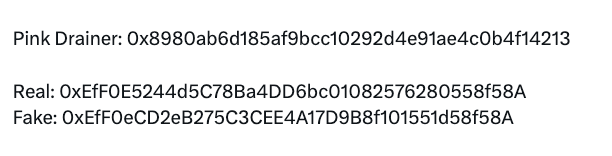
It seems like an address associated with the Pink Drainer fell victim to the address poisoning scam.
Pink Drainer: 0x8980ab6d185af9bcc10292d4e91ae4c0b4f14213
Real: 0xEfF0E5244d5C78Ba4DD6bc01082576280558f58A
Fake:… pic.twitter.com/1CCWTufeZv— MistTrack?️ (@MistTrack_io) July 7, 2024
The incident, which occurred on June 27, was highlighted by analysts from the MistTrack platform. According to their data, the hackers sent 10 ETH, valued at approximately $30,000, to a fake address mimicking their own.
Address poisoning occurs when a perpetrator sends a small amount of digital assets from a wallet with a similar address to confuse the victim into using incorrect data.
“Scammers have bots that look for new transactions. Since they cannot replace the entire address, they make only the first and last few characters look similar. This way, the scammer hopes the victim [copies] the address instead of the original,” MistTrack experts noted in a conversation with Cointelegraph.
In the case of Pink Drainer, the poisoned address duplicated the first and last five characters.


In May, it was revealed that the hacker group ceased operations after reaching a financial goal.
According to a dashboard by Dune, since July 2023, the hackers have stolen over $85 million from more than 21,000 victims.
Previously, an unknown individual stole 22,960 ETH (~$67.1 million) using address poisoning. Later, they returned all the funds to the affected user.
In May, Binance introduced a mechanism to combat this type of scam. The algorithm detects fake addresses by initially identifying suspicious transfers, such as transactions with near-zero value or low-value tokens.