



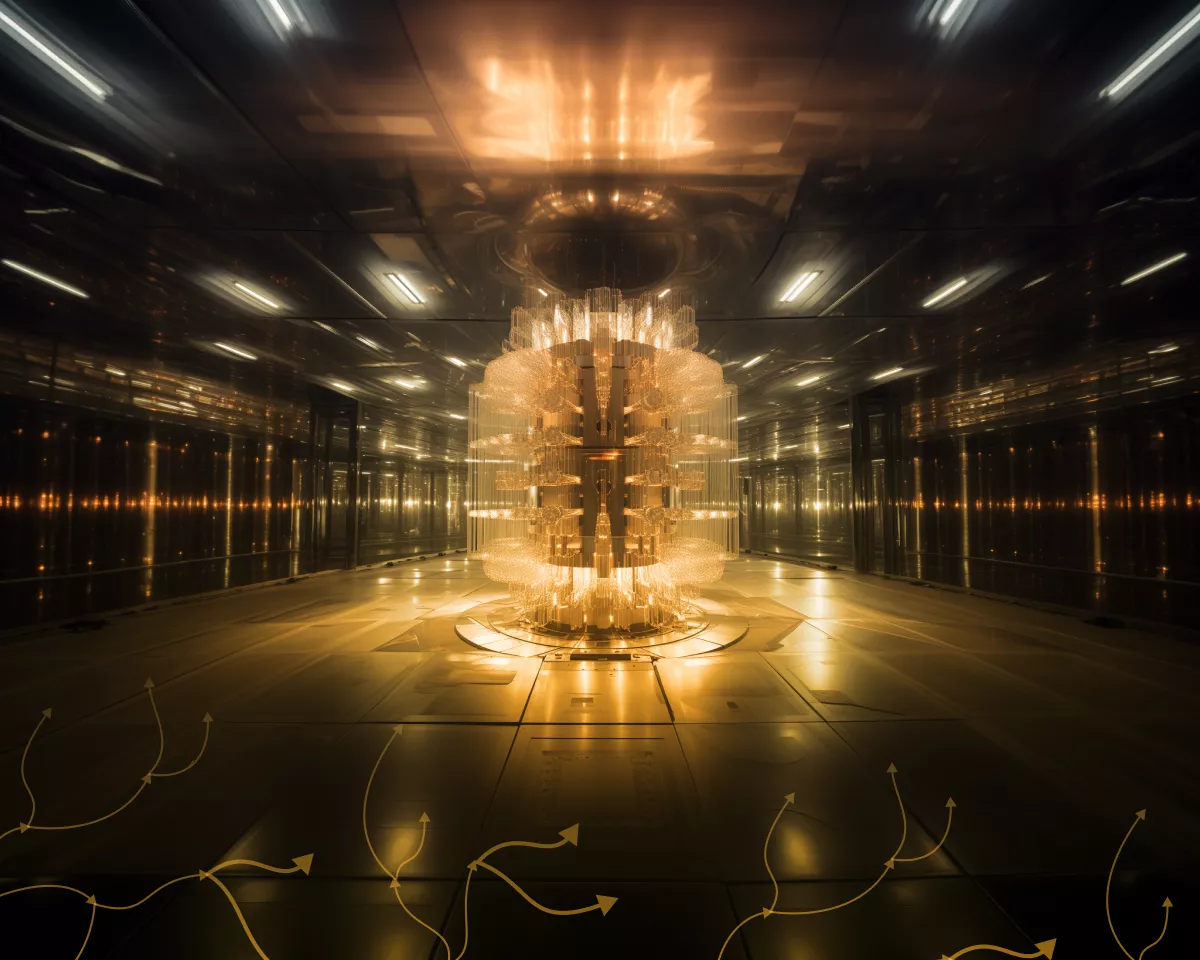
Quantum computers have long inspired both hope and anxiety. Optimists expect them to propel computing into a new era, tackling problems beyond the reach of today’s most powerful machines. Pessimists counter that, for ordinary users, all those qubits dangling in “chandeliers” will bring little besides new challenges for cryptography and data protection. For ForkLog readers, Sergey Golubenko explains how quantum computers built by early 2024 actually work and how justified the fears are.
In 1965 the American engineer Gordon Moore observed a pattern: the number of transistors on microchips doubles roughly every two years. The observation was borne out; the power of computing devices has risen exponentially ever since:
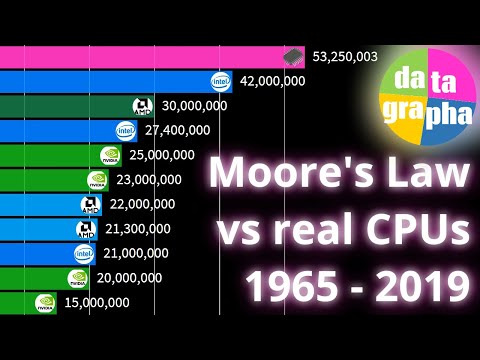
Yet in 2007 Moore himself predicted that his trend would soon break down—physics imposes limits. The most promising way out of this cul‑de‑sac, many argue, is quantum computing systems, which we discuss here.
Their crucial difference from conventional computers lies in how they store and process information. Classical machines, built on silicon chips, contain millions of transistors. Acting as microscopic switches, each can be “on” (1) or “off” (0). Computers therefore store and process data in binary, operating on bits.
Quantum computers operate with qubits (quantum bits) and can be built in various ways—using superconducting electrical circuits or individual ions confined in electromagnetic traps.
Understanding this requires stepping beyond everyday intuition into the quantum realm, where qubits can exist in multiple states at once. This is superposition. A qubit’s quantum state can represent not only 0 or 1, but any combination between—and both at the same time—much like in the thought experiment of “Schrödinger’s cat”.
Crucially, the probabilistic dance stops the moment an observer intervenes and needs a definite result. The operator of a quantum computer, via a specific algorithm, reads out only “1” or “0”. Because a qubit can persist in superposition, a quantum computer can process vastly more data in parallel than a classical machine.
Building and controlling a single qubit is only part of the challenge. Besides superposition, qubits also exhibit “quantum entanglement”—another key quantum‑mechanical property in which one qubit’s state depends on another’s. In simple terms, if two qubits are entangled and one is sent tens of kilometres away via fibre optics, they retain their link and will “know” everything about each other. This opens up remarkable possibilities for transporting information with quantum cryptography. The weak spot is that particles have a habit of being lost en route, so not all make it to the finish.
Qubits are extremely sensitive to random excitations—tiny thermal effects or the electromagnetic field of a nearby object. As a result, a quantum computer currently gives the right answer only with a probability of 98–99%. To keep them stable, pairs of qubits are placed in a cold vacuum, isolated from everything else. This raises questions: how should a qubit be stored, and which particles can play its role?


Consider a machine that uses ions as qubits. The task is to assign a suitable natural particle (here, an ion) the value “1” or “0”, which it takes when located respectively north or south of the equator of the Bloch sphere. This enables “valves” that can be controlled (tuning the probabilities within the particle) using low‑level programming. A special electromagnetic trap captures and holds such pairs of ions in close entanglement. The result is an entangled ion pair that can be controlled in a cold vacuum.
The following technologies are used in quantum computing:
- superconducting qubits (currents on chips);
- photonic qubits—entangled light quanta generated and controlled with optical equipment for hours at room temperature;
- ion qubits in magnetic traps—chains of charged ion nuclei held by electromagnetic fields in a cold vacuum;
- solid‑state quantum dots on semiconductors, controlled by electromagnetic fields or laser pulses;
- quasiparticles in topological quantum computers—collective states of clusters of electrons, “frozen” photons or Majorana fermions that behave like particles within semiconductors or superconductors.
Next comes how quantum computers work and how they differ from classical ones.
A quantum computer is a combined analogue–digital system that operates with “sets of probability values” and, via a given algorithm, yields a sample from the algorithm’s final realisations. A classical computer, by contrast, is a digital machine that processes information discretely as strings of ones and zeros.
This raises another question: how are analogue outputs converted into familiar digital form? Using signal‑conversion systems, researchers have achieved low‑level programming of particles. The aim now is to let programmers write high‑level code without deep knowledge of physics or chemistry.
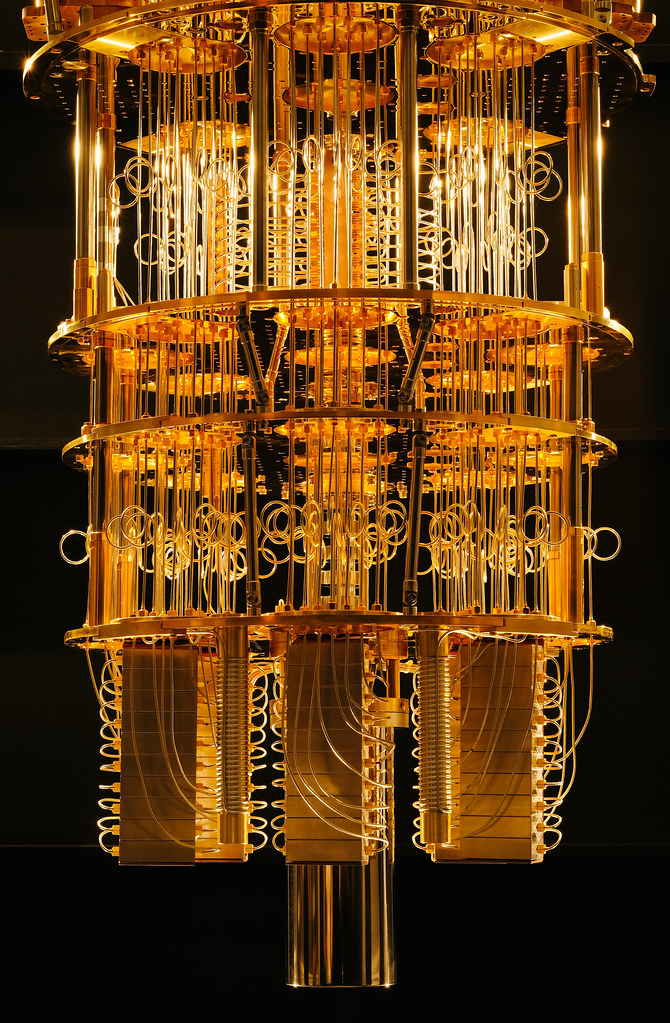
Another current limitation is size: quantum computers are bulky and require large rooms. The “chandelier” form used in IBM and Google’s superconducting technologies is considered the most convenient. It comprises many copper wires connecting all parts of the computer: qubit‑signal amplifiers, superconducting coils, the quantum processor, and shielding from radiation and electromagnetic waves—all inside a vacuum. Where other qubit technologies are used, the machines can look very different, even resembling a traditional server rack.
Qubit properties (superconductivity, superfluidity, and so on) emerge only at temperatures close to absolute zero. Cooling quantum processors requires helium or nitrogen systems.
Are the efforts worth it?
On potential computing power, classical performance scales directly with bits: adding one transistor increases memory by one bit. In quantum machines, adding a single qubit doubles the memory space. As noted, one qubit has two states (0 or 1). Thanks to entanglement, ten qubits span 1,024 states; a hundred qubits span 2 to the 100th power.
There is clearly something to fight for. The main task, however, is to maintain the quality of entanglement as qubits are added, because mere quantity will not boost performance or yield “quantum supremacy”.
Tech giants and startups: quantum computing today
Today, the following corporations, state research centres and young independents have made the most progress in building quantum systems.
IBM
The firm’s quantum fleet already counts more than 20 machines, accessible via the IBM Quantum Experience cloud service. In December 2023 at the Quantum Summit it unveiled the first modular quantum computer, IBM Quantum System Two. It is based on the 133‑qubit Heron processor, which the company calls the most performant in the world. IBM also announced the Condor processor with 1121 qubits and 50% higher qubit density.
In 2019 the tech giant said it had achieved quantum supremacy with its 53‑qubit Sycamore superconducting computer (the claim was contested by IBM). Critics deemed the test more a “showcase performance” in the quantum race. Since then, researchers have added 17 qubits to Sycamore’s tally. It now performs in seconds computations that would take a modern supercomputer 47 years.
Like IBM, Google has taken the proven route of classical chips with superconducting qubits.


Xanadu
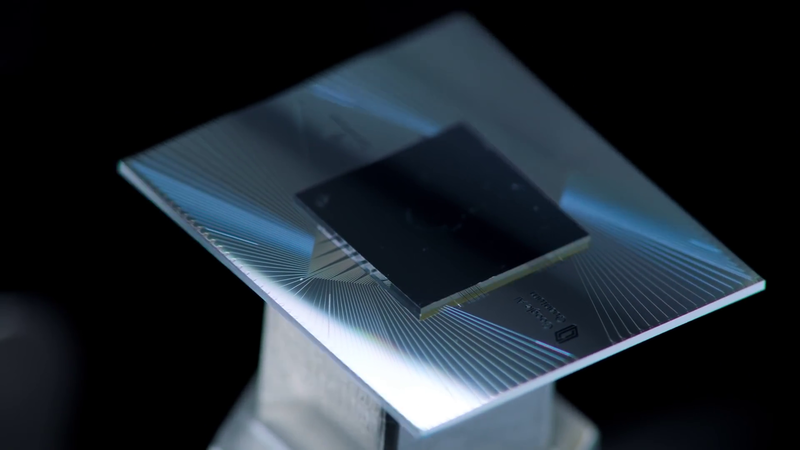
The Canadian company announced in spring 2022 the launch of its Borealis quantum computer, deployed in the cloud for public access. The machine uses 216 photonic qubits. As Nature reports, the system cleared the algorithmic threshold for quantum supremacy. A top supercomputer would need about 9,000 years for the task; Borealis did it in 36 microseconds.
Atom Computing
The California firm built the world’s first quantum computer with 1,180 qubits, using neutral atoms held by lasers in a two‑dimensional lattice. As a result, its qubits can operate error‑free for nearly a minute, whereas a comparable IBM machine managed only 70–80 microseconds.
University of Science and Technology of China
In December 2020 Chinese researchers reported that their Jiuzhang computer, based on entangled photons, had achieved quantum supremacy. In 200 seconds it performed calculations that the world’s fastest digital computer would take half a billion years to complete.
Quantum computing and cryptocurrencies
Some argue that quantum computers will soon be able to crack blockchains and, for instance, destroy Bitcoin. The concern is not baseless, but two nuances matter.
First, the threat is more relevant for PoW blockchains, where deciphering a mined hash is at stake. Second, RSA encryption (the most common alternative to elliptic‑curve cryptography) may prove more quantum‑resistant—even though, in traditional cryptography, the opposite is usually assumed.
In broad terms, much will depend on how swiftly cryptographers address protection against potential quantum attacks.
The crypto sphere already has firms claiming full quantum resistance: Quantum Resistant Ledger with its QRL cryptocurrency, and JPMorgan’s QKD key‑distribution technology to protect blockchains against quantum computing. To achieve quantum resistance, QRL uses IETF XMSS—a hash‑based, forward‑secure signature scheme with minimal security assumptions, where XMSS is an extended Merkle signature scheme.
The shift toward modular blockchains also looks promising. Their structure should ease the introduction of quantum signatures and, in future, help distribute node operators to bolster decentralisation and protect distributed ledgers.
In sum, the fusion of blockchain and quantum computing could yield safer and potentially revolutionary computing solutions, capable of tackling a range of cryptographic and real‑world problems.
Whether we see a quantum hard fork of Bitcoin or a global quantum internet is likely a matter of time.