


Remembering Plasma: Vitalik Buterin on a new take on an old technology
Ethereum co-founder Vitalik Buterin опубликовал эссе, in which he recalls Plasma and outlines how it can be applied in current realities.
- Buterin explains how Plasma works and its drawbacks.
- Integration with ZK-SNARK could resolve many of the technology’s problems.
How Plasma Works
Plasma — a scaling solution for Ethereum proposed in 2017 that enables all data and computations to be stored off-chain, except for information about deposits, withdrawals, and the roots Merkle tree.
Over time the technology grew into several iterations — Minimal Viable Plasma, Plasma Cash, Plasma Cashflow and Plasma Prime. All of them served the same purpose but operated on somewhat different principles.
According to Buterin, the development opened doors for a breakthrough in network scalability. However, later, due to high costs of storing data on the client side and technological limitations rollups, Plasma was displaced.
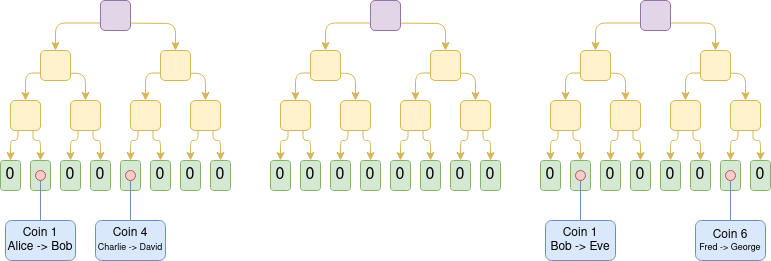
The simplest introductory version of Plasma Cash treats each individual coin as non-fungible token and tracks its movement history.
In the Plasma chain there is an operator responsible for creating and regularly publishing blocks, the transactions in which are stored in a segregated Merkle tree. This makes it possible to know exactly to which user a given coin belonged at a specific moment in time.
Problems with Plasma
Although this data-storage method theoretically suited for mainnet scalability, the approach faced technical difficulties. The primary risk in any Plasma ecosystem is operator misbehavior, for example by publishing an ‘invalid’ or ‘unavailable’ block.
In such cases, a host of errors emerges, including double-spending. Subsequently, network participants had to perform checks and gather evidence of violations themselves.
According to the Ethereum co-founder, the aforementioned construct works for NFTs, but to apply it to fungible tokens one would need to modify the algorithms. He suggested that one could track only a portion of a coin separately (not 1 ETH, but 0.01 ETH), but that would entail excessively high gas costs.
One solution is to optimize protocols that treat many adjacent coins as a single unit with the ability to transfer or withdraw them simultaneously.
«However, both approaches face the problem of fragmentation. If you receive 0.001 ETH from hundreds of people buying coffee from you, you will have 0.001 ETH in many places in the Merkle tree. And withdrawing that ETH still requires creating many separate exit points, which would make gas fees prohibitively high. Defragmentation protocols are well thought-out, but hard to implement», — Buterin explained.
Moreover, the technology is almost impossible to implement within the EVM. One of the key problems is that many objects in the ecosystem do not have a clear ‘owner’, while the security basis of Plasma rests on the mandatory confirmation of ownership.
How ZK-SNARK could help
In Buterin’s view, the emergence of proofs of validity (also known as ZK-SNARK) provides a reason to rethink Plasma’s principles.
The main benefit of ZK-SNARKs is to simplify verification of each block in the Plasma chain. This approach reduces the number of states a user needs to load from a given Merkle branch for a given coin.
If the operator and the final owner were honest, withdrawals from the most recent state would not require verification and could be performed ‘instantly’.
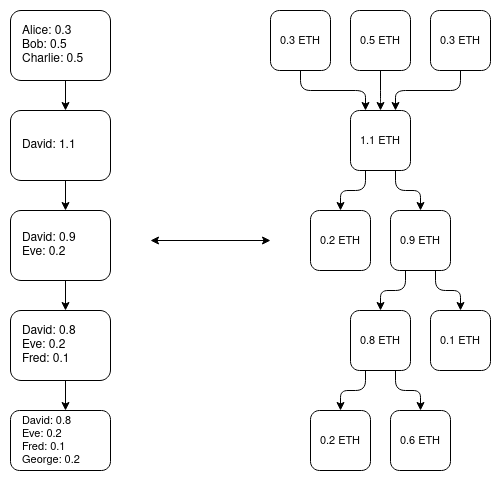
In EVM networks, Buterin proposed using ZK-SNARK in combination with the моделью «вывода неизрасходованных транзакций» (UTXO) for implementing a parallel graph of ETH tokens and ERC-20. Such a system would be able to verify and prove the ownership history of a given coin.
According to the Ethereum co-founder, using Plasma in the EVM is still not fully fleshed out and carries potential privacy issues.
«Such schemes are powerful but cannot provide full security guarantees to all users. They are most clearly broken in situations where a particular state object has no clear owner», — the developer explained.
Nevertheless, Buterin regards Plasma as an undervalued design space that can simplify developers’ work, freeing them from having to think about ownership graphs within applications.
As reported in October, the Ethereum founder explained, how account abstraction could make user accounts resistant to hacking with quantum computers.
Earlier, Buterin shared his views on the future of Ethereum.
Рассылки ForkLog: держите руку на пульсе биткоин-индустрии!