



Report: Demand for Ethereum staking slows
The Ethereum validator queue has fallen to its lowest since the April Shanghai hard fork. This signals a stabilization in demand for staking ETH, according to a Coinbase research report.
On 15 September 2022, the developers of the second-largest cryptocurrency activated a broad upgrade known as The Merge. As a result, the blockchain migrated from the Proof-of-Work (PoW) consensus algorithm to Proof-of-Stake (PoS).
The fundamental change was the shift of network security and coin issuance duties from miners to validators. The latter must lock 32 ETH in staking to run a node. Users can also participate in earning passive income by delegating assets through specialized platforms and services.
The Shanghai hard fork implementation (a component of the Shapella upgrade) opened the possibility of withdrawing ETH from the deposit contract. This led to a growth in the amount of locked cryptocurrency, mainly through LSD protocols such as Lido Finance.
However Coinbase analysts David Don and David Han noted that ‘validators hitting peak capacity’ in recent months has led to a decline in staking yields from more than 5% to 3.5%.
Real, inflation-adjusted yield stands at 3.2% versus 3.1% on US Treasuries.
‘In our view, the ETH staking yield underpins the ecosystem and is a benchmark for alternative cryptocurrency investments,’ the experts said.
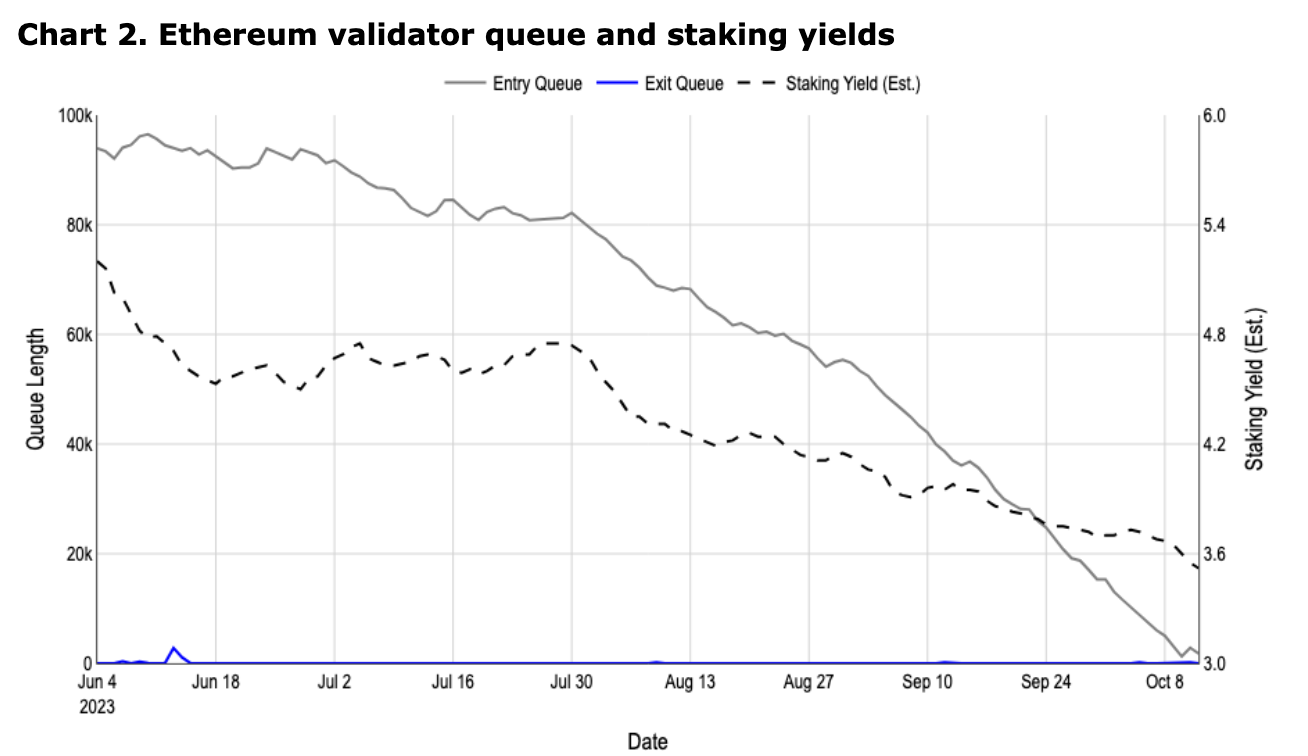
They expect that the ETH staking yield level will stay unchanged amid the slower growth in validator counts. However, this requires sustaining base-network activity and transaction fees. In the third quarter, that was the case, and the number of rollup-operations increased.
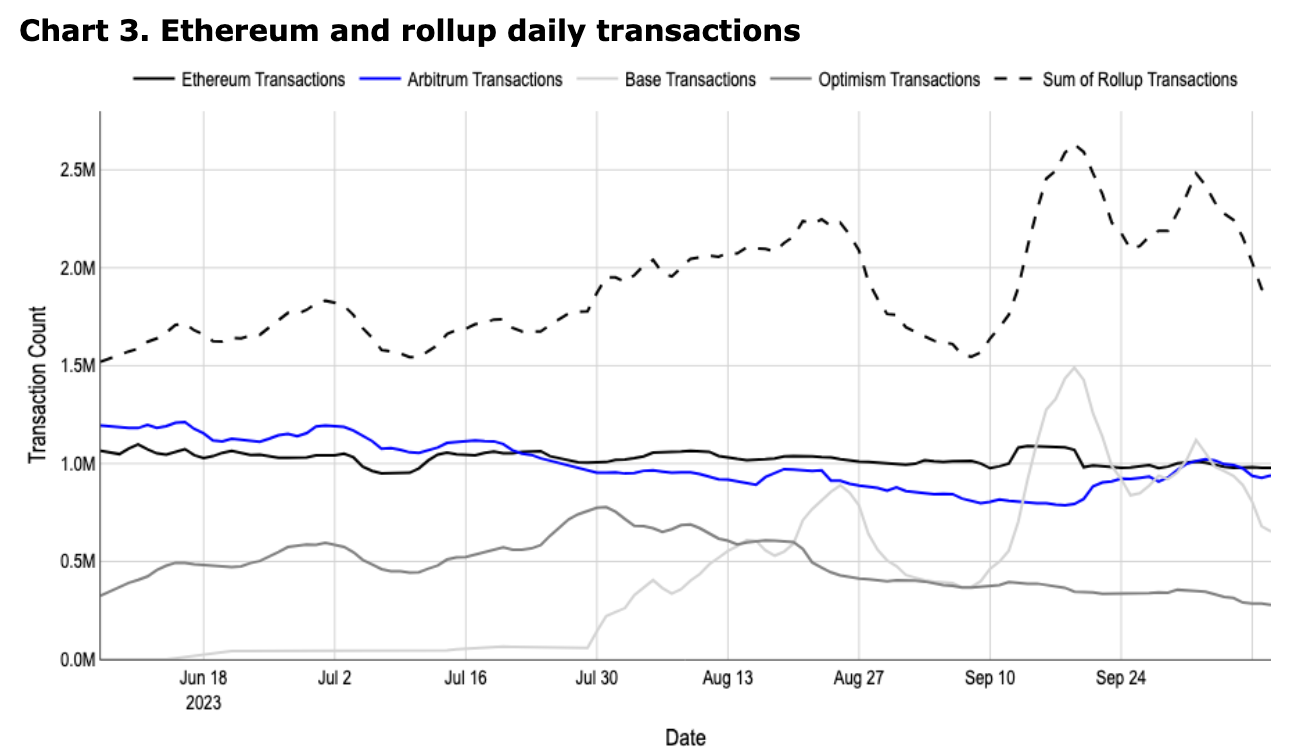
Since before the Dencun hard fork, which is likely to occur in the first half of 2024, there will be no meaningful Ethereum updates, and we do not see any major technical factors that could materially affect network activity, Don and Han stated.
In their view, exceptions could be the emergence of large L2-protocols or ‘egregious’ hacks, they added.
JPMorgan skeptical on Shanghai results
Analysts at JPMorgan, in a September report, said that the activation of Shanghai did not lead to the expected increase in on-chain activity.
The bank’s analysts noted declines:
- in the daily number of transactions by 12%;
- in the number of daily active addresses by almost 20%;
- in the volume of assets locked (TVL) in DeFi protocols by about 8%.
They called the ecosystem results “quite disappointing” and tied hopes for on-chain activity growth to Dencun’s implementation of EIP-4844, known as Proto-Danksharding. The upgrade scales the blockchain by introducing a new type of transactions for large binary data blobs and organising their storage. It is intended to reduce fees for L2 solutions based on rollup technology.
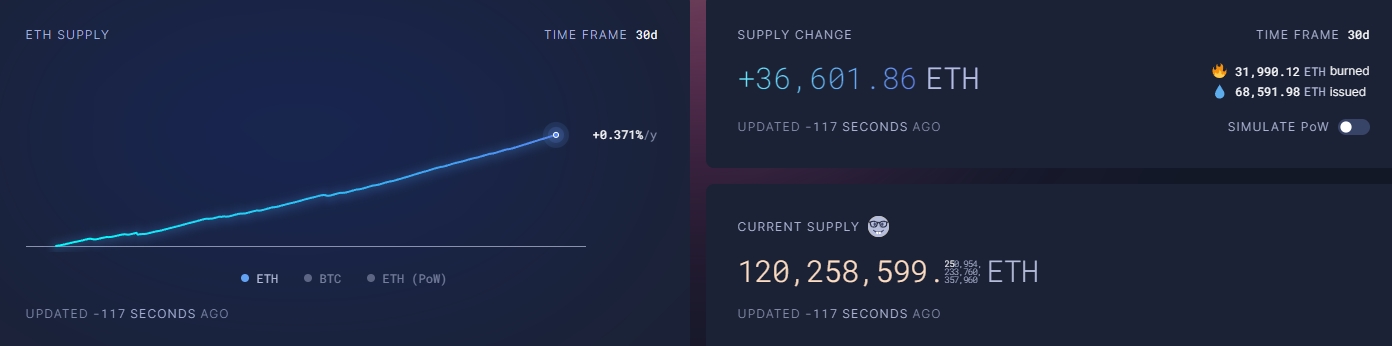
In September, amid a decline in Ethereum activity, the average transaction fee fell to the lowest levels of the year. The cryptocurrency became inflationary, though one of The Merge’s aims was to accelerate the reduction of coin supply.
According to Ultra Sound Money, over the last 30 days an additional 36,601 ETH entered the market. The annual inflation at the time of writing stands at 0.37%.
In early October, gas costs in the network fell to year-to-date lows. This was aided by declines in TVL in the DeFi sector, trading in the NFT space, and activity of Telegram bots.
Meanwhile, JPMorgan’s analysts, in addition to noting the drop in on-chain activity after Shanghai, pointed to another consequence of the fork — increased centralisation of staking.
The Ethereum centralisation issue has taken centre stage
In May, amid a surge of funds flowing into liquid staking protocols, concerns about centralisation began to grow.
Ethereum developer with the pseudonym Superphiz proposed platforms adopt self-imposed rules to prevent market share from exceeding 22%. Theoretically, this would significantly reduce the risk of a 51% attack, since it would require collusion of at least four market participants.
Several protocols agreed with Superphiz’s proposal, but Lido users almost unanimously voted against it.
In October, Glassnode, evaluating the influence of the leader in liquid staking on Ethereum, noted growing popularity of stETH relative to ETH, whose demand is stagnating.
On Lido, 32% of the volume of assets locked in staking is accounted for. The share among LSD providers reached 86.5%. Glassnode experts allowed that these metrics could continue to rise.
Co-founder Vitalik Buterin acknowledged another aspect of centralisation observed after the shift to PoS — the concentration of nodes on services controlled by corporations such as AWS, Google Cloud or Hetzner Online.
Buterin called the situation one of the key problems. He sees a solution in cheaper and simpler maintenance of nodes using affordable hardware. But purely technical constraints are unlikely to permit this for another 10-20 years, the expert noted.
As a reminder, ForkLog has analysed in educational cards what Ethereum’s development roadmap includes.
Рассылки ForkLog: держите руку на пульсе биткоин-индустрии!