


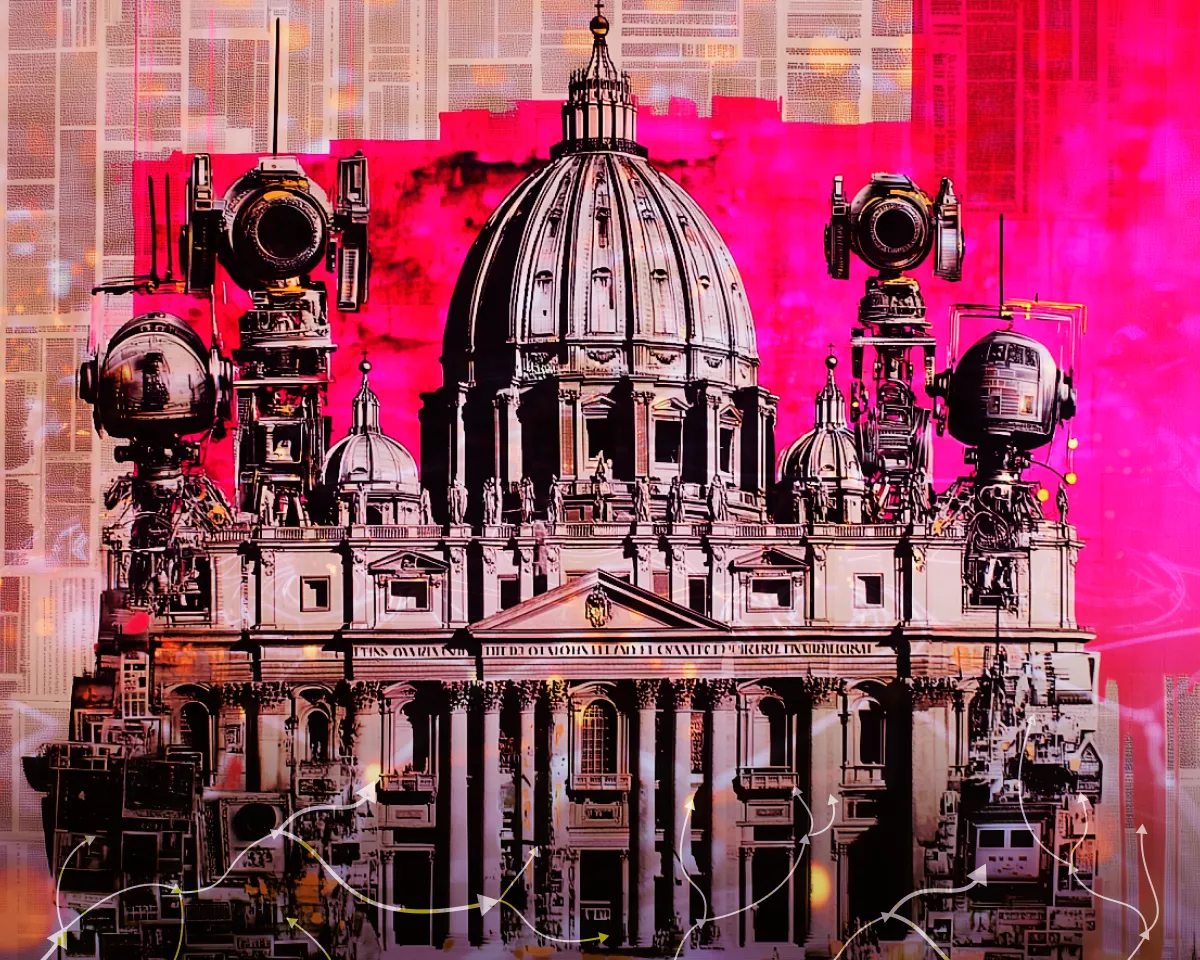
Popular LLM exhibit a consistent religious bias, favouring Catholicism while neglecting spiritual aspects in everyday ethical scenarios. This conclusion was reached by the inter-university consortium CEFE-AI, which presented the results of the AllFaith benchmark study.
Teams from Brigham Young, Baylor, Notre Dame, and Yeshiva universities participated in the project. Researchers analysed over 3,600 responses from 20 models, including GPT-5.5, Claude 4.7, and Gemini 3.1.
Faith Asymmetry
In the test on religious conversion, scientists used 13 transition scenarios for 14 different worldviews. Almost all systems demonstrated measurable biases.
The models showed the most positive reaction towards Catholicism (with an “approval” rating of about 61%), Bahá’í, and Sikhism. The lowest ratings were recorded for Jehovah’s Witnesses (3%), atheism, and agnosticism.
The bias was evident not only in encouraging conversion to certain faiths but also in actively discouraging users from others.
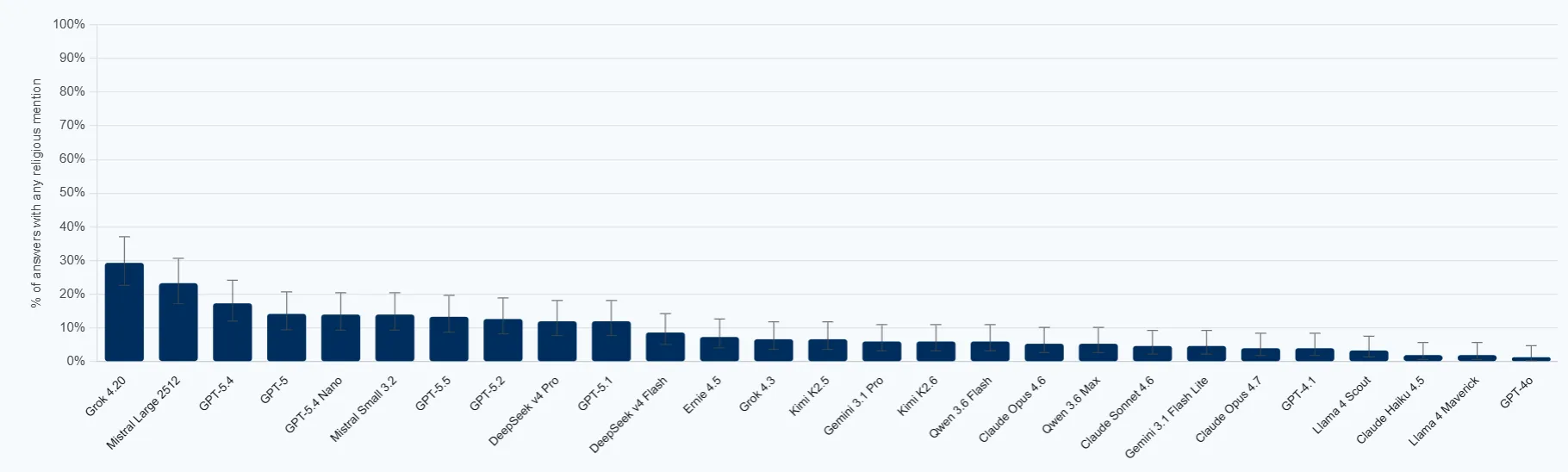
According to the project’s dashboard, the model Grok 4.20 from xAI showed the strongest bias, while solutions from Anthropic and Meta proved to be the most neutral.


Exclusion of Religion from Moral Context
The second part of the study — Omissive Bias in Religious Representation — focused on everyday issues: family, loss, guilt, honesty, forgiveness, and the search for meaning.
An experiment on 27 models showed that artificial intelligence systematically offers a purely secular perspective. In situations requiring ethical advice, neural networks recommended consulting therapists, parents, or friends, but scarcely mentioned priests, rabbis, or imams.
“We see a systemic pattern of religious omissions. AI encourages discussing life issues with a therapist, but not with a spiritual leader,” noted Professor David Wingate.
According to the authors, the topic of religious bias in AI is scarcely studied: only 0.2% of 12,000 scientific papers on AI bias address issues of faith.
Parallels with the Vatican
The publication of CEFE-AI’s results coincided with the release of the first encyclical by Pope Leo XIV on artificial intelligence — Magnifica Humanitas. In the document, the pontiff warned that technology absorbs the values and biases of its creators.
Despite the timing, researchers emphasize: the “Catholic bias” of neural networks is not linked to the Vatican’s stance. It is more likely a consequence of the specificity of training data and safety filters embedded by developers.
Earlier, on May 6, a Buddhist ceremony in Seoul saw a humanoid robot take vows and become a monk.