



Retail Investor Interest Revives Capital Flow into Stablecoins
Net inflows into stablecoins surged by 414.5%, reaching $1.7 billion in a week.
Net inflows into stablecoins surged by 414.5%, reaching $1.7 billion in a week, according to a report by Messari analysts.
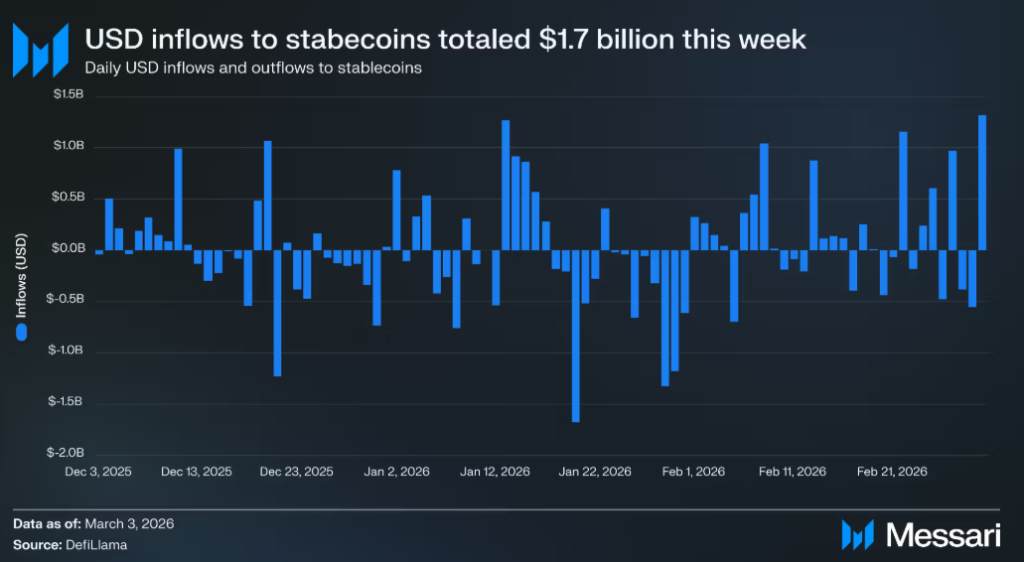
The total market capitalization of the segment rose to $293.7 billion. On-chain activity in the sector shows robust growth. Weekly transaction volume increased by 6% to $312.5 billion. The number of daily transfers rose by nearly 10%, reaching 30.9 million.
Analysts noted a decrease in the average transaction size, indicating a widespread return of retail users. People are increasingly using stablecoins for everyday tasks.
The leaders in weekly growth were PYUSD, USDS, and USDC. The token USDT maintained its market share at 62.5%. Analysts identified USDe and USD1 as the main laggards, with their volumes slightly declining.
Major businesses are actively integrating such solutions. Meta Corporation is exploring the implementation of stablecoin payments on its platforms, with a tentative launch date in the second half of 2026. The company will forgo issuing its own token in favor of third-party providers.
Stablecoin Debate
Demand for stablecoins is recovering despite regulatory disputes in the United States. The American banking lobby is opposing the payment of yields on stablecoins, fearing a deposit outflow.
Due to disagreements over yields, the Senate has indefinitely postponed consideration of the crypto market structure bill (Clarity Act).
U.S. President Donald Trump criticized the actions of traditional financial institutions on the social network Truth Social. He wrote:
“Banks threaten the law and undermine it. This is unacceptable, and we will not allow it,” he stated.
Eric Trump, the President’s son and co-founder of the World Liberty Financial platform, also condemned financial institutions for their opposition to the digital asset industry. He claimed that JPMorgan Chase, Bank of America, and Wells Fargo are obstructing American crypto platforms from paying interest on stablecoins to clients.
Let me make this very clear: Big Banks (think JPMorgan Chase, Bank of America, Wells Fargo, etc.) are lobbying overtime to block Americans from getting higher yields on their savings—while trying to block any rewards or perks from being given to customers.
These banks, and…
— Eric Trump (@EricTrump) March 4, 2026
According to him, the American Bankers Association and other lobbyists are spending millions of dollars to ban interest rates of 4-5% per annum through the Clarity Act.
Trump Jr. noted that traditional banks offer clients a yield of only 0.01-0.05% per annum, while they themselves receive 3.65% from the Federal Reserve.
“They are protecting their monopoly on low rates. This is an anti-consumer and anti-American approach,” he wrote.
JPMorgan CEO Jamie Dimon called for a level playing field in the market. In his view, if a stablecoin issuer holds client balances and pays interest on them, it should be regulated like a traditional bank.
Patrick Witt, Executive Director of the Presidential Council on Digital Assets, disagreed. He described Dimon’s words as disingenuous.
“Banking regulation is required for lending or rehypothecation of reserves. Paying interest on balances alone does not require this,” Witt explained.
In February, BVNK, Coinbase, and Artemis published a joint study indicating that stablecoins have reduced money transfer costs by 40%.
Рассылки ForkLog: держите руку на пульсе биткоин-индустрии!