




The year 2024 is anticipated to be a period of potential large-scale changes in the cryptocurrency market structure, driven by institutional demand, according to Ripple’s quarterly report.
Our latest XRP Markets Report is live — detailing Q4 events in crypto that brought important topics such as compliance and anti-money laundering to the forefront, key regulatory and licensing wins, and the latest on XRP Ledger integrations.https://t.co/5cuMXiVBjl
— Ripple (@Ripple) February 8, 2024
Among the significant factors for transformation, they cited the development of the ETF sector, growing investor interest in “proxy-BTC” through shares of Coinbase, MicroStrategy, and public bitcoin miners, as well as regulation.
Experts believe the fourth quarter of 2023 was significant for the widespread adoption of crypto assets. The “historic” October court decision in favor of Grayscale regarding its application to the SEC to convert a bitcoin trust into an ETF largely sparked bullish sentiment and a market rally.
Industry participants’ expectations regarding the regulator’s approval of exchange-traded funds based on the spot price of digital gold rose sharply. In January, on the first day alone, the trading volume of 11 SEC-registered products exceeded $4.5 billion.
“While this is just the beginning, [the approval of spot bitcoin ETFs] has already become a turning point for the crypto industry and a signal of increased institutional adoption and demand from experienced investors,” experts emphasized.
Q4 2023 Marked a Period of Growth for the Industry
In October-November, XRP trading volume in spot pairs increased significantly. The average daily volume (ADV) reached $300-450 million, stabilizing at around $600 million by year-end. Overall, ADV grew by 75-100% compared to the lows of Q3.


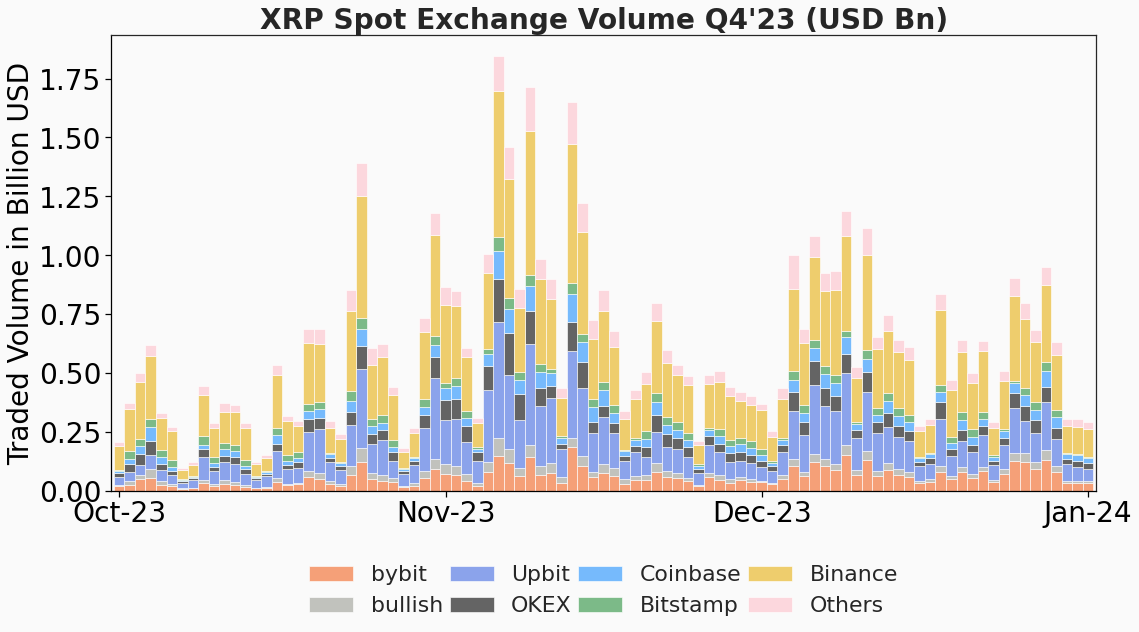
This matched the overall market trend. Bitcoin’s spot trading volumes increased by 88% quarter-on-quarter, while Ethereum’s rose by 140%.
By year-end, the CME became the largest platform for cryptocurrency futures trading — in Q4, open interest surged by 300% to $6 billion. Although largely due to Binance losing market share, the migration contributed to further establishing digital currencies as a recognized asset class, Ripple experts noted. Decentralized options exchanges, where activity jumped by 300%, also benefited from the trader influx.
Regulatory Compliance Takes Center Stage
Legal issues faced by Binance and its founder Changpeng Zhao, as well as the court ruling on former FTX CEO Sam Bankman-Fried, highlighted the importance of compliance, experts believe.
In July, Ripple achieved a partial victory in its case with the SEC. The court ruled that XRP itself is not a security and deemed most token sales and distributions unrelated to investment contract offerings.
However, this does not apply to certain sales of the asset to institutional players. The parties will present their arguments in March-April 2024, after which the court will decide on possible sanctions.
Ripple noted that even before the June court ruling, they had changed the way tokens were offered to organizations to meet regulatory standards.
In Q4 2023, the company continued its program to enhance regulatory compliance. Ripple obtained a full major payment institution license from the Monetary Authority of Singapore (MAS) and registered as a virtual asset service provider in Ireland.
The firm also holds a BitLicense in New York State and is a licensed money transmitter in 40 other U.S. jurisdictions.
Global Cryptocurrency Regulation Aids Recognition
Experts observed positive dynamics in global cryptocurrency regulation in Q4, despite ongoing SEC lawsuits against Coinbase and Kraken.
The Dubai Financial Services Authority (DFSA) opened external applications for tokens that may be approved for use in the Dubai International Financial Centre (DIFC). Ripple was among the first to seize this opportunity for XRP.
The UK government announced it would launch a “sandbox” for digital securities, including debt, equity, and money market instruments. Additionally, the country’s Treasury will examine banking challenges faced by licensed crypto firms to foster innovation in the region.
Spain announced it would aim to implement the EU’s foundational Markets in Crypto-Assets (MiCA) legislation six months ahead of the July 2026 deadline.
In Asia, Hong Kong prepared rules for real-world asset tokenization (RWA). MAS announced plans for a pilot RWA project in Japan, Switzerland, and the UK.
As reported in ForkLog’s New Year article, various regulatory changes impacted the industry in 2023.