



Key points
- The risk–reward ratio (RR) measures prospective return on a trade relative to the risk taken and the trader’s strategy. RR helps assess whether a trade is worthwhile.
- Calculate RR after drafting a trading plan, defining entry and exit points and setting a stop-loss.
- RR is worked out for each position individually, based on the trader’s strategy, statistics and constraints.
- A disciplined risk–reward framework, coupled with proper analysis of strategy results, supports long‑term profitability.
What is the risk–reward ratio (RR)
The risk–reward ratio (RR) shows the relationship between risk and potential profit. A specific RR is calculated before buying an asset to gauge the trade’s potential in the context of the trader’s strategy.
If RR is above 1, risk exceeds potential profit. If it is below 1, potential profit exceeds risk.
In trading and investing, risk is the potential loss a trader is willing to accept when opening a position. Risk is typically controlled with stop‑loss orders that automatically sell an asset at a specified price. This tool matters not only for limiting losses: the level of risk is integral to calculating potential profit and to the trading strategy as a whole.
Profit is the difference between the purchase price and the sale price. In the context of RR, profit refers to the target level a trader sets before entering a position to assess the trade’s potential.
How to calculate the risk–reward ratio
The standard calculation defines RR as risk divided by reward. Some traders, by preference, use the inverse (reward divided by risk), but we will stick to the conventional form below:


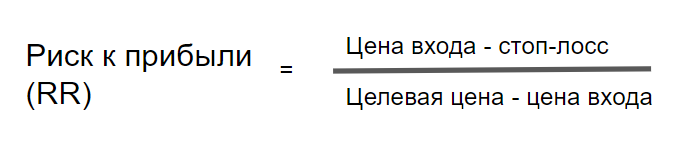
Suppose you want to buy an asset at $100. You place a stop‑loss at $90 and set a target at $130. In this case, RR is 1 to 3, or about 0.33 as a coefficient — risk is lower than potential profit.
With the same entry price ($100) and the same target ($130) but a stop‑loss at $40, RR equals 2. This indicates risk markedly exceeds expected profit.
What is an ‘optimal’ risk–reward
One of the most popular RR settings is 1 to 3 (a coefficient of 0.33). Traders also often use 1 to 7, 1 to 10 and 1 to 15.
Picking such off‑the‑shelf ratios is a mistake. A trader should determine the RR that best fits their strategy using experience, statistics and market conditions.
For example, if only 50% of a trader’s deals are successful, an RR of 0.5, or 1 to 2, will not help. The target exit should be set so that, statistically, it yields profit across trades, not just in a single operation.
With a 1 to 3 ratio (a coefficient of 0.33), the idea is that one winning trade can cover three losing ones. At 1 to 5, one winner should cover five losers.


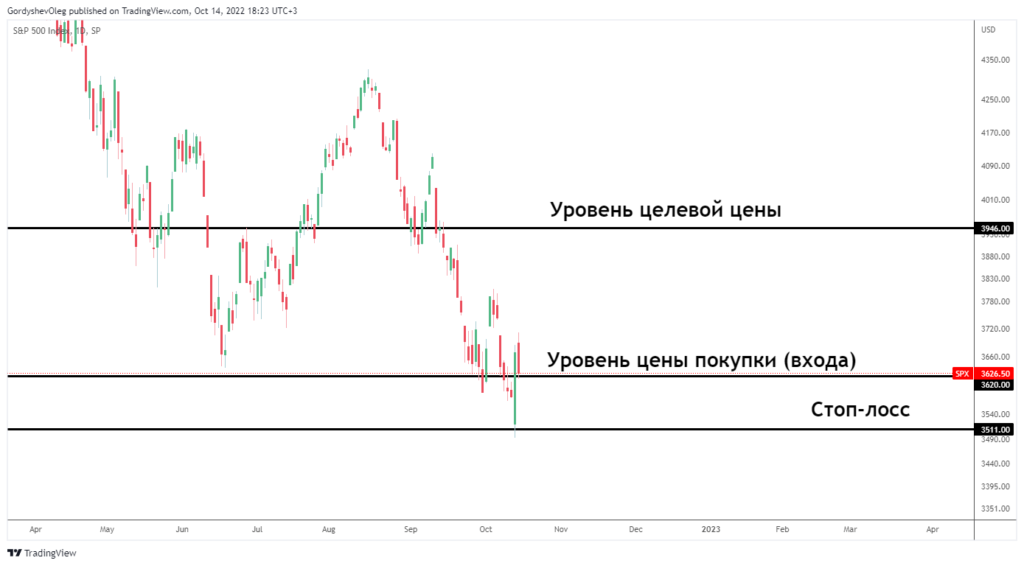
Before assessing risk and computing RR, a trader evaluates price‑move potential, identifies an entry point and forms a price forecast for the asset, including an exit plan.
Only then does it make sense to calculate RR. If the resulting ratio fits the trader’s strategy, they take the position.
Why calculate the risk–reward ratio
RR helps a trader execute their strategy effectively by tuning risk and reward to seek returns over the long run.
Even with a modest win rate — say, 20% — a well‑chosen RR can deliver profits over time.
Frequently asked questions
What is the reward‑to‑risk ratio?
The risk–reward ratio (RR) is a way to assess a trade’s potential based on the trader’s strategy and constraints. Put simply, RR indicates whether a trade is attractive given its potential risk and reward.
What is win rate in trading?
Win rate is the ratio of profitable trades to losing ones. For example, if you close 60% of trades with a profit and 40% with a loss, your win rate is 0.6 to 0.4, or 1.5.
What does 1 to 3 mean in trading?
One to three is among the most popular reward‑to‑risk ratios. It means at least one out of four trades should be profitable. However, the ratio must fit the chosen strategy and align with your win rate. In some cases, the optimal balance of profitable to losing trades will differ.
What is RR in trading?
RR is short for Risk/Reward and denotes the ratio of reward to risk.