



Robocops in Singapore, AI completes Beethoven’s symphony, and other AI news
We aim to inform readers not only about developments in the Bitcoin industry, but also about what is happening in related technology fields — cybersecurity, and now in the world of artificial intelligence (AI).
ForkLog has gathered the most important AI news of the week.
- “Yandex” will test a robotaxi service in Moscow in autumn 2021.
- California passes a law regulating algorithms that measure worker productivity.
- The Singapore police began employing patrol robots.
- HP will supply AI technologies to the U.S. National Security Agency under a $2 billion contract.
- Fraudsters used a deepfake of Oleg Tinkov to advertise a fraudulent ‘Tinkoff Investments’ site.
- OpenAI closed the bot that allowed ‘conversation’ with the deceased.
- A neural network completed Beethoven’s symphony.
Yandex opens registration to participate in robotaxi testing
In autumn 2021, Yandex will begin testing a robotaxi in Moscow. Anyone over 18 may participate by applying on the company’s website.
The electric cars will shuttle passengers in the Yasenevo district. No fare information is available. The company plans to share service details closer to the launch.
In 2021 the Russian government adopted a law on experimental regulatory regimes, under which Yandex unmanned vehicles may operate without a test driver at the wheel and be used as taxis within a restricted area.
California passes a law regulating algorithms that measure worker productivity
The California Senate passed a law that will not allow Amazon and other companies to penalise employees for not meeting certain performance metrics as calculated by algorithms.
The bill will block the use of programs that jeopardise the health and safety of warehouse workers, and any quota systems that impede breaks for meals, rest and using the toilet.
23 September, California Governor Gavin Newsom signed the law.
Singapore begins testing police patrol robots
The Singapore Police began testing the Xavier robot for patrolling public places. It detects ‘undesirable behaviour’, including improper bicycle parking, smoking in restricted areas, and non-compliance with COVID-19 precautions.

The device is equipped with sensors for autonomous movement and 360-degree cameras. It records video around the clock, which AI algorithms analyse. If potentially dangerous actions are detected, the robot transmits information to the authorities.
From 5 to 26 September 2021, Xavier will patrol one of the city’s districts. According to media reports, police have also used it during Singapore’s Independence Day celebrations.
HP wins a $2 billion contract to supply AI technologies to the U.S. NSA
Hewlett-Packard won a $2 billion contract from the United States National Security Agency to develop AI-powered surveillance systems.
The contract runs for ten years and is designed to meet the department’s growing data-management needs.
The new system will ingest and process large volumes of information, and support capabilities for deep learning and AI.
Facebook apologised to users for racist algorithm
Facebook apologised for its AI flagging dark-skinned men in a video as ‘primates’, and called it ‘an unacceptable error’.

On June 27, 2020, the British tabloid Daily Mail published a video on its social network showing a verbal quarrel between a group of Black men and White civilians and police officers. Viewers who were reading the news received an automatic prompt asking: “Continue watching video with primates?”
Facebook disabled the recommendations by topics feature and apologised for the incident. A company spokesperson, Dani Lever, said it was ‘an unacceptable error’. She added that the social network is investigating the cause to prevent similar situations from occurring again.
Fraudsters generated a deepfake of Oleg Tinkov to advertise a fraudulent site
Fraudsters generated a deepfake of Oleg Tinkov and forged the pages of ‘Tinkoff Investments’. They offered, in the businessman’s name, a 50% bonus on any invested amount.
According to reports, the person in the fake video spoke and enunciated in a way that did not resemble Tinkov. However, the authors managed to mimic blinking, which is usually absent in deepfakes.
On the fake ‘Tinkoff Investments’ page, users were asked to answer a series of questions and provide their name, email address and phone number.
Yandex launches AI service for dubbing/translation of videos from YouTube
Yandex launched a service for dubbing English-language videos from YouTube and Vimeo. It is available in Yandex.Browser and the Yandex mobile app.
The system recognises speech, converts it to text and splits it into sentences. It then identifies the speaker’s gender, translates what is said and synthesises the voice. Using neural networks, the tool combines the generated voiceover with the video.
The company notes that the volume level of the original soundtrack is reduced and a new voiceover is layered on top.
AI-powered robot to be delivered to the ISS
In October 2021, CIMON-2 will be delivered to the ISS with a new mission aboard SpaceX Crew-3 Dragon.

The device, developed by Airbus, looks like a hovering orb with a digital face and runs on IBM Watson-based software for speech recognition and synthesis. The robot can converse with astronauts, carry out their commands and document research.
The developers say they have improved and secured data transmission between the ISS and Earth, which will allow CIMON-2 to execute astronauts’ commands smoothly and almost instantly.
AI-powered robot vacuum avoids pet feces
iRobot introduced a Roomba j7+ with AI to detect and avoid obstacles.
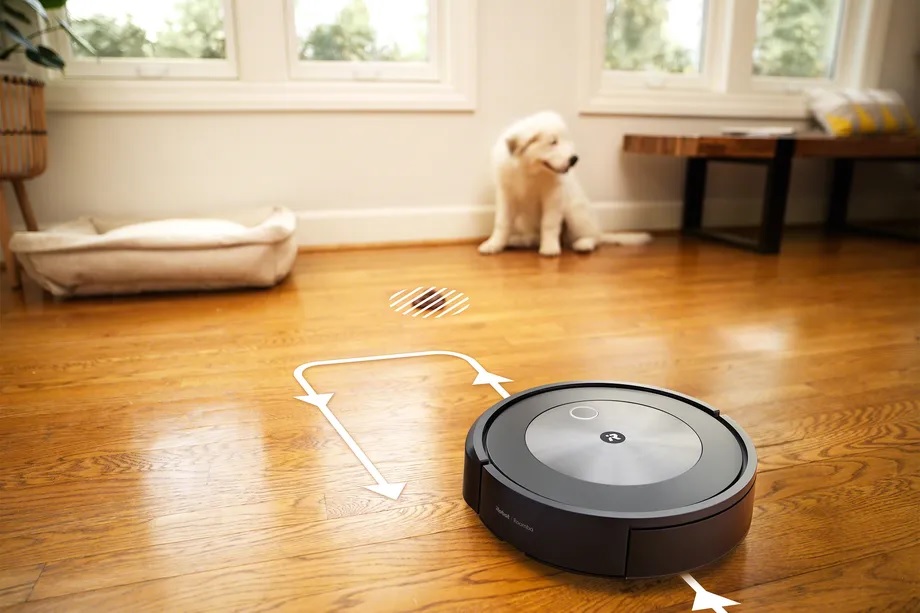

The device can recognise pet feces, socks, footwear, cords and other objects on the floor. When an obstacle is detected, the system via the mobile app will ask the user whether it is temporary or permanent. In the latter case, it will automatically create a no-clean zone.
The company promises that if the vacuum fails to detect objects or cannot recognise feces, iRobot will replace it with a new one or refund.
OpenAI closed the bot for ‘conversation’ with the dead
OpenAI closed the AI bot that allowed a man to ‘talk’ with his deceased fiancée.
In the summer of 2020, developer Jason Rohrer created the chat-bot ‘Samantha’, powered by the GPT-3 language model. The programmer based it on the persona of the AI assistant from the movie Her.
In September 2020, Rohrer launched the Project December website, allowing anyone to train the algorithm and personalise it. Creating an account cost $5 and granted 1000 credits to chat with the bot.
On September 24, 2020, Canadian artist Joshua Barbo used the site to recreate the image of his late fiancée Jessica. He uploaded several messages from Facebook and biographical data about her.
Neural network completes Beethoven’s unfinished symphony
The Swiss ensemble Nexus performed a fragment of Beethoven’s unfinished tenth symphony, generated by artificial intelligence. The authors named the project BeethovANN Symphony 10.1.
A researcher from EPFL trained a deep learning algorithm on scores from 16 string quartets and sketches by the German composer.
The musicians did not see the score beforehand and received a printed score a few hours before the performance.
Also on ForkLog:
- Apple postponed the launch of the ‘illegal content detection’ feature on devices.
- A self-driving Tesla drove through central Kyiv thanks to leaked FSD.
- The US government formed an advisory body on AI.
- In Israel, an AI system to augment the capabilities of combat rifles was developed.
Subscribe to ForkLog AI news on Telegram: ForkLog AI — all AI news!
Рассылки ForkLog: держите руку на пульсе биткоин-индустрии!