




Researchers at the University of California, Berkeley used reinforcement learning to train the four-legged Mini Cheetah robot to play as a goalkeeper.
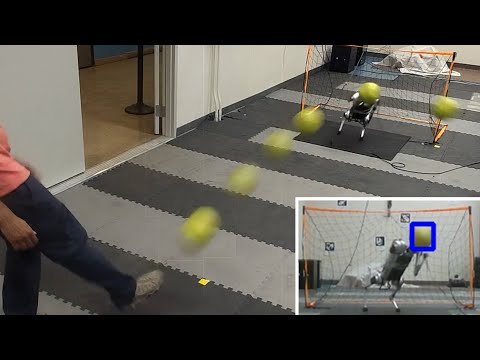
“The task requires performing highly dynamic movements with precise and rapid manipulations of a hard-to-grasp object. The robot must react and intercept a potentially flying ball, using various maneuvers in very short time intervals, usually less than one second,” the study says.
The device is capable of three main movements: a lateral shift, a jump, and a dive. By the latter, the researchers mean a sharp move to the side followed by a fall to intercept a ball flying to the bottom corner of the goal.
Mini Cheetah analyzes the object’s position using a depth camera, after which the AI algorithm selects an appropriate trajectory for the robot’s joints, enabling interception of the ball, and the low-level controller computes the corresponding torques for the motors to realise the required movements.
Initially the robot was trained to defend the goal in Nvidia’s Isaac Gym simulator. The platform enables reinforcement learning in a virtual space that mimics physical interactions.
Researchers subsequently transferred the obtained skills to the real Mini Cheetah and tested its effectiveness in a game of football against a human and another robot. As a result, the device successfully blocked balls, taking 0.9 seconds to perform the movements.
According to the researchers, the technology could be used to train a robot to play football in the role of a forward.
“We focused exclusively on the task of creating a goalkeeper, but the proposed framework can be extended to other scenarios, including taking shots at the ball,” the study notes.
In October, a team of engineers developed a system of algorithms enabling robodogs to move in the wild. Devices equipped with the software can walk and run across rugged terrain, avoiding static and moving obstacles.
In October 2021, scientists from Bristol University turned their attention to teaching robots to interact with radioactive waste.
In August, Boston Dynamics trained the two-legged Atlas robots to overcome an obstacle course and perform a synchronized backflip.
Subscribe to ForkLog news on Telegram: ForkLog AI — all the news from the world of AI!