



Robot vacuum runs away from work; neural networks restore a woman’s sight, and other AI news
We aim to inform readers not only about developments in the Bitcoin industry, but also about what is happening in related tech fields — cybersecurity, and now in the world of artificial intelligence (AI).
ForkLog AI has gathered the most important AI news of the past week.
- The US and the EU will discuss areas of cooperation in AI and quantum computing.
- South Korea will allocate $7.5 billion to the development of national AI and the K-Metaverse.
- IBM to sell part of its Watson Health AI platform assets.
- An AI implant restored sight to an almost blind 88-year-old woman.
- Russian developers taught AI to compose poems in the style of Pushkin.
- In the United Kingdom, a robot vacuum “ran away” from its shift.
- The most significant AI deals of the past week.
Media: US and EU to discuss areas of AI cooperation
In the first half of 2022, the European Union and United States will hold two meetings under the Trade and Technology Council.
According to Bloomberg, the parties will focus on discussing strategies for creating global standards for advanced technologies, including artificial intelligence and quantum computing. EU representatives say that since China is making strides in this field, the West needs to catch up.
Vice-President of the European Commission Valdis Dombrovskis suggested that both meetings will take place in May this year: one virtual, the other in person.
The council will also consider the adoption of green technologies, export controls, and the screening of foreign investments.
Korea to earmark $7.5 billion for AI development and the K-Metaverse
The government of South Korea is investing $7.5 billion in the creation of the K-Metaverse and in AI development.
Of the funds, 20% will go to autonomous driving technologies, 65% to data networks and AI projects, 5.6% to automating home schooling and online doctor visits, and another 9% to cloud services and the K-Metaverse.
In February 2022, authorities invested $28.4 million in developing a virtual world in a Korean style with cultural content, with a further about $14 million to be spent.
Elon Musk: Tesla Bot will become the company’s most important product
During the quarterly earnings event, Elon Musk stated that the Tesla Bot will be the company’s most important product in 2022.
According to him, over time the creation of androids could have a more significant potential than producing electric vehicles. They will help transform the economy and address labour shortages, he added.
Andrey Karpaty, head of the AI division, said that in the future Tesla Bot will become the most powerful platform for AI development. They are actively seeking AI and ML experts.
IBM to sell Watson Health AI platform assets
IBM will sell part of the assets of its Watson Health division, focused on applying AI technologies in healthcare.
The buyer is private investment firm Francisco Partners. Bloomberg reports that it will acquire IBM’s extensive and diverse medical data and products, as well as image-processing software, for more than $1 billion.
IBM said the deal is the obvious next step for a company that will now focus on hybrid cloud on its platform and AI strategy.
Amazon to open several new cashierless stores
Amazon will open cashierless stores to serve customers in several American suburbs.
In the coming months the company will launch the first Just Walk Out-powered supermarket, spanning about 570 square metres in Mill Creek, Washington. Later the tech giant plans to open a store in a suburb of Los Angeles.
In these new retail locations, customers will be able to purchase groceries, alcohol and daily necessities without interacting with a cashier or staff. Shoppers will select items, and AI will identify them and charge the necessary amount to their account.
Apple adds Face ID to recognise faces in masks
Apple has added to the beta version of iOS 15.4 the feature to recognise users’ faces when wearing medical masks.

The updated biometric authentication will allow a person to unlock an iPhone using recognition of the “unique features around the eyes.”
In the new OS version, users must re-scan their face, enable the “Use Face ID with a Mask” feature, and while unlocking look straight at their smartphone. They can also enable the “Add glasses” option.
The company said that the level of security and accuracy for identifying a person with part of the face hidden will decrease. AI will also not be able to recognise a user wearing sunglasses.
AI implant restored sight to an 88-year-old woman
Scientists developed an AI-based ocular implant that restored sight to a nearly blind woman.
Pixium Vision’s technology involves implanting a 2 mm-wide microchip into the retina, along with special glasses and a small computer worn on the waist. The algorithm processes the image from a camera mounted on the frame and determines the focus target.
Then the glasses project the obtained image as an IR beam through the eye onto the chip, which converts the information into an electrical signal interpreted by the brain as natural vision.
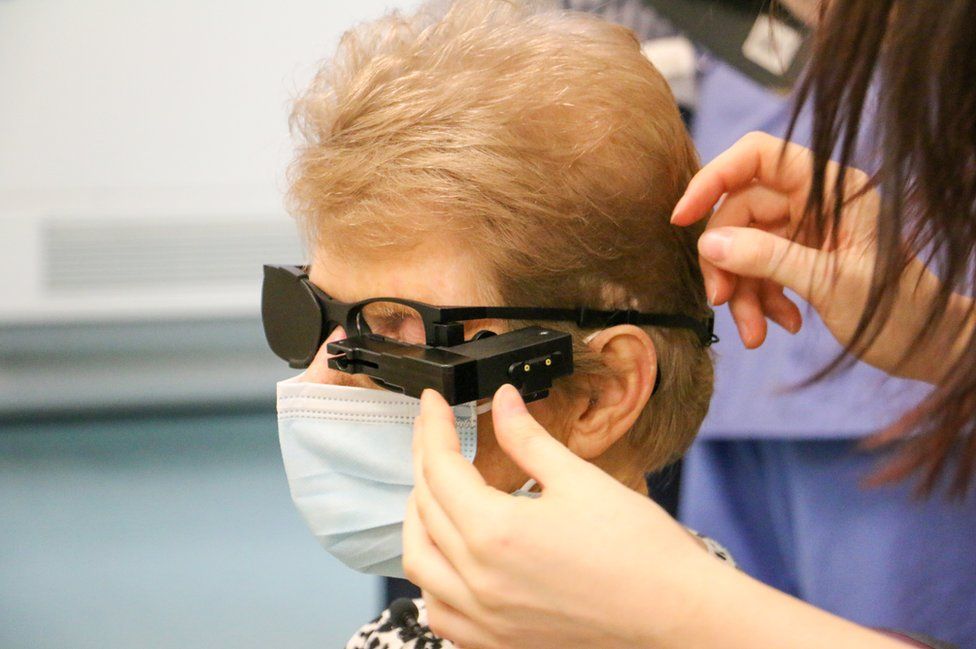
Researchers, with clinicians from Moorfields Eye Hospital, tested the device on an 88-year-old London resident diagnosed with age-related macular degeneration. The woman said she can now enjoy hobbies again, including gardening, bowling and watercolor painting.
AI da Pushkin! poetry generator developed in Russia
Engineers at the neobank Tinkoff launched a neural poetry generator that creates poems from a single line of text, “AI da Pushkin!”.
The developers trained the AI on works by Alexander Pushkin and more than 60 million filtered quatrains from the Sтихи.ру resource. They used VoiceKit to vocalise the generated text and also built a model to animate the poet’s image, linking speech with facial expression and the speaker’s demeanour.
The service is open to anyone. ForkLog AI tried generating a poem from the prompt “Your words are water,” and here is what we got.
Robot vacuum ran away from its shift at a hotel
In the United Kingdom, the Skynet robot vacuum “ran away” from its shift at the Orchard Park Travelodge hotel.
According to the administration, the device’s sensors misread the door threshold and the gadget inadvertently left the premises. Travelodge posted a social-media plea offering a free cocktail at the hotel’s bar as a reward for returning the vacuum.
The robot was found the day after its disappearance in a hedge along the hotel’s driveway.
Scientists taught a drone to detect and disperse pigeons
Swiss researchers trained a drone to scare away pigeons. In tests they activated the system 55 times, reducing the number of birds and the time they spent on site.
Researchers mounted a camera on the roof of the SwissTech conference centre and, over 21 days, recorded the birds’ behaviour. They trained a neural network to count them and determine their exact location, and to relay these data to a drone.
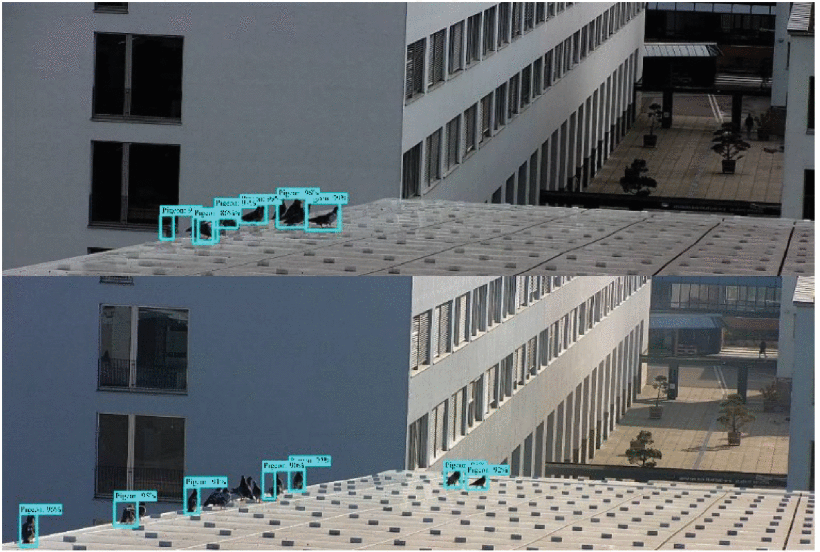
When the algorithm detected a large flock, the drone activated and drove them away with noise without causing harm. However, due to local safety rules, researchers had to obtain permission for each takeoff.
During the experiment, scientists also made several observations about the interaction between pigeons and the drone. For example, large flocks often fled simply when the drone took off at a distance of 40–60 metres, while smaller groups ignored its approach to within a few metres. Some birds returned to the site as soon as the drone swiftly left.
The most significant AI deals of the past week
From January 23 to January 29, 2022, AI startups attracted more than $682.5 million. Here are the most notable deals.
- Expper Technologies received $2 million to advance medical-robot technology for children.
- Metaphysic, the creators of Tom Cruise deepfakes, raised $7.5 million to build content for metaverses.
- InstaDeep raised $100 million to launch new AI products solving real-world problems.
- NLX raised $5 million to enhance voice-driven customer support.
- Pimloc raised $7.5 million to scale software for video anonymisation.
- Alta raised $12.4 million.
- Anch.ai raised $2.1 million to accelerate ethical AI governance.
- DigitalOwl raised $20 million in a Series A to support software for medical-record analysis.
- Tekever raised $23 million for industrial drone tech optimized for maritime surveillance.
- Spectrum Labs raised $32 million to expand content moderation tech and block toxic conversations.
Also on ForkLog:
- The European Parliament passed a law banning certain types of personalized advertising online.
- Meta will build the world’s largest AI supercomputer.
- The Ministry of Digital Development will develop a plan to provide access to government data for AI developers.
- ID.me confirmed the use of a vast database for facial recognition.
- OpenAI created a less toxic version of GPT-3.
What to read this weekend?
In the new ForkLog AI educational cards we explain what natural language processing is, how the technology works, what it is used for and its drawbacks.
Subscribe to ForkLog AI news on Telegram: ForkLog AI — all AI news!
Рассылки ForkLog: держите руку на пульсе биткоин-индустрии!