




As the week draws to a close, we recall the KuCoin exchange hack, the scandal surrounding the world’s largest banks, the mass arrests of darknet vendors, the Russian Finance Ministry’s ‘draconian’ amendments to the law on digital financial assets, and other notable events.
Bitcoin partially regains lost ground
The week began with a fairly rapid drop in the price of the leading cryptocurrency.


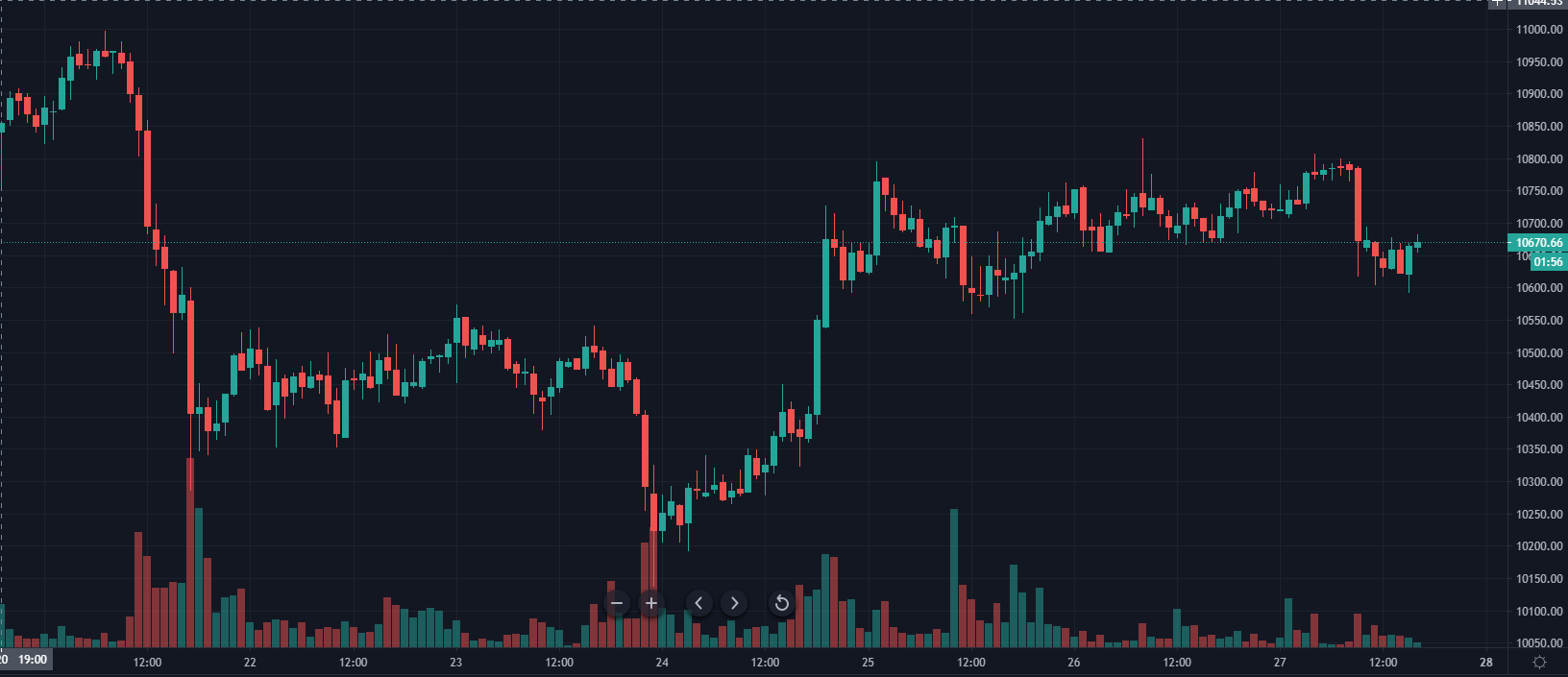
On 22-23 September the BTC price “hovered around” in a sideways pattern, dipped a little further, but then held above $10,500. Closer to the end of the week, bulls managed to partially recover the lost ground.
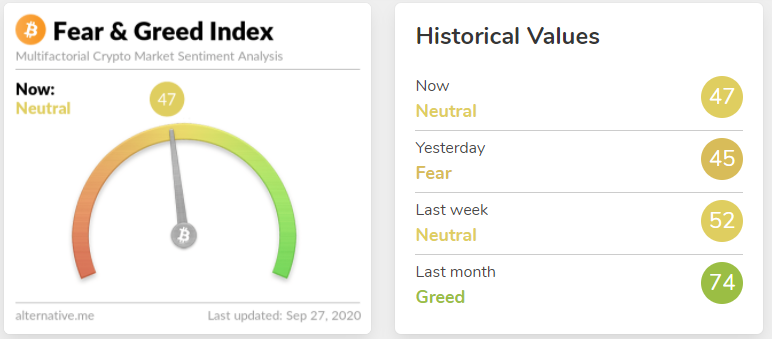
Against the backdrop of the price rebound, the crypto “Fear and Greed Index” returned to neutral readings, signaling relative market calm.


The situation among whales does not inspire optimism. Open interest (OI) in CME Bitcoin futures resumed its decline — large players in the Non-Commercial category closed positions.
Small traders, as before, remain upbeat. They predominantly hold long positions amid relatively stable OI dynamics.
Whalemap analysts are confident that the situation is under buyers’ control. Potential selling pressure is unlikely to break the robust support range formed at $10,407-$10,570.
Whalemap’s view is echoed by certain Glassnode metrics. For example, balances on Bitcoin exchanges decreased, which could also reduce potential selling pressure on Bitcoin’s price.
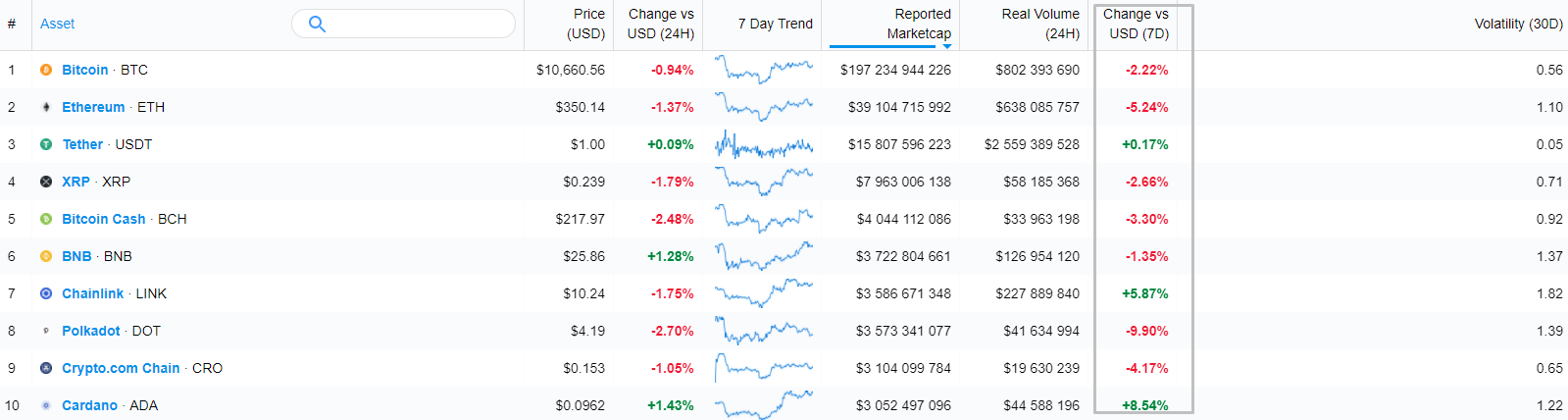
At the end of the week, the top-10 most capitalised crypto assets looked like this:


Data: Messari.
The best seven-day performers were Cardano (+8.54%) and Chainlink (+5.87%), the worst were Polkadot (-9.90%) and Ethereum (-5.24%). Over the same period, the most volatile were Chainlink, Polkadot and BNB.
The largest daily trading volume among stablecoins was Tether — $2.5 billion. For Bitcoin, this figure stood at $802 million.
Hackers breached KuCoin. Loss estimated at $150 million
On Saturday, 26 September, the KuCoin cryptocurrency exchange reported unauthorized withdrawals from hot wallets.
The exchange noted that cold storage assets remained safe. It pledged to reimburse all user losses from its insurance fund. Preliminary estimates put the damage at up to $150 million.
CEO Johnny Lyu confirmed that the incident was caused by a hacker attack. He said the exchange had already approached law enforcement authorities.
Later Lyu wrote that the exchange would resume deposits and withdrawals within a week.
Per our current estimation, within a week, we will be gradually enabling the deposit and withdrawal service
— lyu_johnny (@lyu_johnny) September 27, 2020
After the hack, Bitfinex and Tether CTO Paolo Ardoino said the exchange froze 13 million USDT on the EOS blockchain, and the stablecoin issuer blocked 20 million USDT on one Ethereum address “as a precaution”.
Similar measures were taken by other market participants, information about which is posted on KuCoin’s site.
Shortly it turned out the KuCoin hackers are using the decentralised exchange Uniswap to convert altcoins into Ethereum. According to Paolo Ardoino, money laundering through DEXs could have “interesting consequences” casting a shadow over liquidity providers.
Binance is listed in Roskomnadzor’s registry of blocked sites
The cryptocurrency exchange Binance received a notice from Roskomnadzor about its inclusion in the registry of blocked websites for hosting information banned in the Russian Federation about the sale of cryptocurrency. Platform representatives have already said they intend to challenge the decision in court and will continue serving users in Russia.
Lawyers say the Binance decision violates procedural norms.
“Without notifying the defendant, a unilateral, unfounded decision was issued based on conjecture and violated a number of procedural norms. We see sufficient grounds to restore deadlines and appeal,” said Andrey Tugaryin, managing partner at GMT Legal.
This week Roskomnadzor’s registry also included the mirror site of the p2p platform LocalBitcoins and the email service Mailbox.
Global banks implicated in FinCEN documents leak
The international investigative project Cassandra published secret FinCEN documents from 1997-2017, detailing how oligarchs laundered $2 trillion through banks worldwide. The documents include Russian and Ukrainian businessmen and politicians.
The lists also feature crypto-industry figures — the missing founder of OneCoin, Ruja Ignatova, and Mayzus Financial Services, Sergey Mayzus, which serviced the now-defunct BTC-e exchange.
179 darknet vendors arrested in the EU and US
Europol and the US DOJ reported a successful operation that led to the arrest of 179 darknet vendors, with $6.5 million seized in cash and cryptocurrency.
The operation, named DisrupTor, involved authorities from Austria, Cyprus, Germany, the Netherlands, Sweden, Australia, Canada, the United Kingdom and the United States.
Aggregate value of stablecoins exceeds $20 billion
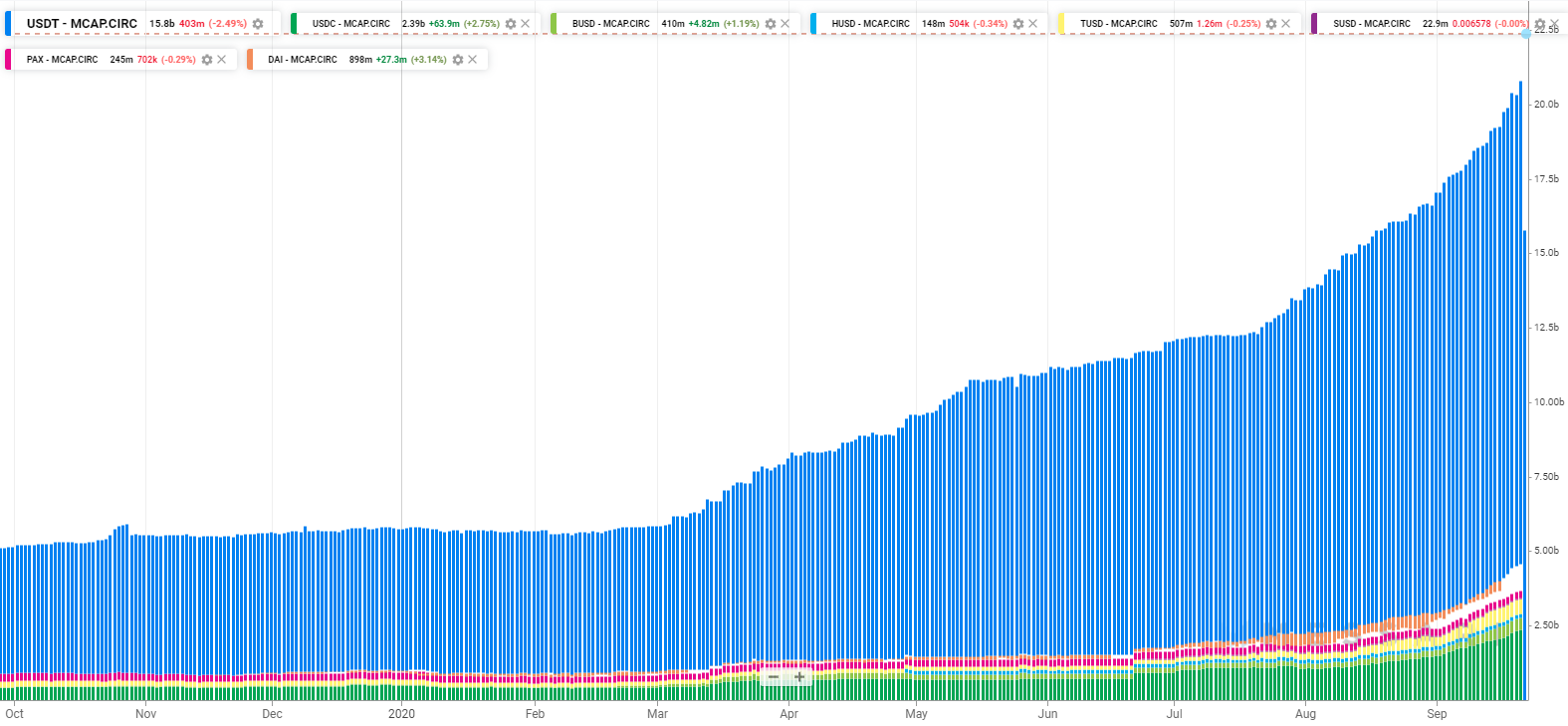
Over the past 12 months, total stablecoin market capitalization has quadrupled, surpassing $20 billion.


Data: Messari.
The space is led by USDT from Tether, accounting for more than 75% of all stablecoins.
Regulatory bodies consider stablecoins legitimate institutions. For example, this week the Office of the Comptroller of the Currency within the US Treasury allowed national banks and federal savings associations to hold reserves for stablecoin issuers.
Russian Finance Ministry proposes “draconian” amendments to the law on digital assets
The Russian Finance Ministry proposed declaring digital currencies and reporting to tax authorities if wallet assets exceed 100,000 rubles in a calendar year. The amendments apply to both individuals and legal entities, and violations carry fines and even criminal liability.
Head of the State Duma committee on financial markets Anatoly Aksakov said the Finance Ministry’s proposal and other amendments will be reviewed in the coming month.
Calling the amendments “draconian,” lawyer Maria Agranovskaya said the path toward prohibition would lead to the creation of black and grey markets and push all operations that could yield tax revenue in Russia abroad.
Yet some argue the Finance Ministry’s amendments could positively affect the Bitcoin industry. Aximetria CEO Alex Axelrod expressed the view that the new norms confirm that storing cryptocurrency in wallets is legal, and their adoption will drive unscrupulous players out.
European Commission proposes rules for regulating crypto and stablecoins
In the EU they presented rules for regulating crypto assets and stablecoins. The 168-page document covers not only asset requirements but also the creation of a sandbox for blockchain projects.
Crypto assets and stablecoins will face “stricter requirements” regarding capital controls, investor protection and supervision. The European Commission proposes an individual legal regime for such assets.
The Commission’s crypto-asset requirements have unsettled many in the industry. The International Association for Trusted Blockchain Applications stated that the new rules threaten to push companies out of the European Economic Area.
China aims to curb dollar dominance with CBDC
The People’s Bank of China stated plans to be the first to issue its own digital currency, strengthening the yuan’s position globally, and added that the CBDC will become a new battleground on the international stage.
“China has advantages and opportunities in issuing a national digital currency. We need to accelerate to gain leadership,” says the central bank’s statement.
The Fed, in response, stated it is expanding research into digital assets by engaging specialists from regional banks.
Bitcoin Core developers to enable GLV endomorphism optimization, tested by Hal Finney in 2011
On Friday, September 26, the patent on the elliptic-curve acceleration technique known as GLV endomorphism expired. It can be activated in the next release of the popular Bitcoin Core client to speed up and improve signature verification.
Hal Finney, the recipient of the first Bitcoin transaction from Satoshi Nakamoto, studied the possibilities of GLV endomorphism. As far back as 2011, the crypto pioneer found that the technology could boost signature verification speed by 25%.
What to read and watch next?
This week a piece was published on how Uniswap became the first DEX to surpass Coinbase in trading volume.
Just add a token: how Uniswap became the first DEX to beat Coinbase
ForkLog published an interview with Ricardo “Fluffypony” Spagni, a key figure in the early days of the privacy-focused cryptocurrency Monero.
Ricardo Spagni: Monero’s attributed privacy is a big misconception
Also available is a digest of the most interesting blockchain initiatives from recent weeks.
Blockchain certification of auto parts by Renault and other technology initiatives
In the “Explain for Crypto” column, Newcent head Vladimir Smetanin explains the quirks of dealing with major players in the crypto industry.

Subscribe to the ForkLog channel on YouTube!