



Roskomnadzor seeks information on Google’s Global Cache servers. Banning them would hit YouTube
Russian telecom operators have received letters from Roskomnadzor demanding information on whether they are connected to Google Global Cache servers. The authenticity of the letters has been confirmed by several large providers.
In its departmental requests, Roskomnadzor refers to the provisions of the law on the Runet isolation.
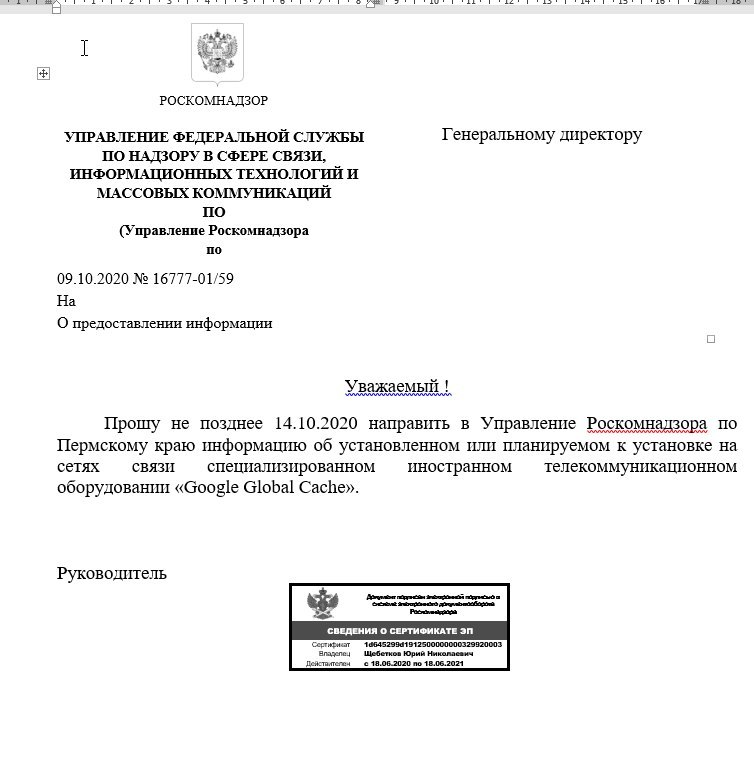
Source: Telegram channel «ЗаТелеком».
However, according to Mikhail Klimarev, executive director of the Internet Defence Organisation, these letters are likely politically motivated:
“Roskomnadzor cannot currently control Google’s servers and, accordingly, has no ability to press the company to remove content that is undesirable to the authorities,” he explained to ForkLog.
The experts also note the unusually short deadline for fulfilling the request—less than a week, whereas operators are usually given at least a month.
“Large operators may simply not know where Google’s servers are physically located,” says Mikhail Klimarev.
ForkLog has sought comment from Roskomnadzor.
Caching nodes of Google Global Cache (GGC) are installed in the networks of large internet providers, a significant share of whose traffic consists of Google’s resource‑intensive services, such as YouTube and Google Maps.
On the servers, popular content is temporarily stored, which users frequently request. This allows not fetching it every time directly from Google’s data centre, but loading the first copy.
If you abandon GGC, the load on Google’s servers and the provider’s backbone would increase.
The main hit would come from the video hosting platform YouTube. Without GGC, video files would load more slowly, and the site’s load time would increase. Because of bandwidth constraints, users would lose the ability to watch videos in high resolution.
GGC also helps save on traffic processed in the provider’s data centre and that does not leave the internal network. With its removal, this traffic would become billable, which could lead to higher Internet prices or even a rollback of unlimited plans.
In autumn 2017 Roskomnadzor already attempted to ban Google Global Cache, arguing that the servers require certification. Violators faced fines of up to 300,000 rubles. One of the first to be fined by Roskomnadzor was the Chita branch of TransTeleCom.
As noted, the law on Runet isolation came into force on 1 November 2019, but the implementation of its provisions has been postponed until 2021. At least 30 billion rubles will be allocated from the state budget to implement the law.
In December 2019, in the Urals, DPI equipment testing necessary for implementing the law took place. According to the test results, five operators recorded instances of reduced speeds and degraded signal quality.
Experts warn that Runet isolation could slow Internet speeds by as much as 625 times.
Subscribe to ForkLog’s news on Telegram: ForkLog Feed — the full news feed, ForkLog — the most important news and polls.
Рассылки ForkLog: держите руку на пульсе биткоин-индустрии!