



Russia develops a four-legged robodog; neural networks partially restore a blind woman’s sight, and other AI news
We strive to inform readers not only about developments in the bitcoin industry, but also about what happens in adjacent technology fields — cybersecurity, and now in the world of artificial intelligence (AI).
ForkLog has gathered the most important AI news of the past week.
- The EU has opened an investigation into Nvidia’s $40 billion deal with ARM.
- GitHub Copilot helped write 30% of all new code committed to repositories.
- ARM unveiled a new graphics processor that speeds up machine learning tasks by 4.7x.
- Photoshop added an AI tool to select objects in photos with a single click.
- Russia developed a four-legged robodog.
- Scientists using an AI implant partially restored the sight of a blind woman.
- The week’s most important AI deals.
European regulators began investigating the Nvidia-ARM deal
The European Commission has begun an investigation into Nvidia’s $40 billion deal with ARM. The regulator says it could “affect many markets” and lead to higher prices for competitors’ products.
According to Nvidia representatives, this would not happen and ARM technology licensing principles will not change. However the Commission requires firm guarantees.
The investigation is expected to run until 15 March 2022. Deal participants believe similar investigations could be initiated by regulators in other countries.
Study: 30% of new code on GitHub is authored with the help of Copilot AI assistant
GitHub expanded capabilities of the AI-based Copilot tool. It now helps write 30% of software code on the platform.
The system is based on Codex algorithm from OpenAI and is used as an “autocompleter” for developers. It supports languages such as Python, JavaScript, TypeScript, Ruby, Go and Java.
The company announced the tool in June 2021. It remains in technical preview.
TSMC uses AI to remotely operate chip manufacturing facilities
Chipmaker TSMC applied artificial intelligence to remote control its microprocessor fabrication plants.
According to company representatives, the algorithms control machines at facilities and reduce the workload on personnel. Engineers should be present at the plants, while other staff only need to monitor the AI’s operation.
All 5-nm technology production at TSMC’s plants is also performed with AI.
ARM announces a new graphics processor
Chipmaker ARM unveiled a next-generation graphics processor at the Limited DevSummit.

The new GPU is 4.7x faster at machine-learning tasks compared with the Mali-G76 when accounting for per-core power. It will also deliver a twofold increase in FP32 computations over the current ARM Mali-G710.
The company plans to release the new GPU in 2022.
Photoshop adds AI-powered object selection
Software maker Adobe released an update for Photoshop that lets you select an object by hovering the cursor.
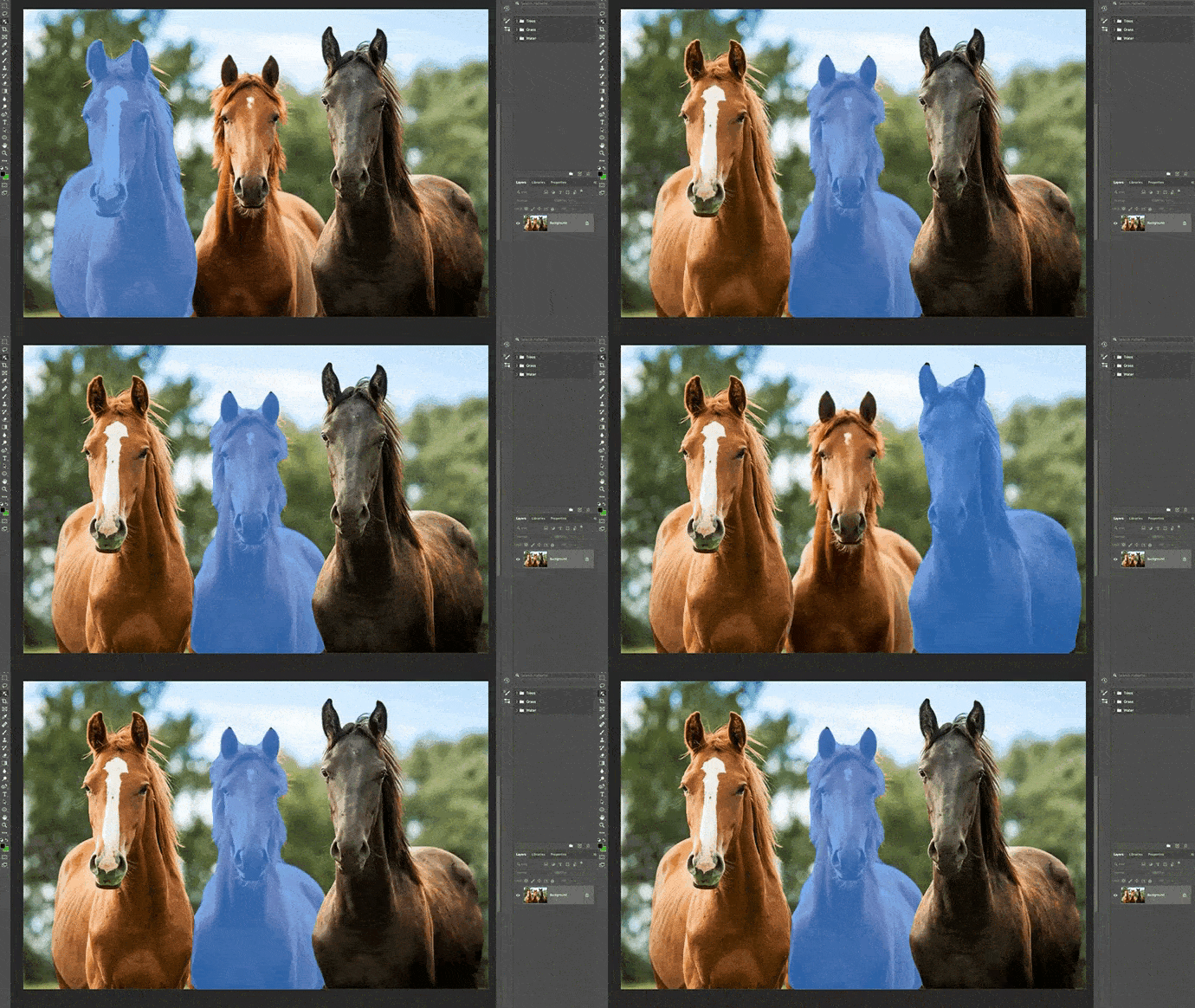
The tool is based on AI and highlights the required items in the image with a mask. The Sensei AI technology automatically detects object edges and selects it with a single click.
The algorithm does not yet recognise all objects in the frame. But the company says it is continually improving it and expanding object categories.
YouTube adds a new section with recommended videos
Video platform YouTube has launched a personalized feature “New for you” that helps discover creators and content beyond recommended videos.

Layout of the “New for you” section on mobile and desktop. Data: YouTube.
The section displays information tailored to the user’s preferences from previously unknown channels. The feature also helps creators reach new audiences.
“New for you” is already available on YouTube’s homepage on mobile, desktop, and televisions.
Russia develops a four-legged robodog
A team of engineers from MSU and the “Brothers Volt” project created their own robodog.
The device weighs 15 kg and has four two-segment legs operated by three electric motors. Its chassis consists of anisotropic composite materials and aluminum alloys manufactured with a 3D printer.
To date the robot has only basic capabilities, such as moving at different speeds. Engineers will continue to study and refine the device so that in the future it can be used in various scientific institutions and universities to explore robotics principles.
Scientists using AI and a neural implant restored a blind woman’s sight
An international group of scientists developed a brain implant that partially restored sight to a blind woman.
The technology relies on implanting microelectrodes in the occipital lobe and wearing special glasses with an integrated camera. It enables stimulating brain neurons and provides artificial vision.
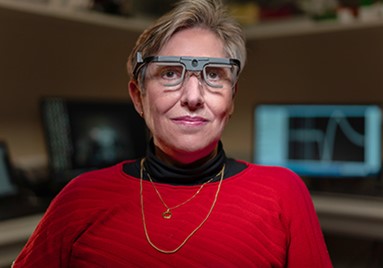
Researchers tested the development on Berne Gomez, a former teacher from Bern who completely lost the ability to see. Thanks to the implant she could recognise the silhouettes of simple shapes.
Autonomous boats appear in Amsterdam
Researchers from MIT launched Roboat autonomous boats along Amsterdam’s canals. They will be able to transport passengers, collect waste, and deliver goods.
The vessels are fully electric and equipped with LiDAR, cameras and a GPS module. They are four meters long, two meters wide, and weigh 1,200 kg.
Initially they will be used as waste containers that, as they fill, will autonomously return to base along the canals. Later the city administration will consider carrying passengers.
In the United States, autonomous car race
In Indianapolis, a race of autonomous cars running open-source software took place.
The winner was a team from the Technical University of Munich, winning $1 million. Their autonomous vehicle posted an average speed of 218 km/h and set a record pace over two laps.
The EuroRacing vehicle was fastest. It accelerated to 223 km/h, but slowed on the final lap due to a software error.
Third place went to the PoliMOVE team. GPS tracker issues left their car “blind” during the race.
The week’s most important AI deals
From 24 to 30 October 2021, AI startups raised over $1.07B. Here are the most notable deals.
- SlashNextexpanded capabilities of its phishing-prevention service and raised $26M.
- Dragosraised $200M to scale protection for industrial clients against cyberattacks.
- Abacus.ai raised $50M.
- Ontraraised $200M to expand contract-management automation tools.
- The creators of disinformation-detection platform Cyabra raised $5.6M.
- Cogniacraised $20M to expand the team behind its automation service.
- DroneBaseraised $20M.
- Fabricraised $200M to scale micro-fulfillment centers for retailers.
- Gluwareraised $43M to expand sales of network-automation tools for cloud environments.
- Devo Technologyraised $250M to develop cloud log management and cybersecurity services.
Also on ForkLog:
- Russian authorities are using AI to locate debtors.
- Media: Amazon has sold AI to British intelligence services for espionage.
- Russia has adopted the AI Ethics Code in the field of artificial intelligence.
- Scottish schools have abandoned the use of facial recognition systems under government pressure.
- Adobe has developed tools for animating photos and creating deepfakes.
- Meta (formerly Facebook) unveiled digital avatars for virtual and augmented reality.
Subscribe to ForkLog’s AI news in Telegram: ForkLog AI — all AI news!
Рассылки ForkLog: держите руку на пульсе биткоин-индустрии!