


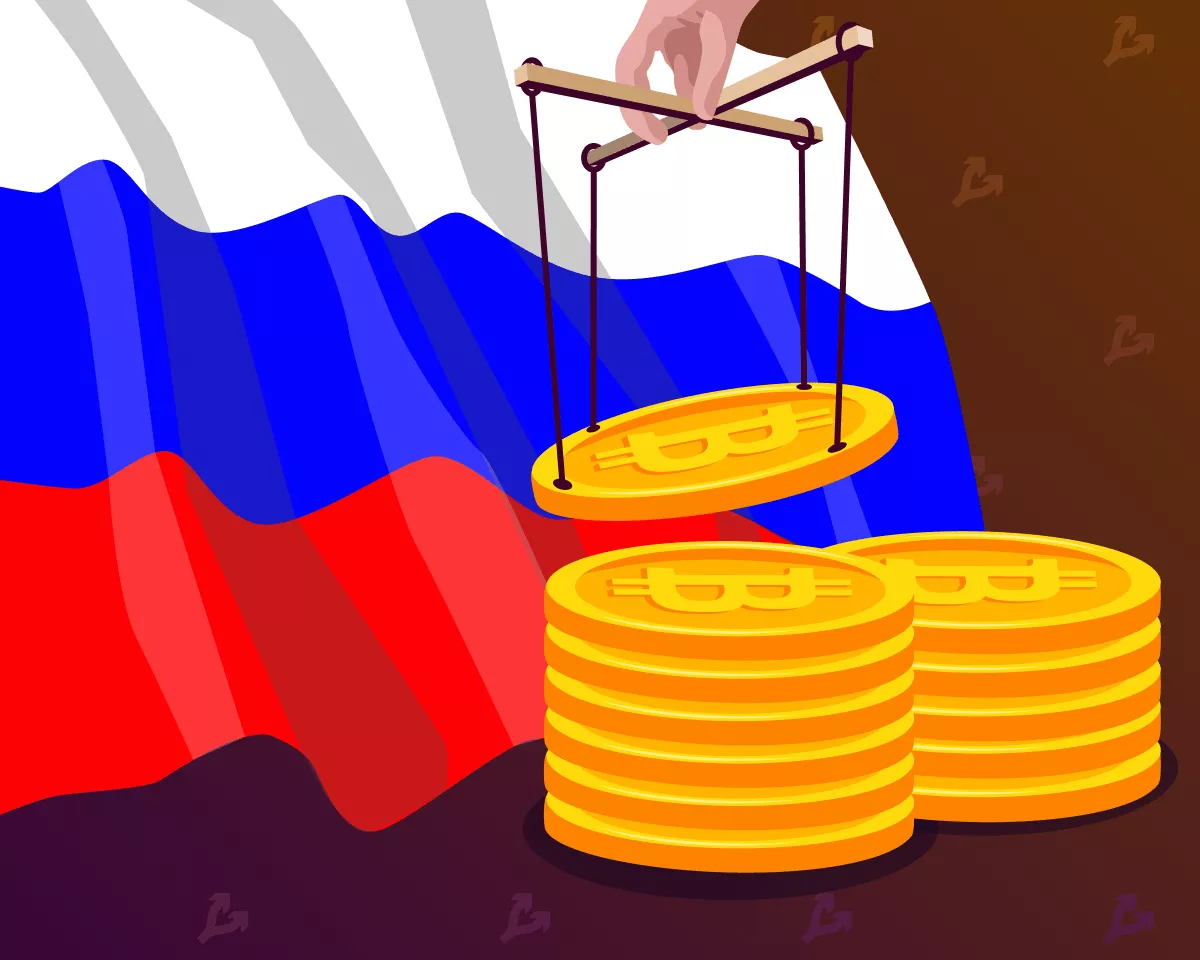
Russian finance ministry accused of drafting bitcoin-market regulation to favour a single player
The concept of regulating the crypto market by the Russian Ministry of Finance is a positive sign for bitcoin holders, but the proposed measures run counter to the nature of digital assets and are probably designed for a specific player. This was stated by ForkLog experts.
proposes to conduct cryptocurrency transactions through banks, introduce full user identification and transaction tracking in the manner of the Swiss service Aximetria, and also create a registry of exchanges and exchangers.
Identification of users in cryptocurrency transactions aligns with global practice. However the proposal to open a bitcoin wallet through a bank sounds, at least, strange, says Eduard Kim, partner at BaksDAO.
“The very idea of crypto wallets opened in banks runs counter to the idea of cryptocurrencies, which were conceived as an alternative to banks. I can hardly even technically imagine how this could be implemented. If these wallets must be opened in a bank, then it would mean that the bank manages them,” he said.
Overall, such an approach would require new licences for commercial banks and rules governing their interaction with the Central Bank, agrees partner and head of the IP/IT practice at the law firm DRC, Mikhail Bystrov (Tretyak).
The strongest caution from the expert was raised by the explicit reference to Aximetria as a positive example of client identification.
“Given that in November 2021 a stake in this service was acquired by «Tinkoff Bank», it creates the impression that it is indeed them behind this initiative. This is indirectly supported by information from several sources that Tinkoff has already developed functionality for working with digital currencies,” said Bystrov.
In the document, banks are explicitly named as “organisers of the system for exchanging digital currencies.” This leads the expert to think that the Ministry’s sole task is to lobby the interests of the largest Russian banks in their confrontation with the Central Bank over the planned introduction of a digital ruble. Moreover, without a unified approach by banks to the processing of personal data, there is a risk of information leakage and a potential increase in cybercrime.
Mikhail Bystrov also sees the division of investors by qualification levels and transaction-size limits as reasons for private traders to withdraw from Russia.
The lawyer is also perplexed by the proposal to split market supervision duties among six state bodies: the Central Bank, the Finance Ministry, Rosfinmonitoring, the Federal Tax Service, the Ministry of Digital Development, and the Prosecutor General’s Office.
“It is absolutely certain that each of them will impose its own rules. It would be more appropriate to create a separate federal service, composed of professionals with direct experience of working with crypto assets,” suggested Bystrov.
At the same time, the full legalization of cryptocurrencies and mining would, without doubt, be beneficial for medium and large businesses—for instance, industrial miners who need to convert digital revenue into fiat, noted Artem Shtanov, EMCD’s product director.
“There is a case for considering special electricity tariffs for mining companies, as well as incentives for those willing to locate capacities in depressed regions of Russia or in areas with an energy surplus.”
While the implementation of all these initiatives will take a long time, the Finance Ministry’s approach is encouraging because it takes into account the interests of all market players.
“Potential difficulties may lie in the fact that not all crypto exchanges will want to open offices in Russia. Binance, the market’s largest player, appears most prepared for such a development,” noted Exante analyst Vladimir Ananyev.
In an interview with ForkLog, Binance’s director for Eastern Europe, Gleb Kostarev, said the exchange is ready for both licensing and registry creation, provided that the market is given transparent and clear rules of the game.
“The problem now is not the lack of licences, but the lack of clear and transparent regulation. This prevents crypto exchanges from operating directly with Russia’s financial institutions,” he said.
Kostarev added that Binance welcomes the Finance Ministry’s proposal as a starting point for dialogue on legalising cryptocurrency organisations in Russia. The exchange is prepared to share international experience in this area.
Managing partner of GMT Legal, Andrey Tugarin, described the Finance Ministry’s stance as the most adequate under current conditions.
“A total ban on cryptocurrency would not benefit either the state or crypto holders. Regulating cryptocurrencies would ensure proper protection of the rights of participants in this market,” the lawyer argues.
He also expressed puzzlement as to why Russian authorities have long overlooked already existing FATF recommendations, which include the definition of crypto companies and prescribing licensing.
Regulated crypto markets seem a lesser evil than a total ban on digital assets, says Dmitry Kirillov, adviser at Lidings and lecturer at Moscow Digital School.
“Officially permitted use of the Bank of Russia–supervised domestic banking infrastructure will ease citizens’ settlements in cryptocurrency operations. At the same time, I hope for a compromise where regulation is not so strict that it dampens the appetite to deal with cryptoassets even with formal permission to do so,” he summarised.
In January, the Bank of Russia put forward for discussion a complete ban on the circulation and mining of cryptocurrencies in the country. This approach has already been criticised in the State Duma, the government and law enforcement agencies.
It is expected that the final legislation in Russia’s crypto industry will be formed by the end of 2023.
Readers can read ForkLog’s coverage of the Bank of Russia’s remarks on the Finance Ministry’s concept in the ForkLog article.
Read ForkLog’s bitcoin news on our Telegram — cryptocurrency news, prices and analysis.
Рассылки ForkLog: держите руку на пульсе биткоин-индустрии!