



OpenAI will amend its agreement with the Pentagon following a wave of criticism and a mass user shift to Anthropic, announced the AI startup’s CEO, Sam Altman.
Here is re-post of an internal post:
We have been working with the DoW to make some additions in our agreement to make our principles very clear.
1. We are going to amend our deal to add this language, in addition to everything else:
“• Consistent with applicable laws,…
— Sam Altman (@sama) March 3, 2026
“One thing I did wrong: we shouldn’t have rushed into the deal. The issues are very complex and require clear communication. We sincerely tried to ease tensions and avoid a much worse outcome, but I think it looked opportunistic and sloppy,” he wrote.
OpenAI signed a contract with the U.S. Department of Defense on February 28. Just hours before, President Donald Trump ordered federal agencies to abandon Anthropic’s tools.
The reason was a statement by the project’s CEO, Dario Amodei, who publicly prohibited the use of the developer’s neural networks in mass surveillance and the creation of autonomous weapons.
New Terms
In the revised contract, OpenAI added a clause prohibiting the “intentional use of artificial intelligence” for spying on U.S. citizens. It is also specified that the restrictions apply to the purchase or use of commercial personal data bases.
The U.S. Department of Defense also confirmed: the company’s tools will not be used by intelligence agencies, including the NSA. Any supplies to such agencies will require additional agreements.
“It is extremely important to protect the civil liberties of Americans. So much attention was focused on this that we wanted to clarify this point especially clearly,” explained the CEO of OpenAI.
He emphasized that it is important to adhere to democratic processes in controlling AI development. According to Altman, no private firm should decide the fate of the world.
The CEO of the ChatGPT developer urged the Pentagon not to list Anthropic as a threat to supply chains and to offer competitors the same terms as OpenAI.
“I think the real dangers to the world are still ahead. I tried to put myself in the shoes of someone who wakes up the day after an attack on the U.S. or the emergence of a new biological weapon that we could have helped prevent,” concluded Altman.
ChatGPT Boycott
Following the news of the Pentagon deal, American users began to massively abandon ChatGPT, reports TechCrunch. On March 1, the number of app deletions surged by 295%, according to Sensor Tower.
The usual daily uninstall rate over the past 30 days was 9%, analysts noted.
The trend in new downloads turned to decline: immediately after the agreement, ChatGPT downloads fell by 13%, and the next day by another 5%. The app’s rating also plummeted: the number of “five-star” reviews halved, while negative reviews increased 8.5 times on the first night and doubled on March 2.
ChatGPT is getting COOKED on the iOS App Store reviews and I think it’s deserved. pic.twitter.com/QaCZx7iHrC
— Not Greg (@dogecoinmillion) March 3, 2026
Downloads of Claude from Anthropic soared by 37% on February 28 and by another 51% on March 1. The chatbot reached the top spot in the U.S. App Store and maintained its lead as of March 3.
Other analytics platforms confirmed the trend. Appfigures reported that daily installations of Claude in the U.S. surpassed ChatGPT for the first time: on March 1, the figure rose by 88%. The app also topped the rankings of free iPhone apps in Belgium, Canada, Germany, Luxembourg, Norway, and Switzerland.


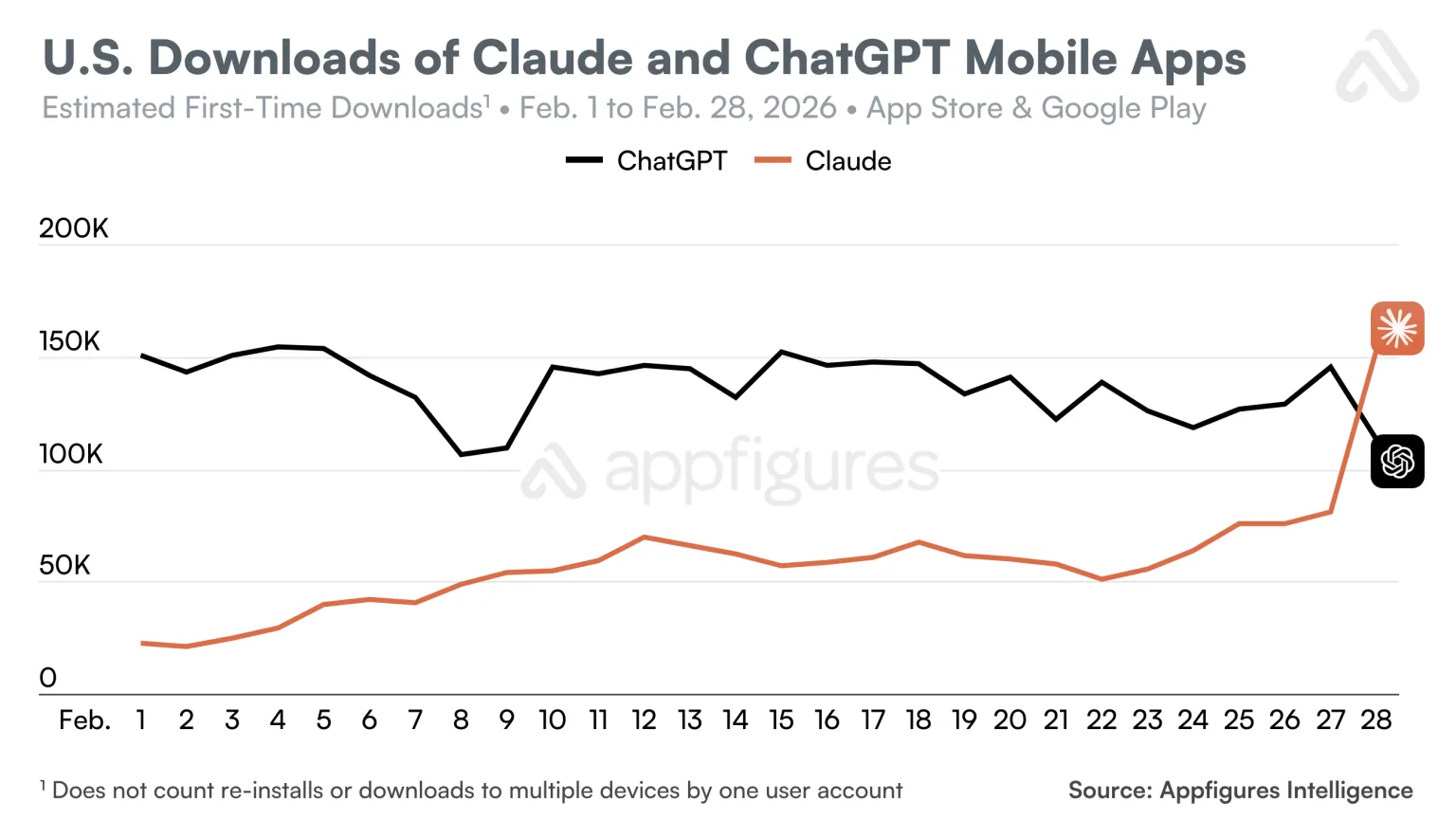
Similarweb calculated that in the last week, Claude downloads in the United States exceeded January figures by about 20 times. However, experts cautioned against jumping to conclusions, suggesting that other factors might have influenced the statistics.
In addition to abandoning ChatGPT, more than 700 employees of Google and OpenAI also signed an open letter. The document called for refraining from using AI in surveillance systems or for carrying out combat tasks without direct human control.
Back in mid-February, Bloomberg journalists learned of SpaceX’s plans to create software for the Pentagon’s autonomous weapons.