


Scaling at full tilt: what is happening on blockchain Layer 3
As the number of scaling solutions grows, so does demand for their quality and usefulness. In April 2024, Vitalik Buterin backed a sceptical view of L3. He pointed to other, potentially “lighter” ways to achieve the same cost savings.
In September, Buterin urged L2 teams to “get their act together”, saying that from next year he would not publicly mention projects below “stage 1+”.
The L-suffixed alphabet soup has stirred debate in the community. ForkLog examines how scaling works via what is, for now, the highest tier of customisation — Layer 3.
What is happening across blockchain layers
Beyond the fundamental ones, there are four blockchain layers: Layer 0 (L0), L1, L2 and L3. Each hosts distinct solutions, but only L1 typically has a complete architecture. The others are chiefly for scaling.
The zero layer, also called the communication layer, provides physical infrastructure (cables, data centres, nodes) or enables cross-chain compatibility so that dapps can be built across multiple blockchains. In both cases it lays the groundwork for interoperability.
Cosmos and Polkadot’s parachains fit here. Because these projects span functions across layers, they are also described as L1 and L3 networks.
On L1 (the base layer) sit full-fledged, independent blockchains such as Solana and Ethereum. They secure the network as new blocks are created and transactions are finalised using Proof-of-Work or Proof-of-Stake.
In its current form, Ethereum is hard to imagine without an array of scaling mechanisms — Layer 2 (L2) solutions. The rise of optimistic and ZK rollups such as OP Mainnet, Arbitrum and Polygon has helped dapp users save significantly on fees while speeding up execution.
A comparable stack has emerged atop Bitcoin — Bitcoin Layers. State channels, rollups and sidechains offset the first cryptocurrency’s architectural limitations and allow programmable smart contracts, as in Ethereum. Projects such as Rootstock, Merlin Chain and BOB add DeFi features, increasing transaction speed and accessibility.
How Layer 3 works
Buterin was among the first to use the term Layer 3 in 2015 in the context of multi-layer blockchain scaling. Almost all existing third-layer solutions today are built around the network of the second-largest cryptocurrency.
On L3, developers tackle bespoke configuration of dapps on top of L2. Also called the application layer, it is akin to Layer 0 but, unlike L0, achieves interoperability within existing blockchains. Customising specific projects extends functionality and boosts performance.
Rollups, sidechains and other L2 constructions have allowed third-layer blockchains to perform complex off-chain computation while retaining strong base security and throughput. Via protocols, cross-chain bridges and configurable scaling, L3 improves the experience of dapps in decentralised finance, GameFi, RWA and DeSoc.
Additional third-layer scalability patterns include:
- appchains (Appchains). These sit atop any layer and are intended for applications. In summer 2024 the StarkWare team presented the idea of using appchains “to provide the specific needs of dapps” in L3 networks. In their design, the tool increases transaction speed while minimising cost and enabling network-configuration tuning (block size, forms of transaction finality);
- validiums (Validiums). As a component of a third-layer blockchain and using off-chain verification of transactions, they address scalability with zero-knowledge proofs (ZKP). The approach reduces costs and latency. It is used for applications that require high speed and efficiency while sacrificing security;
- optimiums (Optimiums). An “optimistic” form of off-chain computation, popular among L3 designs. It uses fraud proofs and requires additional trust.
Live L3 solutions
In September 2022, Vitalik Buterin published an article, “What kinds of L3s make sense?”. He argued that this tier is not meant directly for scaling; such protocols would instead implement certain “individualized functions” for L2.
He has been proved right. Leaders among L2 networks now offer comprehensive kits for building custom projects. Using the OP Stack, Arbitrum Orbit and ZK Stack development environments, a profusion of niche blockchains and dapps is being launched to match specific producer needs.
According to analytics service L2BEAT as of 27 September 2024, the top L3 by TVL is zkLink Nova with more than $164m. Offering scalability and native compatibility across multiple ZK rollups via zkLink Nexus, it provides a ready-to-use, highly customisable trading layer for the Ethereum ecosystem.
Arbitrum Orbit. In June 2023, Offchain Labs released a developer toolkit aimed at implementing L3 solutions on Arbitrum. Orbit allows applications with a high degree of bespoke configuration.
According to L2BEAT, the L3 ecosystem based on Arbitrum Orbit is the most popular, with 16 GameFi and DeFi projects.
Leading the subsegment is Sanko, a platform from Sanko GameCorp focused on NFTs and gaming with the DMT token. The dapp is deployed via the RaaS provider Caldera, and data availability in this L3 is handled by AnyTrust.
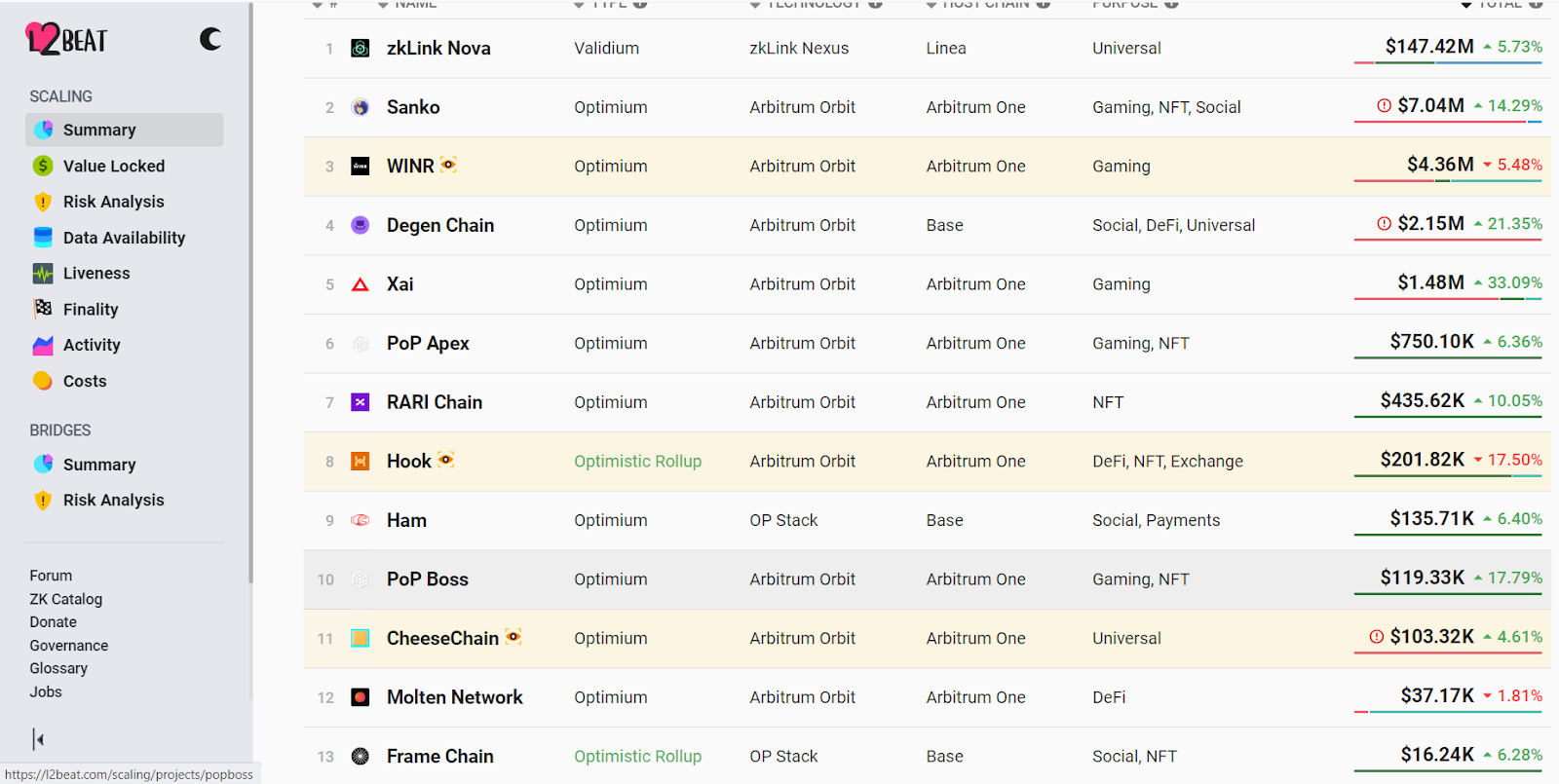
Next comes the betting platform WinR. As of 27 September 2024, the project’s TVL is about $4m.
Degen Chain is an L3 developed by Syndicate in collaboration with Conduit, Decent and Airstack specifically for the Degen community. In March 2024, the Degen channel community on Farcaster issued a token on Base called DEGEN, mainly to reward content creators. The token quickly gained popularity, and in April the team launched its own blockchain, Degen Chain.
In May 2024, the project encountered block-production issues; later, in July, a user under the handle Tempe.degen reported losing 90% of his funds during a cross-chain transfer. The team placed responsibility on third-party service providers. At the time of writing, the project’s TVL is about $2.5m.
Another popular third-layer solution is Xai, built for gaming applications. It offers lower fees and account abstraction (AA) not available on second-layer solutions. AA is important for consumer-facing dapps such as Web3 games because it simplifies onboarding for mass users. As of 27 September 2024, the project’s TVL is about $1.9m.
OP Stack (Superchain). This stack implements horizontal scaling by building a “network of blockchains”. These use shared components such as bridges, decentralised governance, connectivity layers and more.
In May 2024, L3 support was added to OP Stack. To enable L3 networks alongside L2 protocols, custom gas tokens had to be introduced, and the stack switched to using off-chain DA providers.
One of the largest users of OP Stack is Base. In 2024 the L2 team announced plans to use third-layer solutions to build custom, fast dapps on top of the network. The same year, a gamer-focused L3 platform — B3 — launched on it.
Most of the solutions presented on OP Stack are built as optimiums atop Base, using Celestia as the data-availability layer.
Among such projects are Frame Chain, a framework by Syndicate for supporting users of DeSoc platforms; the similarly themed dapp Ham; and the Conduite-built platform Stack, which lets brands create and move loyalty points onto the blockchain.
ZK Stack (Hyperchains). The company behind zkSync, Matter Labs, aims to build a network of interconnected blockchains using ZKPs. To realise this, the team released the ZK Stack developer toolkit. The architecture enables deployment of “hyperchains” — both parallel L2s and third-layer protocols. In 2023 the Pathfinder testnet opened.
According to L2BEAT, the only project in the ZK Stack category that is already live but still under analyst review is Teva Chain, one of the first hyperchains on ZK Sync with configurable DA and a focus on the gaming industry.
In the fourth quarter of 2024, the mainnet launch of the hybrid crypto exchange GRVT is planned, combining a CEX interface with non-custodial asset storage.
Conclusions
According to L2BEAT, more than 15 third-layer solutions are upcoming. By their own accounts, they aim to support dapps across categories from gaming and music to DeFi and IoT.
L3 networks can meet dapp builders’ needs by raising throughput while keeping fees low. Their security relies on the base layers they sit atop and often on third parties for asset transfer, warranting careful scrutiny by users.
Text: Sergey Golubenko
Рассылки ForkLog: держите руку на пульсе биткоин-индустрии!