



Scientists develop a brain–computer interface to decode commands sent by the brain to the speech tract. The technology enabled a patient who has been paralyzed for about 15 years due to anarthria, to communicate, as reported in the study.

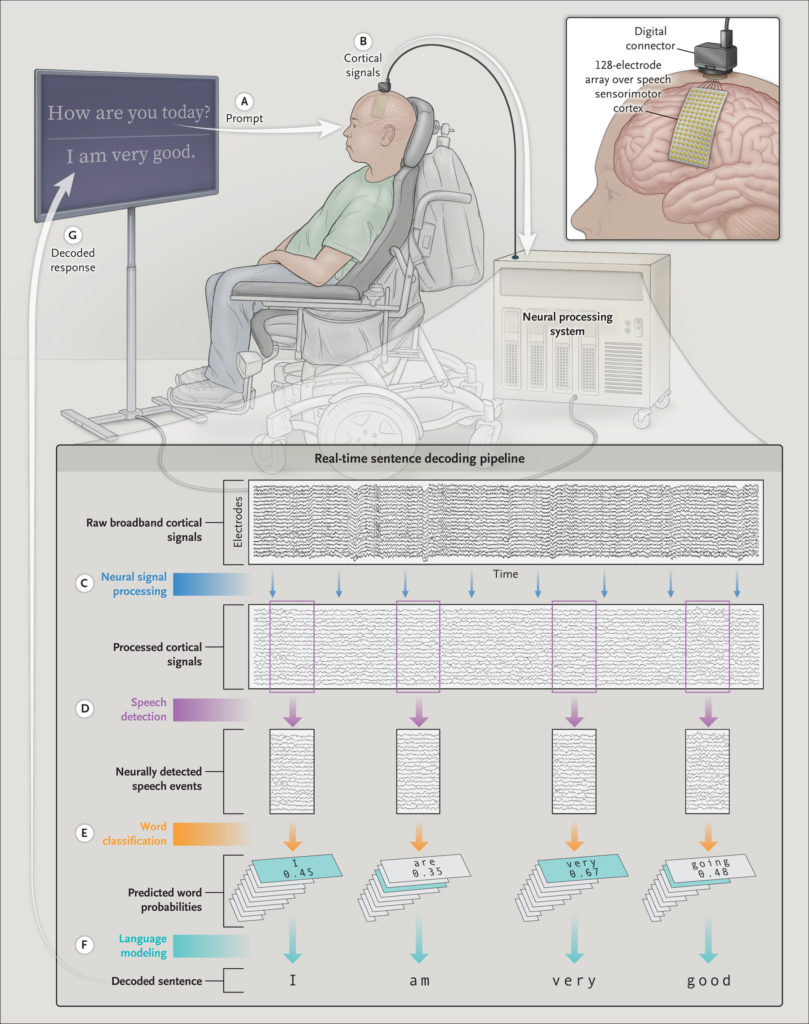
Experts placed a thin flexible electrode grid on the surface of the volunteer’s cerebral cortex. The system recorded neural signals and transmitted the data to a speech decoder.
The researchers said this is the first instance of a paralyzed person who has lost the ability to speak using neurotechnology to reproduce whole words.
The system decodes the user’s intent to engage the speech tract, which includes dozens of muscles that control the larynx, tongue and lips. According to the researchers, when speaking people use a relatively small set of core configurations.


Researchers noted that at the outset of the study the team faced a lack of data on patterns explaining the link between brain activity and even the simplest components of speech — phonemes and syllables.
To this end they used information provided by volunteers from the UCSF epilepsy center. There, before surgery, electrodes are surgically implanted on the surface of the cerebral cortex to map the regions involved during seizures.
Many such patients participate in research experiments that use recordings of their brain waves. Therefore, the researchers asked the volunteers to allow study of the patterns of neural activity during communication.
They recorded changes in participants’ brain waves as they pronounced simple words and sounds, and tracked movements of their tongue and mouth.
Sometimes the researchers painted the patients’ faces so that a computer-vision system could extract their articulatory movements. They also used an ultrasound device under the jaw to model tongue movements in the mouth.
Then the team mapped neural patterns to muscle contractions. According to the researchers, there is a map of representations that controls different parts of the speech tract. They also found that during light speech various brain regions work together in a coordinated fashion.
The UCSF team has already recruited two volunteers to test the system. In the future they plan to increase the number of participants and enable them to communicate at a rate of 100 words per minute.
In May, the American startup Synchron launched clinical trials of its neurointerface Stentrode, designed to assist paralyzed patients.
In January, researchers developed an AI-based eye implant that restored vision to a nearly blind woman.
In August 2021, Synchron received FDA clearance to conduct human testing of neurointerfaces.
Subscribe to ForkLog’s Telegram news: ForkLog AI — all the news from the world of AI!