


Scientists Develop AI Model Mimicking Human Behavior
A team of experts from several universities has developed a computational model that predicts and mimics human behavior with high accuracy, according to a research paper.
Centaur is trained on a dataset called Psych101, which offers an “unprecedented scale of information on human behavior.” The model is “capable of accelerating experiments for scientific discoveries.”
Psych101 encompasses 160 psychological experiments involving 60,092 individuals, who made a total of over 10 million choices.
“Previous attempts have been made to embody such theories by building computational models, yet we currently lack one that fully reflects the human mind,” the researchers noted.
Today, most modern computational models are tailored to specific domains. They are designed to solve particular problems, the experts noted.
“The human mind is remarkably versatile. We not only regularly make mundane decisions like choosing breakfast cereal or attire, but also tackle complex challenges such as finding ways to cure cancer or explore space,” they added.
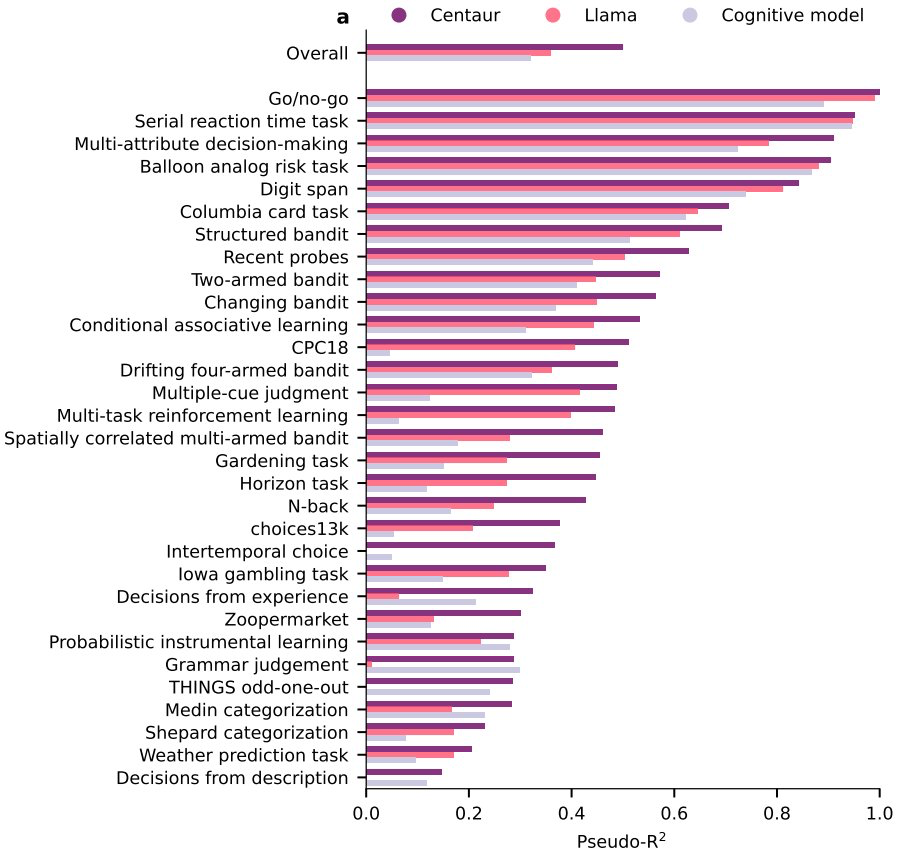
Lead scientist Marcel Binz noted that the team refined the modern LLM Llama 3.1 70B by Meta and discovered its “ability to predict the behavior of unseen participants better than existing cognitive models in almost every experiment.”
We then finetuned a state-of-the-art language model (Llama 3.1 70B) on this data set and found that the resulting model predicts behavior of unseen participants better than existing cognitive models in almost every single experiment. pic.twitter.com/AS3BVutlpK
— Marcel Binz (@marcel_binz) October 28, 2024
According to him, Centaur “aligns more closely with human neural activity, even though it was not specifically trained to capture it.”
The model can operate in real-time, demonstrate rational adaptive behavior, and learn from its environment, the article states.
Taken together, we believe that Centaur is the first real candidate for a unified model of human cognition as envisioned by the great cognitive scientist Alan Newell. pic.twitter.com/LpbdsRiZdm
— Marcel Binz (@marcel_binz) October 28, 2024
“We believe that Centaur is the first real candidate for a unified model of human cognition, as envisioned by the great cognitive scientist Alan Newell,” Binz noted.
Previously, Swiss company FinalSpark developed a computer architecture from living biological matter—human brain organoids—and rents it to scientists for $500 a month.
Chinese researchers developed a robot with a lab-grown artificial brain, which can be taught to perform various tasks.
Рассылки ForkLog: держите руку на пульсе биткоин-индустрии!