


SEC Closes Investigation Into DeFi Protocol Aave
Founder Stani Kulechov outlined plans for 2026
The US Securities and Exchange Commission has concluded a four-year investigation into the lending platform Aave, according to its founder, Stani Kulechov.
After four years, we are finally ready to share that the SEC has concluded its investigation into the Aave Protocol.
This process demanded significant effort and resources from our team, and from me personally as the founder, to protect Aave, its ecosystem, and DeFi more… pic.twitter.com/aZeLrZz5ZQ
— Stani.eth (@StaniKulechov) December 16, 2025
“In recent years the decentralised finance sector has faced unfair regulatory pressure. We are glad to leave this behind as we enter a new era in which builders can truly create the future of finance. DeFi will win,” he wrote.
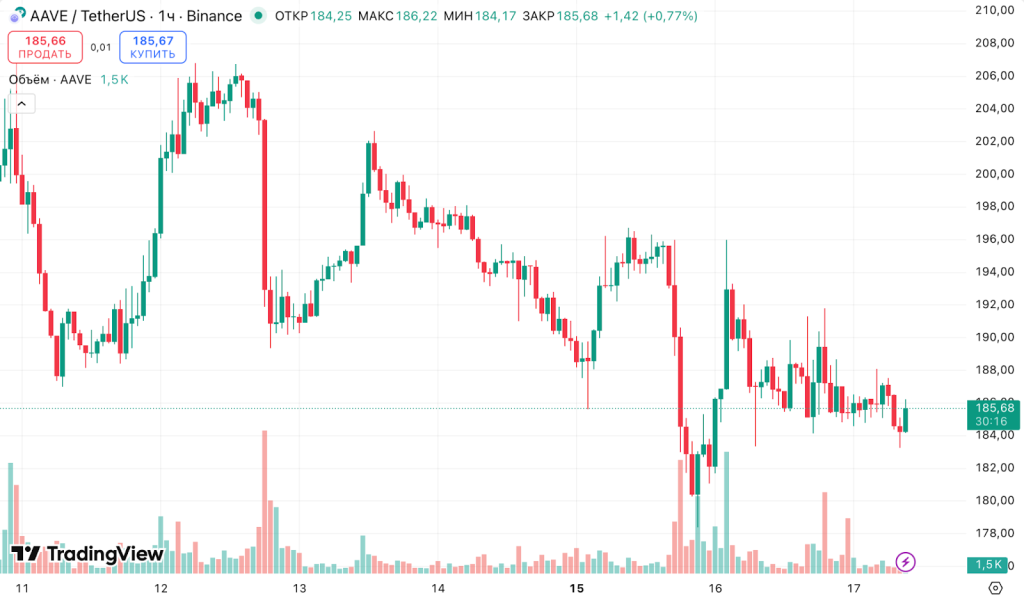
On the news, the AAVE token rose as much as 3% before easing 1.1% to $185.
The closure of the Aave case is part of a broader normalisation between the regulator and the crypto industry under the new US administration of Donald Trump. According to The New York Times, since January 2025 the SEC has paused or ended 60% of investigations into crypto projects.
Its most successful year
Aave’s CEO called 2025 the most successful year in the project’s history.
— Stani.eth (@StaniKulechov) December 16, 2025
Net deposits reached a record $75bn. Over five years since launch the protocol processed $3.3trn in payments and originated more than $1trn in loans. All this puts Aave alongside the 50 largest banks in the US, Kulechov stressed.

The project now controls 59% of the DeFi lending market and accounts for 61% of all active loans in the sector.
In 2025 Aave generated $885m in fees, equal to 52% of all revenues among lending protocols.
Aave’s plans
Kulechov also outlined plans for 2026. Development will proceed along three pillars: Aave V4, Horizon and Aave App.
Aave V4 is a major upgrade to improve the protocol’s architecture via a Hub and Spoke model:
- Hub — a single cross-network liquidity pool acting as a central vault for all assets;
- Spoke — specialised, configurable markets (for example, for a specific institution or asset class) that borrow liquidity from the Hub.
“[The upgrade] will enable Aave to process trillions of dollars’ worth of assets, making the protocol the preferred choice for any institution, fintech or company seeking access to deep, reliable liquidity,” Kulechov noted.
The second pillar — Horizon — targets transforming Aave into the central venue for decentralised financing of RWA. The strategy is to onboard traditional-finance players directly.
The project aims to lift net deposits from $550m to $1bn. According to the founder, deeper collaboration with Circle, Ripple, Franklin Templeton and VanEck will help achieve this.
The third strategic pillar is Aave App, a mobile application launched in November. Kulechov called it a “Trojan horse” designed to hide complex blockchain infrastructure behind a simple interface and push DeFi into the mainstream.
“At the beginning of next year we will begin the full-scale launch of Aave App and set out on the path to our first million users. This will directly spur growth of the Aave protocol through a completely new and untapped market. Aave cannot scale to trillions of dollars without mass product-level adoption,” he said.
Disputes
An DAO participant in Aave under the handle tulipking proposed, via a “poison pill” lawsuit, transferring full control over Aave Labs’ intellectual property and assets to the decentralised organisation.
The goal is to prevent a “stealth privatisation” of the protocol and return all created value to AAVE holders.
The trigger was Aave Labs’ unilateral decision to integrate the CoW Swap aggregator, which redirected front-end fees to a private company wallet.
Aave Labs is partnering with @CoWSwap to provide an improved swap experience across https://t.co/uaJ3qsRWMw.
Swaps will now have better prices via CoW Swap’s solver and protection against MEV attacks. pic.twitter.com/hlsVuWpLqO
— Aave (@aave) December 4, 2025
“This is a protective measure to save the DAO from a centralised takeover. By monetising the Aave brand, front end and user base without tokenholder approval, Aave Labs has essentially privatised an asset that should belong to the community,” wrote tulipking.
His proposal also includes:
- returning all past revenues received by Aave Labs from products under the Aave brand;
- de facto expropriation of the company’s corporate equity to turn it into a structure fully controlled by the DAO.
Marc Zeller, founder of the Aave Chan Initiative, called tulipking’s initiative “the most important proposal in the protocol’s governance history”. In his view, the outcome will have long-term implications for the DAO model and the fundamental principles for valuing governance tokens.
In a forum post Zeller also stressed that it remains unclear “who owns the Aave trademark”.
Kulechov confirmed that the CoW Swap integration did change the revenue flow. However, he described previous remittances to the DAO treasury as a “voluntary contribution” rather than a legal or procedural obligation.
According to Aave’s CEO, the switch to CoW Swap was driven by product improvement — better price execution and protection against MEV. He also emphasised that Aave Labs, as the developer and front-end operator, has the legal right and even a duty to monetise its work.
Even so, Kulechov agreed with community criticism, acknowledging that such a decision required prior discussion.
In late October, the Aave community proposed launching a $50m token buyback funded by protocol revenues.
Рассылки ForkLog: держите руку на пульсе биткоин-индустрии!