




- Insiders report SEC’s “leaning” towards approving ETH-ETFs.
- Ethereum co-founder Joe Lubin predicts a supply crunch post-ETF launch.
- Some experts see political undertones in the regulator’s actions.
Officials from the U.S. Securities and Exchange Commission (SEC) have informed trading platforms that the agency is “leaning” towards approving spot Ethereum-ETFs. This was reported by Barron’s, citing anonymous sources.
“The SEC on Monday notified exchanges where the [funds] will be listed that the regulator is leaning towards their approval, according to people familiar with the matter. The agency provided comments on the applications, and if they are submitted in time, it could lead to approval as early as this week,” the article states.
On May 20, media reported that the agency asked potential issuers to update form 19b-4 in their applications for launching the instrument. May 23 is the deadline for applications from VanEck and Grayscale.
Bloomberg exchange analyst James Seyffart noted that at least five management companies have submitted updated documents to the SEC. These include Fidelity, VanEck, Invesco/Galaxy, ARK Invest/21Shares, and Franklin Templeton.
UPDATE: It’s happening. We have at least 5 of the potential #Ethereum ETF issuers that have submitted their Amended 19b-4’s in the last ~25 min.
Fidelity, VanEck, Invesco/Galaxy, Ark/21Shares, & Franklin all submitted via CBOE. pic.twitter.com/pHGt8iRWi8— James Seyffart (@JSeyff) May 21, 2024
Simultaneously, the proposed VanEck spot ETH-ETF under the ticker ETHV appeared in the DTCC asset list. Franklin Templeton’s fund — EZET — was also added to the list.
Market Impact
Ethereum co-founder and ConsenSys CEO Joe Lubin stated in an interview with DL News that the “streaming gateway” of demand for Ethereum, which will arise if the ETF is launched, is likely to lead to a supply crunch of the asset.
In his view, institutions that gained access to Bitcoin through recently launched funds “will want to diversify into the second approved exchange-traded fund.”
“There is expected to be quite a large natural, pent-up buying pressure for ETH through the ETF, but the supply to meet this demand will be less than for the January spot Bitcoin-ETFs,” Lubin added.
The Ethereum co-founder noted that a large portion of ether is used in the main protocol, DeFi, or DAOs. Thus, the market value of ETH is lower than that of the first cryptocurrency, and some of the asset’s issuance is unavailable for inclusion in the ETF.
Additionally, the resumption of activity in Ethereum will eventually lead to the burning of significant volumes of tokens, further limiting supply, the developer believes.
Lubin emphasized that the product launch could become a “turning point” for ether and the crypto industry as a whole.
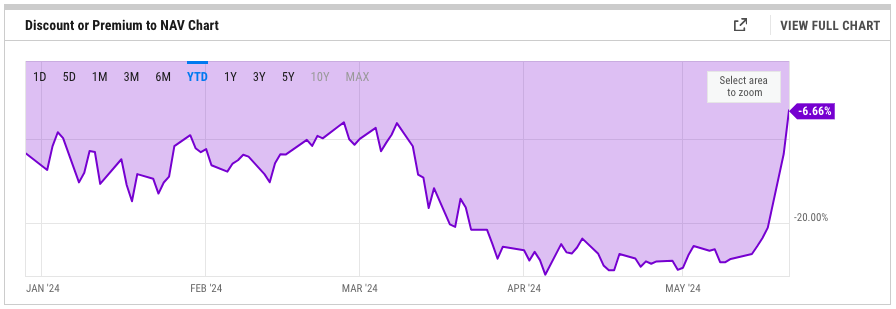
Amid renewed discussions of ETH-ETF, the discount on the Grayscale Ethereum Trust (ETHE) narrowed to 6.6% — the lowest level in several years.


Political Motives
In a conversation with The Block, Bloomberg exchange analyst Eric Balchunas called the resumption of dialogue with the SEC an important step that could indicate a “180-degree policy shift by the regulator.”
According to him, ETF issuers are waiting for the approval of form 19b-4 and the registration of S-1. He noted that the latter might take longer than usual, as this is an unprecedented situation:
“We don’t know exactly when [the documents will be approved], but it all depends on logistics. Getting over the mountain of potential approval is a big deal. Now it’s just about bureaucracy, legal documents, and such, which, as I hear, caught everyone by surprise.”
Balchunas pointed out potential issues with preparing ETH-ETF, as management firms may not have had enough time to accumulate the asset.
He also confirmed his concerns that Ethereum funds might attract less demand than Bitcoin products.
“People who are really into [these instruments] probably already own them, right? As for regular tourists, I think many of them are probably satisfied with Bitcoin,” the expert clarified.
According to Balchunas’ estimates, ETH-ETF could attract only 10-15% of the volume of Bitcoin funds — approximately $5-8 billion in monetary terms.
Some see political motives in the SEC’s actions. An anonymous source familiar with the matter confirmed the change in the agency’s rhetoric.
“This is an entirely unprecedented situation, which means it is entirely political,” the insider added.
The speaker discussed the internal workings of the regulator. According to him, the SEC’s trading and markets division approves 19b-4, while the corporate finance division is responsible for S-1. Both divisions “are not even internally coordinated,” so the decision likely comes from the top.
“Once the SEC approved futures ETH-ETFs, it immediately decided the fate of spot funds. I suspect the regulator learned an important lesson from the circus atmosphere surrounding the spot Bitcoin-ETF approval process and decided to approach the Ethereum issue much more quietly,” noted ETF Store President Nate Geraci.
Previously, Coinbase exchange analyst David Han called the approval of an ether-based product a matter of time. According to the specialist, the rationale used for approving Bitcoin-ETFs is applicable to the instrument based on the second-largest cryptocurrency by market capitalization.
Attorney Scott Johnson stated that the SEC is examining grounds for rejecting applications for spot Ethereum-ETFs. One of these could be assigning the asset the status of a security.
Earlier, following news of the request to update applications, several industry experts predicted increased volatility for Ethereum amid the narrative of exchange-traded funds.