




As precious metals continue to push into uncharted territory in 2025, silver is increasingly emerging from gold’s shadow. Beyond short-term price action, the current rally offers a useful lens through which to examine scarcity, utility, and diversification—parallels that resonate not only within traditional markets, but also with the dynamics of Bitcoin and the wider digital asset space.
Silver prices touched a new record high above $72 per ounce this week, extending a remarkable rally that has seen the precious metal surge more than an eye-watering 130% year-to-date, driven by industrial demand, supply constraints, and investors seeking hedges against inflation and currency debasement. This performance outpaces gold, which has risen about 65% in 2025 but remains a more traditional safe-haven play.
At the time of this writing, the market capitalization of silver, calculated as the current spot price per ounce multiplied by the total historical production (approximately 55.9 billion troy ounces), is close to $4 trillion. This positions “the devil’s metal,” as silver is sometimes referred to, as one of the largest assets globally by this metric, recently surpassing companies like Google.


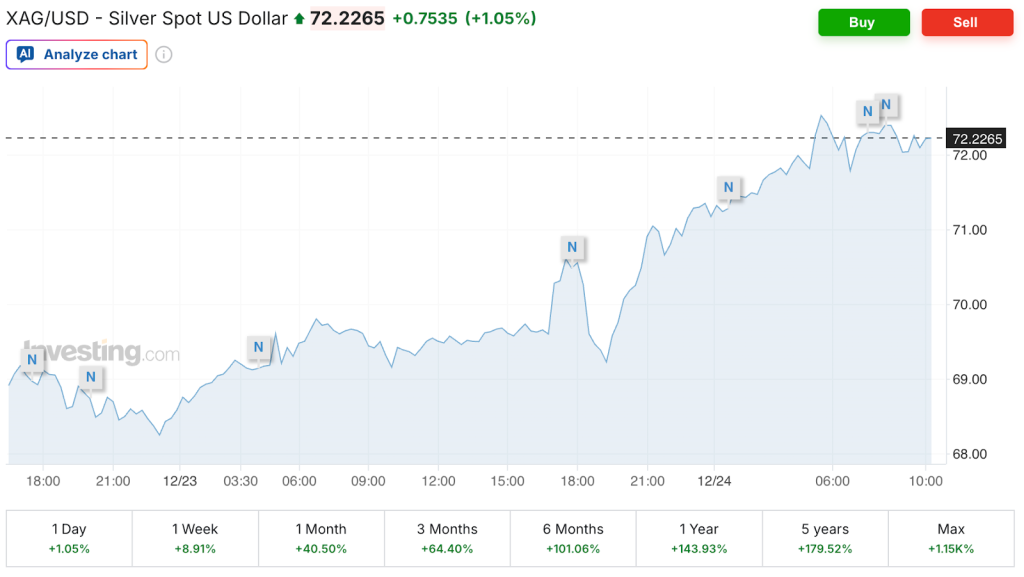
The surge in silver spot prices, which on December 23 hit an intraday high of 70.67, reflects a confluence of factors including geopolitical tensions, monetary policy shifts, and booming industrial applications. This milestone comes amid broader market volatility, with cryptocurrencies experiencing their own fluctuations, inviting comparisons between the two asset classes and highlighting potential takeaways for digital asset investors.
Unpacking the Silver Surge
Silver’s ascent has been fueled by persistent global supply deficits, estimated at 180 million ounces for 2025 by the Silver Institute. This marks the fifth consecutive year in which mining production has failed to keep pace with consumption.
Unlike gold, which has also hit records above $4,000 per ounce, silver benefits from dual utility: as a monetary store of value and an essential industrial component in sectors like solar energy, electronics, and electric vehicles. Supply constraints exacerbate the bull run, with annual deficits estimated at approximately 120 million ounces due to stagnant mining production and geopolitical restrictions.
Earlier this year, these pressures led to physical shortages of the actual metal (not just on paper), prompting spikes in deliveries on major trading venues such as COMEX, while refiners temporarily halted orders amid a surge of margin calls.
“London inventories remain thin. Shanghai warehouse stocks have fallen to their lowest level since 2015. COMEX has already seen 75 million ounces pulled from vaults since early October. Borrowing rates for physical silver are still elevated. Every major hub is signaling the same problem: supply is under acute pressure,” journalist and host of The Real Story Michelle Makori noted last month in an X post.
Industrial demand, particularly from solar energy, electronics, and electric vehicles, has played a pivotal role in this year’s price spike, with solar alone tripling its silver usage over the past decade. Geopolitical developments, such as China’s export restrictions on refined silver and the U.S. government through its Geological Survey (USGS) designating it as a critical mineral, have further tightened supply chains.
The USGS has maintained a critical minerals list since 2017, guiding U.S. government policy, funding priorities, and the approval process for domestic mining projects.
The agency defines a critical mineral as: “Those commodities which are essential to the economic or national security of the U.S.; have a supply chain that is vulnerable to disruption; and serve an essential function in the manufacturing of a product, the absence of which would have significant consequences for the economic or national security of the U.S.”
The USGS final 2025 update added a total of 10 new minerals, including copper, metallurgical coal, potash, rhenium, silicon, and uranium.
“Once a mineral reaches that status, governments usually start evaluating tariffs, export restrictions, and stockpile strategies,” added Makori. “Traders know this. The possibility of new US policy is already making some hesitate before shipping metal out of the country.”
Macroeconomic pressures have also played a role, with the U.S. fiscal deficit topping $1.78 trillion in 2025 and the Federal Reserve’s rate cuts creating negative real yields.
“Silver’s rise right now is the result of monetary shifts, industrial demand, and geopolitical restructuring all colliding at once,” explained macro strategist EndGame Macro, describing silver as a bridge between eroding fiat systems and emerging technologies.
Implications for Cryptocurrency Investors
As silver’s rally unfolds, experts are noting similarities with cryptocurrencies, where assets like Bitcoin are currently changing hands 30% below their all-time highs despite broader market highs in stocks and other commodities.
“Silver at new all-time highs above both 1980 and 2011 is the market screaming that the old pricing regime for trust is breaking,” SightBringer, a macro and crypto analyst, elaborated in an X post last month. “Silver is the training signal for what the market will eventually express more cleanly through Bitcoin.”
He argued that precious metals reflect the growing distrust in fiat, a sentiment that underpins Bitcoin’s appeal as “digital scarcity,” but warned of short-term rotations where metals gain at crypto’s expense.
As blockchain philosopher Jack Sage recently pointed out, “Silver isn’t running. It’s being forced higher… With limited inventory: Any new sovereign reserve demand, any acceleration in ETF inflows, or any supply disruption can wipe out available supply quickly.”
For those familiar with Bitcoin’s mechanics, this naturally calls to mind the protocol’s halving events, where a reduction in new supply has historically acted as a powerful catalyst for price appreciation.
While retail investor fervor in silver mirrors the intensity seen during crypto booms, the rally also underscores the importance of diversification and real-world utility. Unlike purely speculative cryptocurrencies, silver benefits from inelastic industrial demand, a factor that may serve as a useful reference point for crypto projects seeking to ground their value propositions in practical, real-world applications.
Overall, the 2025 surge in gold and silver appears to reflect a more pragmatic evolution in asset allocation, one that prioritizes diversification over panic. In this context, allocating capital to gold, silver, and Bitcoin—given their roles as alternatives to traditional financial systems—may represent a deliberate strategic choice rather than a reactionary one.
“Silver is experiencing a moment of profound significance, with major implications for the history of hard money, fiat currency debasement, and — most critically — inflation,” said macro thinker and value-oriented investor Otavio Costa in a recent social media post.
Costa added that this could set the stage for a “historic move” as silver broke out above previous highs.
Looking further ahead, commodities analyst Tim Hack argues that the underlying momentum could ultimately propel prices into the four-digit range over the long term. While he suggests this trajectory may unfold over the next 10 to 15 years, he also notes that an initial surge toward the $100–$400 range could materialize far more quickly—potentially within a year or even sooner—depending on where systemic stress emerges first.
Andrew Asmakov
Disclaimer
The views and projections referenced above reflect the opinions of the cited analyst and the author and are provided for informational purposes only. They do not constitute financial, investment, or trading advice. Readers should conduct their own research and consult a qualified financial professional before making any investment decisions.