



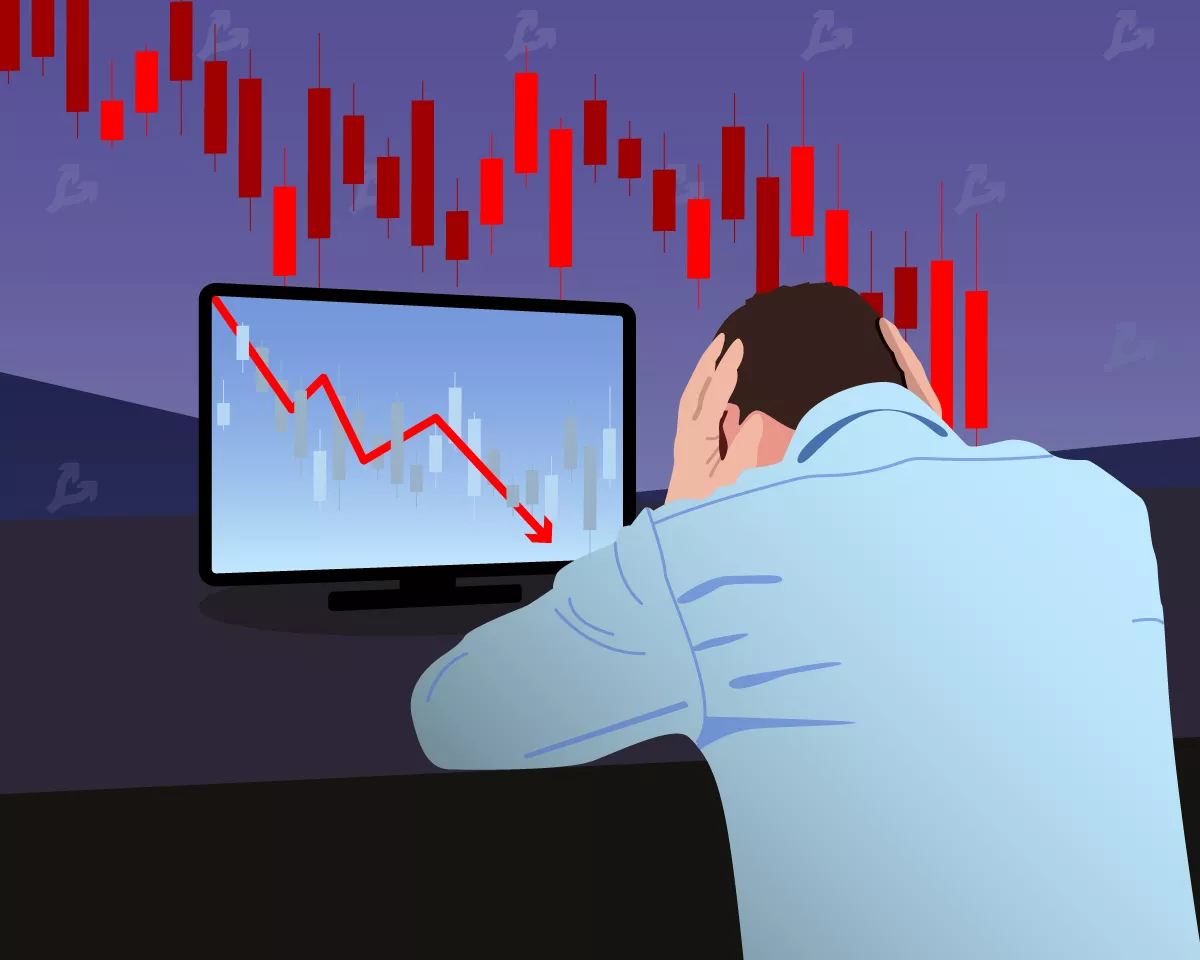
Many enter trading in search of easy money. Beginners think trading is simple: they look at a chart, press a button, and profit. In reality, 70% of traders lose money. The problem lies not in knowledge of technical analysis, but in common emotional mistakes.
Together with the cryptocurrency exchange EXMO, we outline six typical trading mistakes and offer advice on how to avoid them.
Buying at the end of a rally
Beginners often buy cryptocurrency at the end of an uptrend. Their behaviour is illustrated by Wall Street Cheat Sheet. It explains the psychology of the average trader during the stages of the market cycle:
- At the start of a trend, traders do not believe in the move — fear is stronger than greed;
- In the middle of the trend, they regret not buying earlier — fear and greed are balanced;
- At the end of the trend, the trader enters a position — greed is stronger than fear;
- The trend reverses — the trader loses money.
Wall Street Cheat Sheet shown on the BTC/USD chart on EXMO
Why this happens: prices move chaotically. This is described by Bill Williams in the book Trading Chaos. According to him, 7 of 8 moves of price by 1% end in a pullback. Only one of such moves begins a new trend.
Experienced traders enter a position on each such move. They hope that the profit from a single trend trade will cover the losses from seven unsuccessful ones.
Novices miss the start of the trend: they fear a pullback and wait for favorable conditions. Yet at the end of the trend they buy the asset and create a frenzy — price swings inside the candle with a new high.
Trader flips position due to small price fluctuations
Why this happens: novices fear losses and perceive paper losses too emotionally. They confuse micro-volatility with the start of a new trend and constantly flip positions.
How to avoid the error: switch the chart to a longer time frame so you do not get distracted by minute fluctuations.
Bill Williams advises treating each trade as buying a lottery ticket. The price of the ticket is the maximum acceptable loss. In other words: hold the trade until the stop-loss triggers.
Obvious stop-loss
Usually traders set stop-losses beyond recent extremes of the market. At times, prices break through extremes and then reverse in the intended direction. In such cases traders do not take profit: the stop-losses fire.
Probitie of recent lows with continuation of rise (BTC/USD on EXMO)
Why this happens: large players push the price in the desired direction using volumes of private traders. If newcomers rush in to buy as a group, professionals trigger their stop-losses and push the price up. After that, newcomers buy the asset again and help push the price higher.
5 июля биткоин пробил прошлый минимум и спровоцировал трейдеров на дальнейшие покупки
How to avoid the error: do not place stop-losses beyond extremes, as well as obvious support and resistance levels.
Trader Barry Burns advises to set stop-losses at a level where there is no reason to hold the position. For example, where the pattern loses its strength.
Too large a position
Traders follow a rule: in a trade, risk no more than 2% of the deposit. Beginners misinterpret it and allocate 2% of the account balance to a position, typically around $20. On such a trade you would not earn even in a strong uptrend: for example, when Bitcoin rises 5%, the profit would be $1.
More often, the novice will want to earn more and increase the position size. If the trade goes bad, they lose a larger portion. Therefore, the trader will hold until the end: what if the market reverses and the loss becomes profit?
Why this happens: novices want to earn money quickly. They ignore the 2% rule and lose the deposit on several unsuccessful trades.
In reality, the 2% rule states: set stop-losses so that when triggered you lose no more than 2% of the deposit. Then you will have money for new trades even after a string of failures.
How to avoid the mistake: select positions to ensure that a losing trade costs no more than 2% of the deposit. For example, with a stop-loss at 4% from the entry, you can use half the deposit.
Trying to make up losses
Novices react badly to losing money. After a losing trade they try to make it back and “get their money back.” Traders become greedy: increase the size of the position and enter the market under emotional influence. As a result — they lose more money.
Why this happens: traders take losses too personally and play roulette with the market instead of trading.
How to avoid the mistake: do not take losses as a personal insult. The market behaves chaotically. Even the best trading strategies do not guarantee 100% profitable trades.
Impatience
Novices often close profitable trades with minimal gains: usually at the first pullback during a trend.
For example, a trader buys Bitcoin. The price rises 5%, then falls 2%. The novice wants to protect paper profits and closes the position. After that Bitcoin continues to rise, but the trader cannot profit from it.
Why this happens: novices treat unrealised profits as earned money, and its decline as a loss. They close positions during pullbacks and fail to profit from larger moves.
Traders save unrealized profits. After pullbacks, Bitcoin continues to rise (BTC/USD on EXMO)
How to avoid the error: remember that prices do not move in a straight line. Every trend features pullbacks. To maximise profits, wait for the start of the frenzy and exit the market with the big players.
Conclusions
Traders’ earnings depend not only on the ability to analyse charts and news. In trading, personality traits such as calm, patience and prudence matter.
Even experienced traders are not immune to mistakes. But there are a few rules that can help beginners make fewer errors:
- do not enter the market during upward or downward moves; wait for a pullback or a period of flat trading;
- do not close or flip a position with a small loss; instead, set stop-losses;
- place stops away from extremes so they will not be hit by a false breakout;
- select position sizes so that a losing trade costs no more than 2% of the deposit;
- do not try to recover losses; these are the costs of running a trading business;
- do not fear pullbacks; a 1% decline does not spell the end of the trend.
Remember: in trading it is important to think, not feel. To worry less about losses, do not trade with money you are not prepared to lose.
Follow Forklog’s news on Facebook!