



Snap plans to cut around 1,000 employees, approximately 16% of its global workforce. This move is part of CEO Evan Spiegel’s strategy to reduce costs and achieve profitability, according to Bloomberg.
In a letter to staff, the company’s head emphasized that workforce optimization is necessary to enhance efficiency. He mentioned advancements in artificial intelligence technologies that enable employees to perform their tasks much faster.
“While changes are necessary to realize Snap’s long-term potential, we believe that advancements in AI allow our teams to reduce routine work, increase speed, and better support the community, partners, and advertisers,” the entrepreneur stated.
In addition to layoffs, the company has canceled hiring for more than 300 open positions.
According to Spiegel, these measures will reduce annual expenses by more than $500 million by the second half of the current year. The company’s total revenue in the first quarter increased by 12%, reaching $1.53 billion.
“Last fall, I described the situation at Snap as a turning point, requiring the implementation of a new, faster, and more efficient approach to work, as well as a refocus on profitable growth,” the executive wrote in a memo.
He added that in recent months, the leadership has carefully analyzed the necessary measures to “serve the community and partners” and made “difficult decisions about prioritizing investments.”
Since the beginning of the year, Snap’s shares have fallen by 25%. One reason is the challenge of expanding its user base, exacerbated by regulatory pressures from various countries. These regulators seek to limit the use of social networks by teenagers.


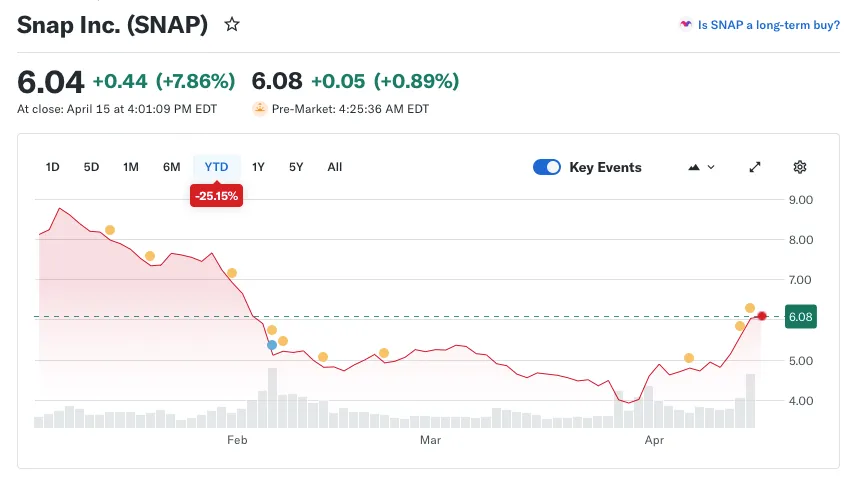
The company’s efforts to reorganize its advertising business have yielded mixed results.
While CEO Evan Spiegel promotes the concept of augmented reality glasses, the firm continues to rely heavily on third-party AI solutions. Meanwhile, competitors are actively investing in developing their own AI tools and necessary infrastructure.
The workforce reduction occurred a few weeks after investor Irenic Capital Management acquired a stake in the company and called for rapid changes to improve financial performance.
Layoffs as a Broad Trend
Other major tech companies have also conducted significant layoffs. For instance, Meta laid off hundreds of employees worldwide in March and cut around 1,000 people from its Reality Labs division in January. Simultaneously, the company is increasing its investments in artificial intelligence.
In February, Block CEO Jack Dorsey announced the layoff of nearly 4,000 employees. The decision is related to the firm’s transition to a “more compact, flat, and AI-focused” structure.
According to Dorsey, artificial intelligence and related tools are fundamentally changing work principles. Despite financial stability and gross profit growth, Block is forced to restructure its business for long-term development.
In April, Oracle began laying off thousands of employees amid falling stock prices and significant capital expenditures on AI infrastructure. The company’s core business faces challenges due to competition from generative AI models. Additionally, investors are concerned about increasing debt and shrinking cash flows.
Silicon Valley IT corporations have moved from recommending AI adoption to policies requiring employees to use neural networks in their work.
Nearly half of firms already report positive returns on investments in generative AI. In comparison, this figure averages 35% in other industries.
Some employers have even stopped considering candidates without skills in working with neural networks. Potential employees undergo testing on their ability to solve tasks using AI and must explain their choice of tools and prompts.
Earlier in February, OpenAI CEO Sam Altman stated that some companies use artificial intelligence as a pretext for layoffs.