



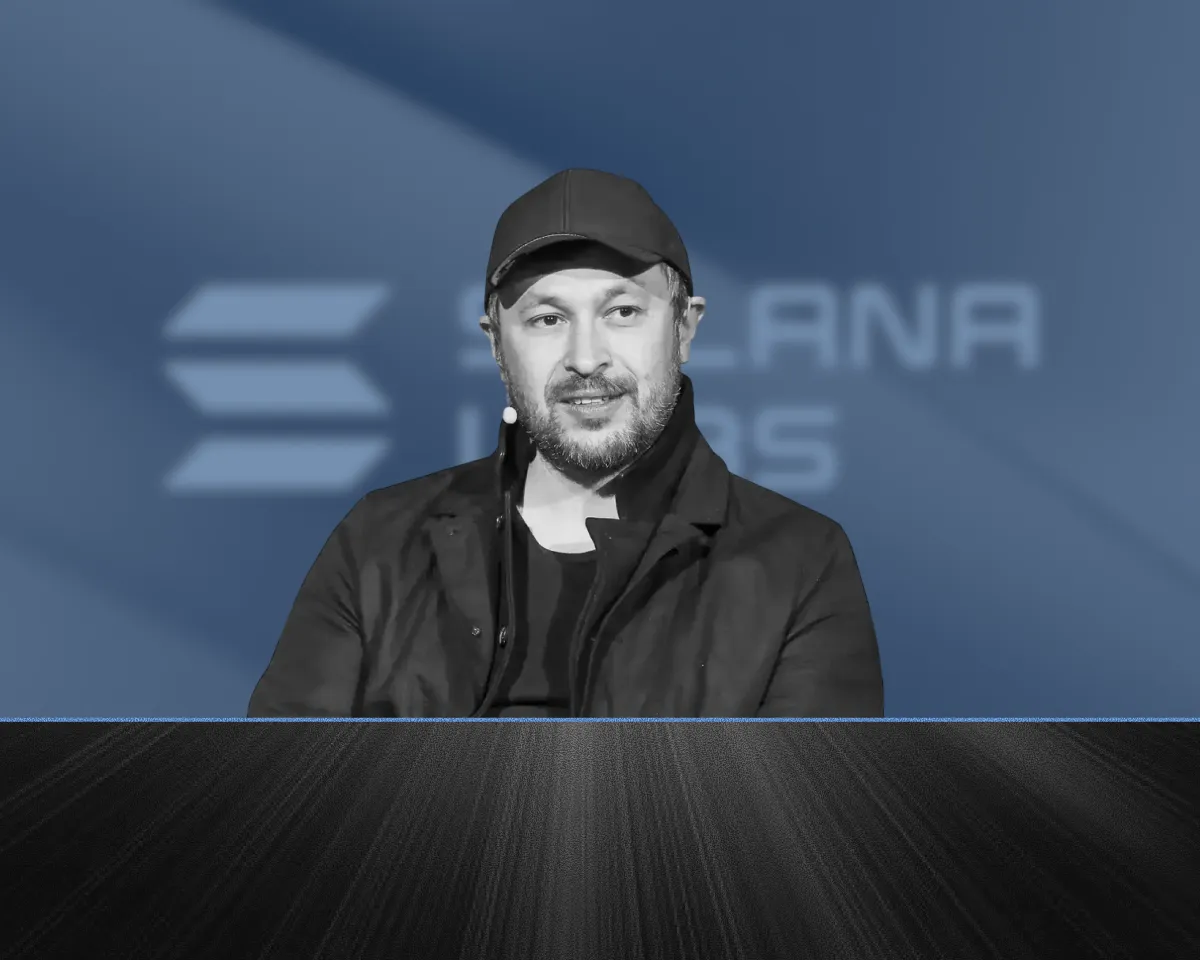
A blockchain must evolve continuously to survive, said Solana Labs CEO Anatoly Yakovenko.
I actually think fairly differently on this. Solana needs to never stop iterating. It shouldn’t depend on any single group or individual to do so, but if it ever stops changing to fit the needs of its devs and users, it will die.
It needs to be so materially useful to humans… https://t.co/itqr1b5az4
— toly 🇺🇸 (@toly) January 17, 2026
“Solana should never stop iterating. It should not depend on any single group or individual to do so, but if the network ever stops changing to fit the needs of its developers and users, it will die,” the expert wrote.
He was responding to comments by Ethereum co-founder Vitalik Buterin, who said the blockchain of the second-largest cryptocurrency should reach the point of passing a “walkaway test”.
“This means that Ethereum should reach a state where we can ‘ossify’ if we want. We do not need to stop making changes to the protocol, but we should get to a situation where the value proposition of the blockchain does not strictly depend on any features that do not yet exist,” he emphasized.
Ethereum’s philosophy
The industry’s leaders take different approaches to development. Buterin prioritizes maximal decentralization, privacy and sustaining the system over the long term without constant developer involvement.
A day earlier he urged the Ethereum community to combat ‘protocol bloat’, caused by the endless urge to add new features while keeping obsolete ones.
An important, and perenially underrated, aspect of “trustlessness”, “passing the walkaway test” and “self-sovereignty” is protocol simplicity.
Even if a protocol is super decentralized with hundreds of thousands of nodes, and it has 49% byzantine fault tolerance, and nodes fully… pic.twitter.com/kvzkg11M3c
— vitalik.eth (@VitalikButerin) January 18, 2026
In his view, true trustlessness depends less on quantitative decentralization metrics than on the simplicity of the system.
“Even if a protocol is super-decentralized with hundreds of thousands of nodes, […] but is a cumbersome mishmash of hundreds of thousands of lines of code built on five different PhD-level cryptography systems, then it will ultimately fail,” Buterin believes.
He said complexity undermines Ethereum in three ways:
- undermining trustlessness: users are forced to blindly trust a narrow circle of experts because they cannot verify its operation themselves;
- failing the “walkaway test”: if the current client development teams leave, recreating full and secure services from scratch would be almost impossible because of the system’s complexity;
- erosion of self-sovereignty: even technically savvy users lose the ability to analyze, verify and understand the system’s logic, forfeiting direct control and sovereignty over their assets and actions on the network.
“Garbage collection”
Buterin argues the root of the problem lies in the methodology for assessing changes. When the primary criterion for an upgrade is minimizing disruption to existing infrastructure, backward compatibility inevitably takes precedence.
That creates a structural bias: features are added but almost never removed, leading to perpetual growth and complexity.
To counter this tendency he proposed formalizing a process of “simplification” (or “garbage collection”). The initiative includes:
- systematic reduction of the codebase;
- abandoning overly complex cryptographic constructions;
- introducing strict rules to make client logic stable and predictable.
As a successful example of such a “clean-up” Buterin cited the transition from PoW to PoS, which rebooted the network’s architecture, and the current reforms of the gas model intended to replace artificial limits with transparent economic principles.
In time, “garbage collection” would push obsolete functions out of the protocol’s core and into smart contracts. That would lighten client software and simplify further development.
Solana’s philosophy
Yakovenko follows an “adapt or die” principle, advocating constant upgrades to meet real-world needs. Upgrades, he says, should come from the broader community, not a narrow set of developers.
“To survive, you must always be useful. Therefore the main goal of protocol changes should be to solve a specific problem for developers or users. That does not mean solving every problem; in fact, you need to be able to say no to most requests,” the expert stressed.
Adherents of Solana’s philosophy argue that a lack of updates leads to stagnation and defeat in the competitive race.
The Solana Labs head also suggested that in future network fees could fund AI development to write and improve the blockchain’s codebase.
“You should always count on the next version of Solana,” Yakovenko said
Earlier, Vitalik Buterin criticised modern DAOs and called for them to change.