


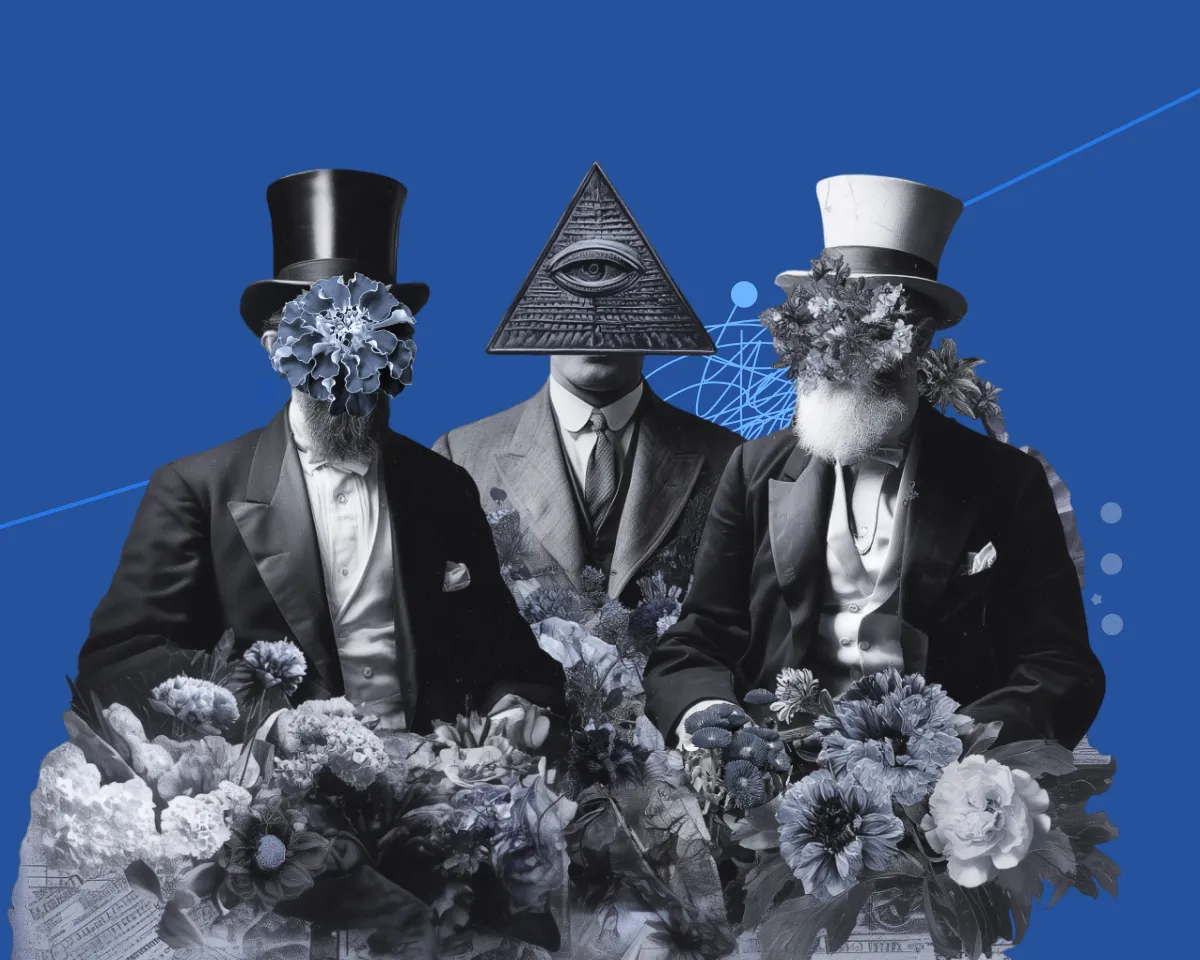
Sometimes a Scam Is Just a Scam (𓂀)
A moderately paranoid Elena Vasilyeva on why crypto followers believe in conspiracies (and why they’re sometimes right)
In the crypto industry, paranoia isn’t a disorder — it’s a survival tool. It’s easy to laugh at boomers who believe everything on TV, but in crypto Telegram channels, people seriously discuss whether regulators are working for the Chinese Communist Party, if Satoshi Nakamoto is an NSA project, or whether Ethereum will definitely pump while you’re asleep.
Put on your tinfoil hat—we’re diving into how conspiracy theories built the digital economy, why Larry Fink is scarier than the reptilians, and what DYOR has in common with religious ecstasy.
Drawing on psychological profiles of crypto enthusiasts, investigations into account freezes, and academic studies on conspiracy culture, let’s ask ourselves: have we truly seen the light, or have we just lost our minds together?
The Beginning
The crypto market is a perfect storm for conspiracy theorists. It was born from a deep distrust of traditional financial institutions, governments, and the Federal Reserve’s money-printing machines. In a community where everyone is their own bank, it’s only natural for legends to flourish about shadowy puppeteers pulling the strings behind Bitcoin’s price movements.
If, after more than a year in crypto, you’ve never once wondered whether a “global elite” is hunting down wallets — then your dive into the industry has likely been a shallow one. During a bear market, paranoia becomes a defense mechanism (“the market maker is manipulating us”), while in a bull market, it fuels FOMO (“insiders are accumulating, time to jump in”).
The Psychology of the “Dark Tetrad”: Where the Distrust Comes From
According to a study published in PLOS One, crypto holders are a unique breed. Researchers claim that crypto investors tend to display traits of the so-called “Dark Tetrad”: Machiavellianism, narcissism, psychopathy, and sadism.
It sounds like a comic-book villain diagnosis, but in reality, it explains the appetite for risk and the deep-seated contempt for authority. A crypto believer doesn’t trust CNN or the BBC. A crypto believer trusts an anonymous user with the handle CryptoDegenerate69 and a pixelated frog as their profile picture.
This phenomenon fits perfectly with the theory put forward by researcher Ilya Yablokov, author of the book Russian Conspiracy Culture (2020). Conspiracy thinking serves as a tool for socialization and a way to reclaim a sense of control over reality.
When the state has let you down in 1991, 1998, 2008, and 2014, believing that “central banks are a scam” stops being just a theory and becomes lived experience.
The world is chaotic, the market volatile. When a portfolio goes to zero, it’s painful for the psyche to admit you bought a meme coin at the top out of sheer foolishness. It feels much better to think: “The market maker (the sinister Bogdanov on the phone) spotted my long and gave the order to ‘Dump it!’”
The world divides into normies (the asleep) and the enlightened (the crypto faithful). This is classic Gnosticism, as described by American religion scholar Michael Barkun in his book A Culture of Conspiracy: Apocalyptic Visions in Contemporary America (2003).
The author introduces the concept of “stigmatized knowledge”—truth that official institutions reject or ridicule. In our case, it’s the knowledge that fiat money is nothing but paper, backed by nothing more than the regulators’ word.
We feel like the heroes of The Matrix. And that feeling of being chosen—it’s the most potent drug of all, stronger than any green candle on the chart.
“Operation Chokepoint 2.0”: When Paranoia Turns Out to Be True
The most ironic thing about crypto conspiracy theories is that the industry really is being watched. The line between madness and inside information blurs when it comes to the banking system.
Take the story of Austin Federa, former head of strategy at the Solana Foundation. In the spring of 2024, he tried to get a mortgage in New York. According to him, HSBC gave him an ultimatum: quit the crypto project or forget about the house.
“How could I be a more reliable borrower if I were unemployed?” Federa wondered.
Venture capitalist Nic Carter coined the term “Operation Chokepoint 2.0.” The theory goes like this: the administration of former U.S. President Joe Biden, the Federal Reserve, and the FDIC colluded to cut off crypto businesses from the dollar-based financial system.
Sounds like the rantings of a madman? Absolutely. But then documents from the Federal Deposit Insurance Corporation surface (thanks to Coinbase’s lawsuit), where regulators explicitly ask banks to “pause” their work with digital assets. JPMorgan Chase CEO Jamie Dimon calls Bitcoin a fraud. Company accounts get closed without explanation.
Here we see a classic confirmation of Barkun’s ideas: conspiracy theories thrive where there is “systemic opacity.” Regulators don’t even need to pass new laws. It’s enough to act through “soft power”—informal recommendations, phone calls, and whispers behind closed doors. And in this information vacuum, a monster is born: we start believing that the government isn’t just incompetent but actively trying to destroy us.
Donald Trump’s victory in the U.S. presidential election, after he promised to “immediately end Chokepoint 2.0,” was seen by the community not as a political shift but as a triumph in a holy war against the Deep State. And here we smoothly transition to QAnon.
QAnon, Trump, and NESARA: When Scams Meet Politics
You may have noticed how seamlessly the slogans of right-wing conspiracy theorists have woven their way into Crypto Twitter. The QAnon call to “Trust the Plan” is essentially the twin brother of our own beloved “HODL.”
QAnon’s ideas—that the world is ruled by a satanic, pedophilic cabal of bankers and Democrats—perfectly align with the libertarian hatred of centralized finance. New Lines Magazine did a great job dissecting how the vintage NESARA/GESARA conspiracy theory—that Congress secretly forgave all debts and is preparing a new currency—has mutated within the modern crypto industry.
According to the magazine’s investigation, scammers convince their audience that the traditional banking system will collapse, and salvation will come from a “Quantum Financial System” (QFS) and specific digital assets. These fraudsters use social engineering, spending a long time gaining their victims’ trust before persuading them to part with their money. Victims receive phishing emails promising access to NESARA’s “humanitarian funds.”
To receive these payouts or protect their savings from the dollar’s collapse, people are urged to buy XRP tokens immediately. The choice of XRP is based on its low fees and fast transaction speed, making it easier to move stolen funds. Within the conspiracy-minded community, XRP is called the “white hat” currency—the force of good—positioned against Bitcoin.
The investigation revealed links between the promotion of the NESARA theory and some U.S. Republican politicians. In March, Arizona state legislators Mark Finchem and Leo Biasiucci attended the Quantum Summit 2, an event focused on NESARA and ufology.
Finchem openly called for investing in XRP and introduced a bill to create a “strategic reserve” of digital assets in Arizona. He proposed recognizing cryptocurrency as legal tender. Previously, Finchem had called XRP his favorite asset, though his office declined to comment on a potential conflict of interest.
Researchers noted that conspiracy theories have become flexible and easily adapt to market trends. NESARA ideas have blended with QAnon narratives. Experts warned: the audience for such theories is ideal for scammers, as they are already predisposed to believe in hidden knowledge and inevitable global change.
Now, in chat rooms, you can find claims that XRP or Stellar are that very “Quantum Financial System” (QFS) set to replace SWIFT after the inevitable collapse of the cabal. This is no longer just economics; it’s eschatology.
The conspiracy theorist’s logic is paradoxical: since the SEC is suing Ripple and “strangling” the coin, that means it’s the real deal and XRP will become the world’s reserve currency. Tweets from Elon Musk or Trump are dissected like sacred texts, with every typo scrutinized for hidden signals “for those in the know.”
The “Gold Bug” Economy and the Fed as Enemy #1
It’s hard not to notice that the rhetoric of Bitcoin maximalists sounds suspiciously old-fashioned. British writer and cryptocurrency expert David Gerard rightly points out: a certain segment of the crypto industry is a reincarnation of the “gold bugs” from the mid-20th century.
The idea is simple: abandoning the gold standard was a banker-led conspiracy to steal people’s wealth through inflation. This rhetoric has been adopted by modern “maximalists,” except gold in the equation has been replaced by blockchain.
Of course, we should separate technology from ideology. The Bitcoin white paper itself is a purely technical document—it contains no political slogans. However, the ideological motivation is evident in the context of the network’s launch. Many researchers interpret the famous message Satoshi left in the genesis block’s hash—”Chancellor on brink of second bailout for banks”—not just as a timestamp, but as a political manifesto.
This technical document became a banner for those who view quantitative easing (QE) not as a monetary tool, but as malicious intent.
Here, Yablokov’s theory about a “top-down conspiracy” works like clockwork. Crypto believers see the actions of Fed Chair Jerome Powell not as an attempt to save the economy, but as a coordinated attack on the wallets of ordinary citizens.
Folklore, Magic, and Sleeping Ethereum
But politics isn’t the whole story. Reddit is filled with “everyday magic” that shows just how close the industry is to shamanism.
Take the “reverse indicator theory”: the market always moves against a trader as soon as they hit the “Buy” button. Or the popular observation: “Ether only rises while the holder is asleep. The moment you wake up and check the chart, the correction begins.”
This is magical thinking in its purest form. When technical analysis starts to resemble astrology and fundamental analysis fails, the brain finds it easier to blame a liquidated position on the intervention of higher powers than to admit the market’s inherent unpredictability.
DYOR as Cargo Cult
The phrase “Do Your Own Research” (DYOR) is the industry’s main mantra. Formally, it’s a call to fact-checking. Of course, there are deep analytical tools in the industry: on-chain audits, smart contract analysis, liquidity checks. But at the mass level, DYOR has turned into a ritualistic incantation. Influencers utter this phrase to absolve themselves of responsibility when they lead their followers to losses. And their followers nod, like, and buy meme coins on Solana.
For the average retail investor, “doing your own research” often boils down to watching a YouTube video that confirms what they already wanted to believe. DYOR has mutated into a cargo cult.
The paradox: total distrust of institutions (Bloomberg lies!) gives rise to blind faith in anonymous Telegram channels. People feel intellectually superior to the crowd because they’ve “studied the project” (read an X thread), when in reality they’ve just fallen into another propaganda funnel.
In the context of “conspiracy culture,” DYOR is the illusion of possessing secret knowledge. You didn’t just buy an asset—you researched it. You touched a truth hidden from the masses. It gives a sense of control in a completely uncontrollable casino.
Who Created Bitcoin: Cypherpunks or the NSA?
The figure of Satoshi Nakamoto is the holy grail of the community and its greatest source of fear. Theories about him fall into two camps: the light (a lone genius) and the dark. One of the most persistent and grim legends is the hypothesis of involvement by intelligence agencies: the idea that Bitcoin is actually a project of the U.S. National Security Agency (NSA).
Supporters of this version often point to the fact that the SHA-256 hashing algorithm was developed within the NSA’s walls. The conspiracy logic builds on the idea of a “digital trap”: if cash ensures genuine anonymity, Bitcoin, as a public ledger, creates the perfect conditions for total surveillance. In this version of reality, Satoshi isn’t a liberator, but the architect of a digital panopticon.
Of course, there are other, more exotic or mundane theories. Some believe the pseudonym hides a collective mind of developers, others point to cryptography pioneers like Hal Finney or Len Sassaman. Some go further,
involvement by an artificial intelligence from the future.
There are, of course, other takes, some exotic, others prosaic. Some suspect a collective of developers; others point to cryptography pioneers such as Hal Finney or Len Sassaman. Some go further, imagining an AI from the future.
As Yablokov suggests, the “invisible hand” is essential to conspiracist thinking. We struggle to accept that a global financial revolution could be the work of a few geeks. We crave a Grand Design.
Larry Fink’s Trojan horse
Once the enemy was the faceless banker. Now it has a name: BlackRock’s CEO, Larry Fink. Approval of a spot bitcoin ETF sparked not only price euphoria but dread among old-school cypherpunks.
The “Trojan horse” theory runs thus: Wall Street entered crypto not to profit but to seize control.
The feared scenario:
- regulatory pressure purges the field of “grey” exchanges;
- BlackRock rides into the vacuum in the shining armour of legality;
- after amassing enough coins, giants dictate rules at the mining level.
Here lies a real technical risk, not mere conspiracism. If large mining pools (say, US-based and compliant with the OFAC) start ignoring transactions from sanctioned addresses, the network would de facto split.
Bitcoin would bifurcate into “white” (institutional, KYC-ed) and “black” (free but shunned by big players). Block-level transaction censorship is discussed in all seriousness.
In this view, ETFs are a hostile takeover of the decentralisation dream. And, looking at flows into IBIT, it is hard to say the theory is senseless.
Barkun’s conspiracy culture: apocalypse now
Lay professor Barkun’s framework over crypto and things click into place.
- Stigmatized knowledge. When ECB president Christine Lagarde calls crypto trash, that is taken as proof of value. “If they trash it, they want to buy cheaper.”
- Inversion of fact and fiction. A Reuters investigation is dismissed as FUD and a hit piece. An anonymous moon-thread is treated as insider intel.
- Improvisational millenarianism. The end is nigh. Crypto folks expect Hyperbitcoinization: the old order (the dollar) dies in hyperinflationary flames and private-key holders become the new elite.
Preparation isn’t for retirement; it’s for the apocalypse. In this conception, the blockchain is a digital Noah’s Ark.
Don’t Trust, Verify
After analyzing all of this through the lenses of Barkun’s and Yablokov’s research, you arrive at a disheartening yet amusing conclusion. Conspiracy theory in the crypto community isn’t a bug—it’s a feature. It unites people against a common enemy, whether it’s the SEC, the Fed, or reptilians.
But as practice shows, sometimes investors really are being watched. The key skill for a crypto believer in 2026 is the ability to distinguish real regulatory risks from schizoid fantasies about quantum financial systems.
So, you can wear your tinfoil hat with pride. Just don’t forget: sometimes FUD is just FUD, and a scam is just a scam, with no CIA involvement. And, of course, you should DYOR. For real.
Рассылки ForkLog: держите руку на пульсе биткоин-индустрии!