


Spot learns to speak, Grimes backs AI music, and other AI news
We aim to inform readers not only about events in the bitcoin industry, but also about developments in related technological fields — cybersecurity and the world of artificial intelligence (AI).
ForkLog AI has compiled the week’s most important AI news.
- Bard learned to generate code.
- A startup founded by former Apple employees unveiled a wearable AI device with a projector.
- Bill Gates said that within eighteen months chatbots will teach children to read.
- OpenAI allowed turning off chat history in ChatGPT.
- A student developed an AI monocle to assist in sustaining conversations.
- Singer Grimes allowed AI musicians to use her voice.
- Spot the robot dog learned to speak thanks to ChatGPT.
Bard learns to generate code
The Google taught Bard to generate, explain, debug and optimize program code. The tool can also write functions for Sheets.
AI supports code generation in 20 programming languages, including C++, Java, JavaScript and Python. It can export generated code to Colab, Google’s cloud development environment.
The company noted that sometimes Bard “does not produce the expected result” and can generate incomplete code. The chatbot’s answers should be checked and tested, Google added.
Apple alumni unveil wearable AI device
The startup Humane, founded by former Apple employees, developed a wearable AI gadget with a projector.
According to Humane CEO Imran Chaudhri, the device operates autonomously, independent of a smartphone. The device can process voice commands and gestures, voicing the result or projecting information onto nearby objects, for example the palm of a hand.
During the demo Chaudhri took a call from his wife and a colleague.
First demo of the @Humane upcoming AI-powered wearable device. A phone call.
Thanks @ZarifAli9 for sharing! pic.twitter.com/7qyDScPkOh
— Ben Geskin (@BenGeskin) April 21, 2023
The device can surface information about missed emails, display messages and calendar notifications, translate text and voice it.
It is also equipped with a camera for object identification. Chaudhri demonstrated how the system recognized a chocolate bar packaging and provided diet-aware tips.
The release date and price are unknown. However, the company opened a waitlist.
Bill Gates: within 18 months chatbots will teach children to read
Microsoft co-founder Bill Gates said that in the next 18 months AI-powered chatbots will be able to teach children to read.
According to him, the technology needs refinement. By improving AI’s reading and human-language reproduction capabilities, the algorithms will become more accurate in mathematics. If developers spend some time on refinements, AI could help teachers and provide feedback, the billionaire said.
He noted that chatbots already possess an “incredible ability for fluent reading and writing.” Soon this will help them train students to improve these skills, he added.
Opera unveils AI-powered browser
The company Opera unveiled the Opera One browser with AI features. By the end of 2023 it will replace the flagship browser on Windows, macOS and Linux devices.
Opera One features a revised tab grouping concept called Tab Islands. The browser automatically groups open web pages by context. For example, when searching for a place to dine it aggregates tabs with menus and restaurants.
Each group is marked with a vertical colored bar and supplemented with hints for easier search.
According to the company, Opera One uses the Multithreaded Compositor mechanism for smooth rendering of complex web animations using the device’s GPU.
It is also known that the new browser will come with built-in integration with ChatGPT and ChatSonic by default.
For now Opera One is available in a developer preview. Later in 2023 it will be opened to all users.
ChatGPT can opt out of remembering dialogues for training
OpenAI allowed disabling chat history in ChatGPT. The company will also roll out a business version of the bot in the coming months.
New controls are available in user settings under Data Controls. After turning off the Chat History&Training option, recent chats with the bot will disappear from the sidebar, and the company will not be able to use them for AI training.
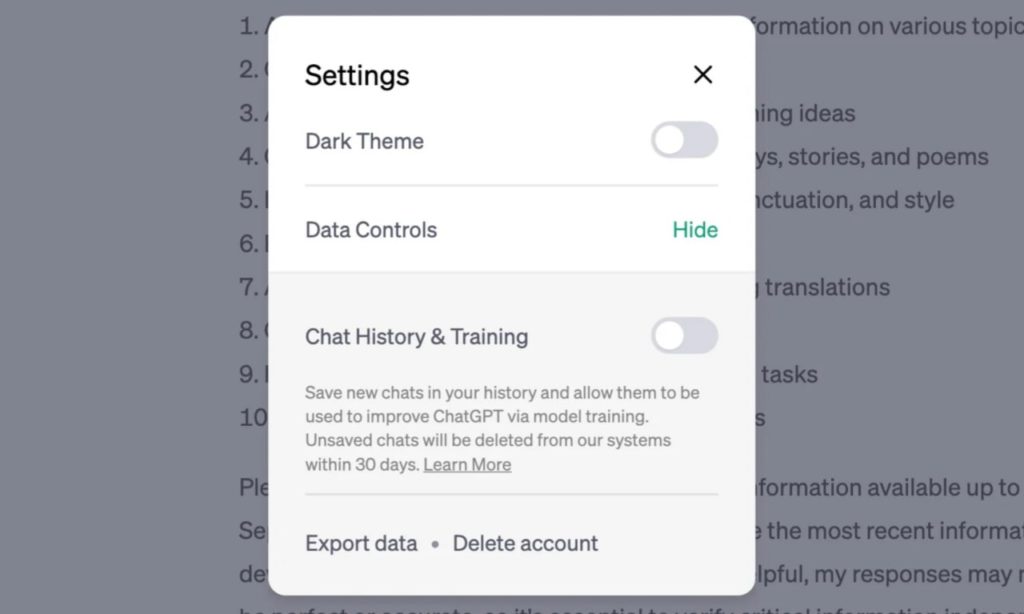
OpenAI noted that chats will be stored for 30 days and, if necessary, reviewed for abuse.
In addition to the new settings there is a simplified export option. The feature will let users email themselves copies of saved OpenAI information.
GitLab unveils assistant for writing code
The GitLab taught AI to explain potential vulnerabilities to developers.
The technology is based on a large language model. It will help programmers identify the best way to fix a vulnerability within the context of a codebase. In the future GitLab plans to teach AI to automatically fix encountered issues.
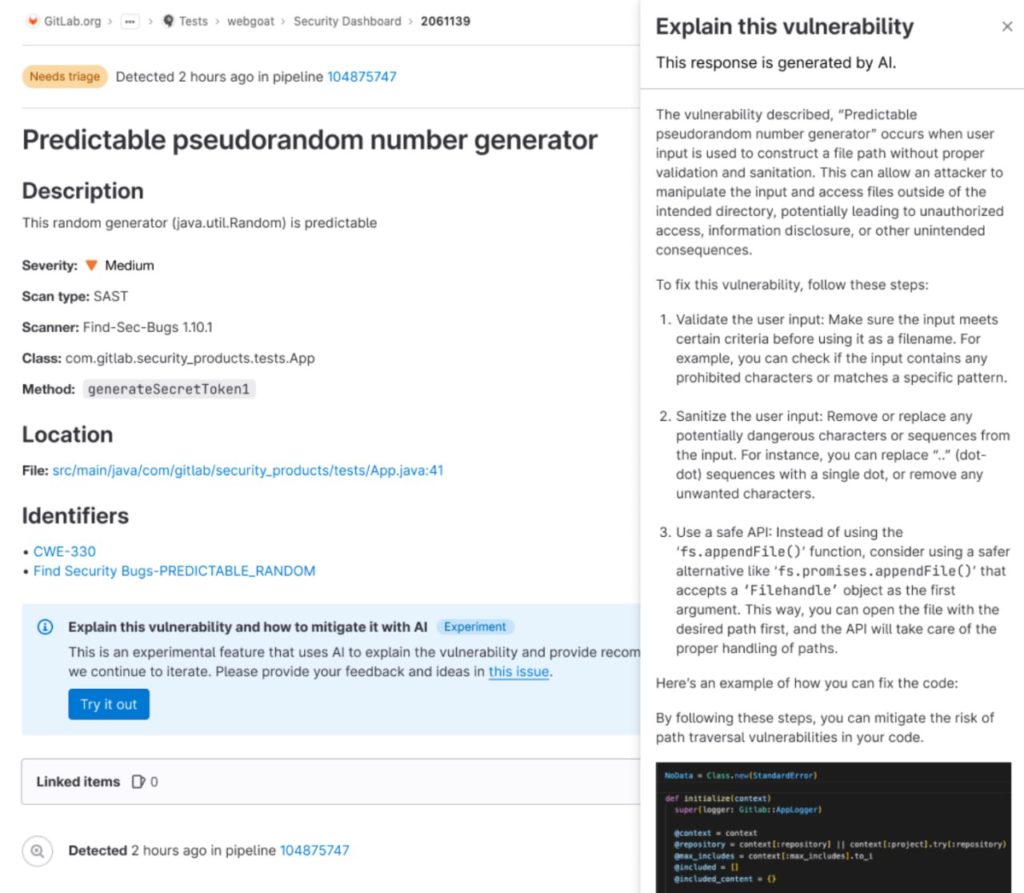
The company stressed that they built AI features with privacy in mind and do not plan to use customers’ personal data to train models.
According to Chief Executive David DeSanto, GitLab’s overarching AI goal is to tenfold the efficiency of developers and the entire software development lifecycle.
Grimes allows use of her voice for AI music synthesis
The singer Grimes proposed a 50% royalty on any successful AI-generated music using her voice.
I’ll split 50% royalties on any successful AI generated song that uses my voice. Same deal as I would with any artist i collab with. Feel free to use my voice without penalty. I have no label and no legal bindings. pic.twitter.com/KIY60B5uqt
— ?????? (@Grimezsz) April 24, 2023
The artist called the royalties split “the same deal as with any other artist she collaborates with.” Grimes granted AI creators a license to use her voice “without penalties” since she has “no label and no legal obligations”.
The artist added that she is developing a program capable of convincingly mimicking her singing. She also considers uploading stems and samples so people can train their own algorithms.
According to Grimes, it’s cool “to be merged with a machine.” The artist said she likes the idea of opening up the source code of all art and “killing” copyrights.
Spot learned to talk
Boston Dynamics’ Spot robot was taught to talk using ChatGPT and Google’s speech synthesizer.
We integrated ChatGPT with our robots.
We had a ton of fun building this!
Read on for the details: pic.twitter.com/DRC2AOF0eU
— Santiago (@svpino) April 25, 2023
According to AI expert from partner Levatas, Santiago Valda rama, in completing tasks the robots gather a data array, information from which was previously hard to obtain on request.
Now Spot can display configuration files and mission results, ask questions and receive a voice response.
RNC created dystopian AI-generated advertising
The National Committee of the Republican Party (RNC) used AI to create a dystopian political advertisement.
The spot responds to President Joe Biden’s 2024 election bid announcement. The video describes what allegedly could happen if he is reelected.
The RNC visualised some upcoming domestic and international events using AI-generated imagery. These include: a Chinese invasion of Taiwan, mass immigration waves at the US-Mexico border, and the complete collapse of civilization in San Francisco.
Researchers develop dancing AI animator
Researchers at Stanford University developed a dancing AI animator called EDGE.
The generative AI model can “bring to life” a character in step with any musical piece. It also allows editing specific parts of a dance sequence.
In the near future users will be able to upload their music and movements captured via a web camera into EDGE.
Experts launched the EDGE Playground website to demonstrate the capabilities of the dance-generation technology.
Student created an AI monocle
Stanford student Bryan Chang developed an AI monocle named RizzGPT to assist in maintaining dialogues.
The device attaches to glasses and listens to the user’s conversations. When a conversational partner asks a question, the system generates an answer and displays it over the lenses.
meet lifeOS: an operating system for your entire life ?
a personal AI agent delivered directly through AR smart glasses ?
it uses computer vision to ?️recognize?️ your friends’ face
then brings up relevant details to talk about based on your texts with them (memory?) pic.twitter.com/BgCuODV4k2
— bryan (@bryanhpchiang) April 10, 2023
To build RizzGPT Chang combined the GPT-4 algorithm, the Whisper speech recognition platform, and the open-source AR device Monocle.
He also developed LifeOS, trained on his personal messages, friends’ photos and other data. It can recognise familiar people and add local details to conversations with them.
Top AI deals of the past week
From 23 to 30 April 2023, AI startups raised over $154 million. Here are the most interesting deals.
- Pinecone, a creator of vector databases and semantic AI search technology, received $100 million.
- Haltian, an IoT devices and deployment services provider, raised $24 million.
- Hydrosat raised $20 million to develop thermal infrared satellites for real-time Earth data collection.
- AirOps raised $7 million to help companies build applications on top of large language models.
- Consensus AI, the creators of an AI search for scientific research, received $3 million.
Also on ForkLog:
- The US will study the use of AI for national security.
- Binance launched a ChatGPT-based chatbot in its online academy.
- The UK will allocate £100 million for a “sovereign” AI program.
- Google unveiled a package of AI tools for cybersecurity.
- Hugging Face introduced a competitor to ChatGPT.
- Nvidia released a tool for building safer language models.
- The EU AI Act will affect 19 platforms.
- Elon Musk discussed AI with Senator Chuck Schumer.
- The Biden administration was urged to accelerate AI regulation.
- Media: The EU will introduce rules for developers of generative algorithms.
- Tencent unveiled a platform for creating digital humans.
Рассылки ForkLog: держите руку на пульсе биткоин-индустрии!