


Stablecoins: the new petrodollar? How Trump reprises Nixon’s playbook
Throughout the election campaign Donald Trump repeatedly invoked bitcoin in his speeches. Now he is back in the White House and has indeed signed an order devoted entirely to digital finance.
Contrary to expectations, the document does not mention bitcoin; instead it assigns a special role to stablecoins in state strategy. Oleg Cash Coin examines what the US president has in mind.
January orders
Mr Trump’s team has persuaded a large part of the community that the new White House administration will create a favourable climate for the development of cryptocurrencies around the world. Business, it is expected, will get a fresh push, and the industry will penetrate the financial market more deeply, ultimately bringing prosperity and success to market participants.
Perhaps so. But before that happens, it is worth looking closely at what exactly Mr Trump’s team is emphasising, and how it understands cryptocurrencies. The long-awaited presidential order was published on January 23 on the White House website under the title “Strengthening American Leadership in Digital Financial Technology”.
The second clause of the document is devoted to “promoting and protecting the sovereignty of the US dollar, including through actions to globally facilitate the development and growth of regulated, dollar-backed stablecoins”.
This is reinforced by a ban on all forms of development and promotion of a central bank digital currency (CBDC). Together the two points signal an intent to clear the way for private stablecoins whose issuers buy up US Treasuries.
Elsewhere the order offers no clear guidance on other cryptocurrencies, including bitcoin. Although digital gold was clearly a flagship of campaign rhetoric, it is not singled out in the final document.
Nixon’s example
To understand the logic of Mr Trump’s team, recall 1971, when US president Richard Nixon ended the dollar’s link to gold. The American leader took such measures because of a relentlessly growing budget deficit and the colossal outlays on the Vietnam war.
Despite the “Nixon shock”, the dollar was preserved as the global currency for international settlements. Abandoning the gold standard allowed the government to print virtually unlimited quantities of money.
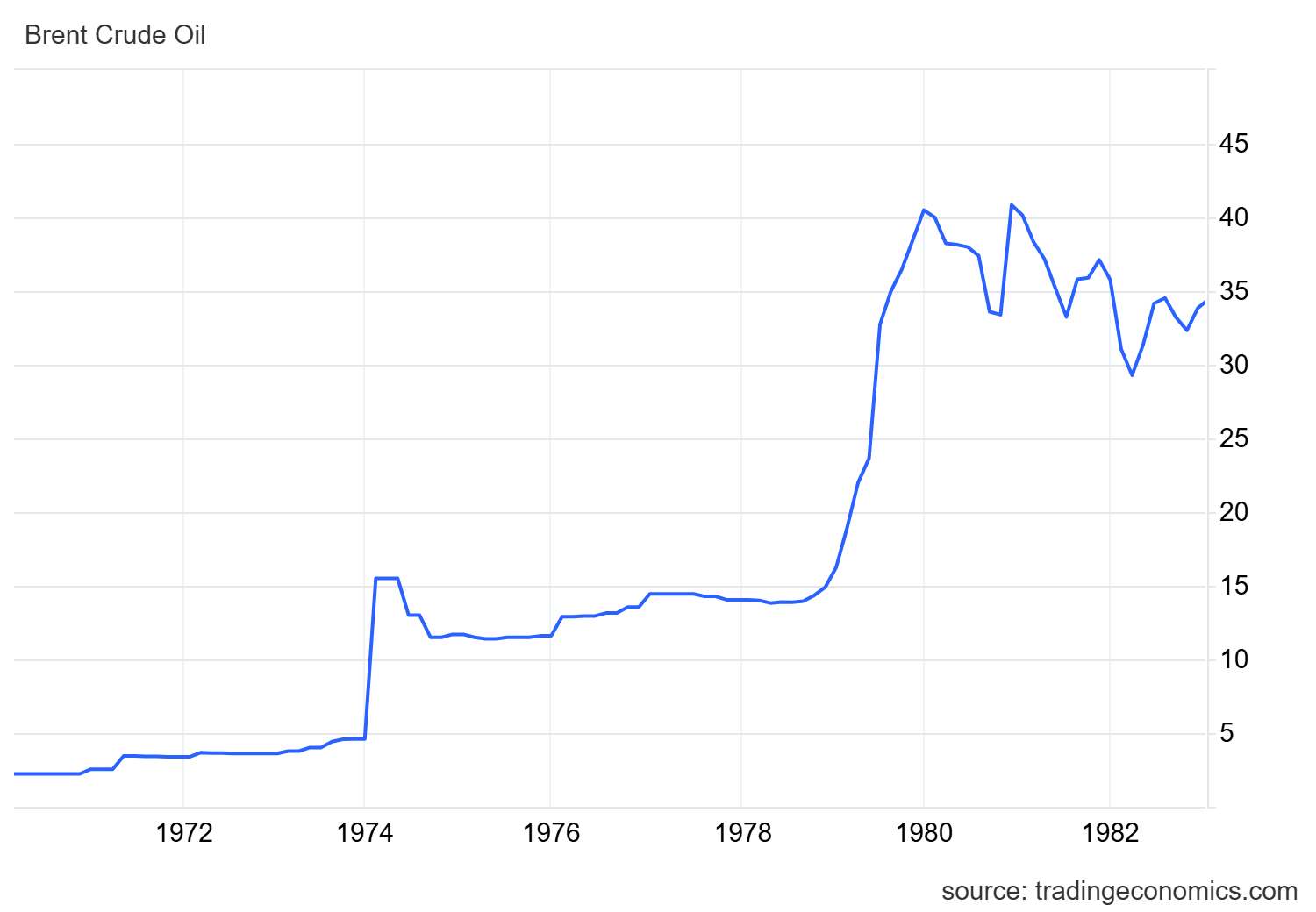
Ending the standard aggravated a powerful crisis in energy markets. In 1973 Arab states triggered it by imposing an embargo on oil supplies to countries that supported Israel in the Yom Kippur War. By 1974 prices for black gold had risen roughly sevenfold, and by the end of the decade twentyfold.
Already in 1973 the term “petrodollars” appeared, denoting the particular importance of the US currency in energy trade: the whole world needed oil, and it was being sold only for dollars. That gave the United States room to issue unlimited amounts of debt for which there would still be a queue.
Things spun out of control during the covid-19 pandemic. Since then US public debt has been steadily increasing by several trillion dollars a year. In parallel, demand for Treasuries has fallen as some market participants turn to alternative settlements. America’s leadership is facing economic problems reminiscent of 1971.
Oil, stablecoins, inflation
The key task for the government now is not to shrink public debt, but to raise demand for new obligations. And if you recall that Tether ranks among the top 20 largest buyers of US government debt, which it uses to issue USDT, the picture looks most convenient. Now the authorities of the world’s biggest economy say plainly that they support stablecoins around the globe—on one condition: that they are backed by dollars.
Of course, this is not quite the petrodollar of the 1970s, but the correlation is certainly there. Especially if you look at inflation, which rose from the 1960s to the 1980s after long years of stability following the second world war.
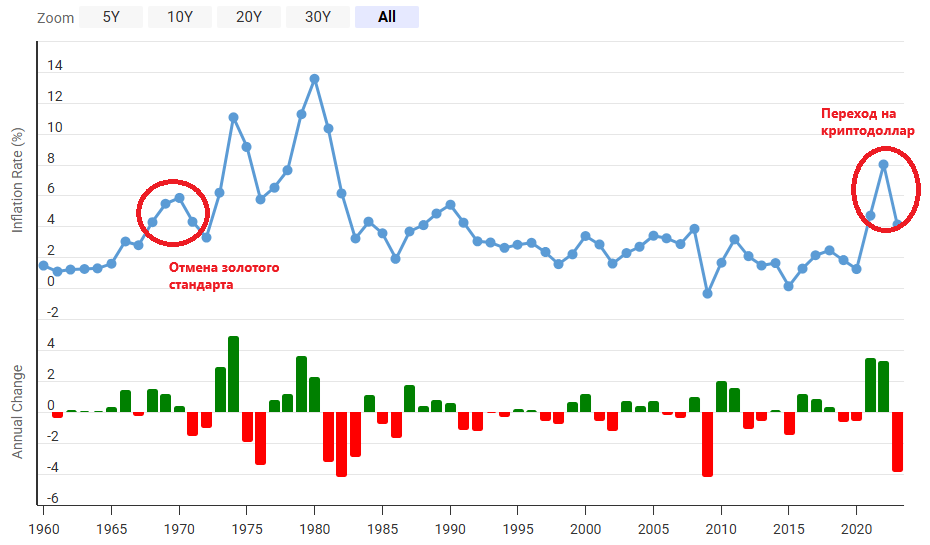
Officials, however, say this time is different. For example, former Federal Reserve chairman Ben Bernanke noted that today the American central bank has sufficient independence to take strategic decisions based solely on economic data, not short-term political considerations.
With Mr Trump’s return, however, the Fed may find itself highly dependent on officials. The US president has already said he understands monetary policy better than those who set it.
“I will demand an immediate reduction in interest rates,” Trump said on January 24 at the World Economic Forum in Davos.
Large firms began to plug into this trend in 2024. BlackRock is actively promoting the RWA concept across industries, even as specialist crypto experts argue that tokenisation is only valuable for debt obligations.
“With the exception of Treasury bonds, I believe that tokenised securities have virtually no value,” — said Ondo Finance CEO Nathan Allman.
Treasuries are exactly what the stablecoin market needs, which is essentially engaged in the following: buying, issuing tokens, earning interest and buying again. That can continue, if not indefinitely, then for a very long time. The approach has already proved its effectiveness: the issuers of USDT and USDC earned billions in 2024 alone. Imagine what will happen with full approval from US authorities.
Prospects for the crypto market
If history is any guide, another powerful crisis awaits, accompanied by a general rise in prices for globally significant goods, and a return to the dollar as the main transit unit between them.
Perhaps it will pass, and we will see a fairer financial system. For now, what is obvious is an attempt to create a new turn of prosperity for debt relations.
Strangely enough, cryptocurrencies have become the central element in the development of these ideas. Public debt still sits at the centre of the economy, and the distributed nature of blockchain allows this trend to be realised in full.
Рассылки ForkLog: держите руку на пульсе биткоин-индустрии!