



Stake or restake: XBANKING weighs the trade-offs—and raffles a Cybertruck
Restaking is a relatively new concept in crypto that began to gain traction in 2024 with the launch of EigenLayer. According to DeFi Llama, as of December more than $27bn is locked in restaking protocols.
Together with the non-custodial platform XBANKING, we compare the advantages and drawbacks of staking and restaking. At the end of the article: details of a Tesla Cybertruck giveaway.
XBANKING’s expertise
EigenLayer is one of the best-known restaking protocols and the largest by TVL. The XBANKING team, however, says it originated the restaking idea.
“Restaking is a concept first introduced by XBANKING. It is the first project to develop this idea and release products related to it. The idea of restaking is to redeploy liquid staking tokens to provide security and enable stakers (users) to earn rewards,” the blog of XBANKING says.
The project launched its restaking protocol in April 2024 with support for the Ethereum, Solana and The Open Network (TON) blockchains.
XBANKING offers passive income via staking and liquidity pools for 99 assets, including Aptos, Polkadot, Avalanche and Tron. The platform also provides a crypto savings service with yields up to 50% in USDT.
The project was audited by CertiK. A bug-bounty programme with rewards of up to $50,000 is also in place.
The @Certik audit confirmed XBANKING’s top-notch quality and security with a score of 74/100. But we’re not settling—we’re climbing higher! We’re now at 76.4/100, proudly ranking in the top 10% of DeFi projects. Discover more: https://t.co/frF8YcIL1N pic.twitter.com/1Sy7C95YmK
— XBANKING (@xbanking_org) November 26, 2024
The XBANKING ecosystem includes a token-farming platform for new projects, Launchpool, and an airdrop discovery tool, Airdrop Checker.
Staking versus restaking
Staking is participation in transaction validation on a blockchain that uses Proof-of-Stake (PoS) consensus. For producing new blocks and verifying data, users receive rewards as a percentage of the staked amount—or face penalties (slashing) for violating PoS consensus rules.
Staking rewards depend on the chosen blockchain and network activity. Current figures are available on analytics resources such as Staking Rewards.
“Staking offers a chance to earn stable passive income, but to maximise returns you need to decide upfront on the reliability and prospects of a blockchain,” XBANKING representatives comment.
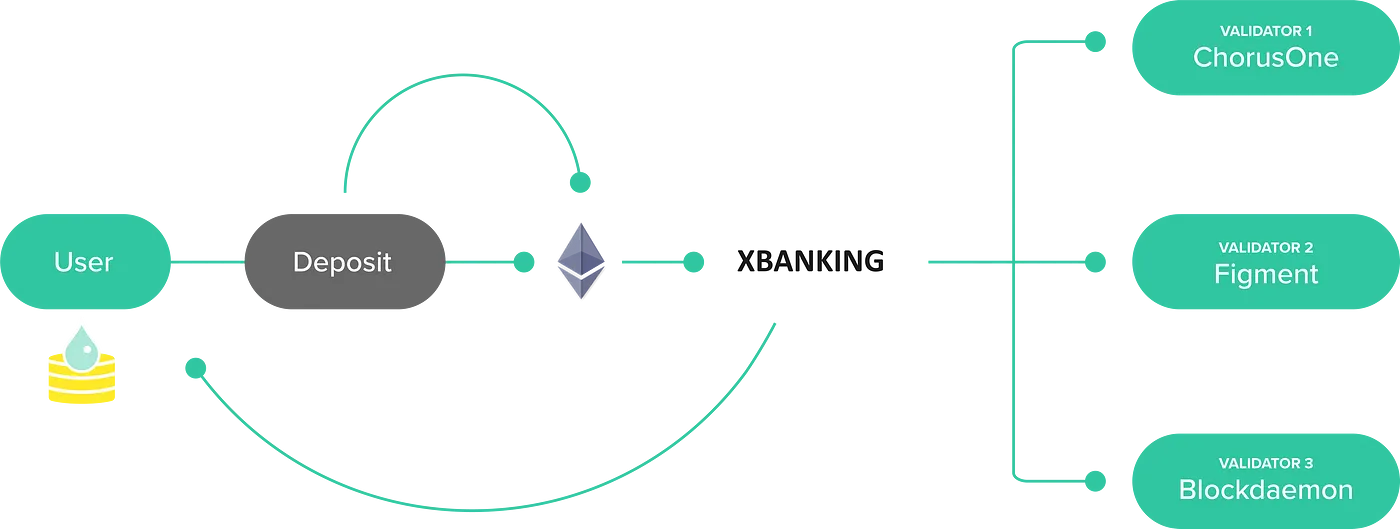
For Ethereum staking, for example, a user only needs to make a deposit on XBANKING. The platform allocates funds among validators and credits the user with staking yield.
Restaking has a more complex yield structure because it reuses a staked asset to provide crypto-economic security for other protocols.
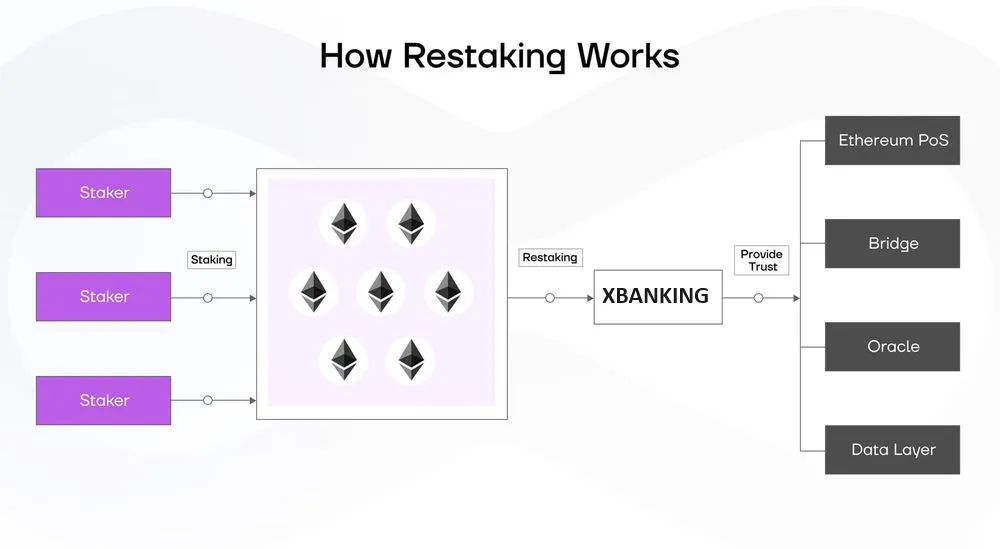
“The most notable advantage of restaking is that it helps avoid staking-related opportunity costs while earning additional rewards. Restaking lets AVS use the trust layer of the main Ethereum, Solana or TON network to secure oracles, bridges, sidechains and other projects,” the service’s representatives comment.
When assets are restaked, XBANKING acts as a decentralised trust marketplace that takes a share of AVS rewards. The project team flags the following risks of restaking:
- the possibility of inadvertent slashing due to a smart-contract error. As Ethereum’s trust is extended to other networks, this risk grows;
- collusion among operators (validators) to reuse the same asset in restaking to provide security and gain control over multiple networks. Operators could attempt an attack to take control of TVL in these networks;
- validator centralisation because some protocols require significant computing resources and operating costs for effective participation.
“The choice between staking and restaking is a textbook risk–return trade-off. PoS assets can be divided into three categories: storage, staking, restaking. Risks increase as you move from one category to the next: cold storage is safer than staking, and staking is safer than restaking. The same holds for potential returns: storage earns nothing beyond any fiat price appreciation; staking yields 3–5%, restaking 8% and above. The choice depends on your risk appetite,” XBANKING concludes.
A Tesla Cybertruck for staking XB
In early December, the XBANKING team announced a raffle of a Tesla Cybertruck and 200 SOL for staking XB, the platform’s native token.
To participate, stake at least 100 XB (~$45) on XBANKING by December 31, 2024. For every 100 XB, a user receives one ticket. The more tickets, the higher the chance to win.
“We thought long and hard about what gift to prepare for users of our platform and holders of XB tokens as a token of gratitude for supporting the project. And we decided to give away something grand!” XBANKING comments.
The organisers will determine the winning tickets at random on January 12, 2025, live on XBANKING’s YouTube channel. The team will announce the exact time on Telegram.
One winner will receive a Tesla Cybertruck. 200 SOL will be split among the holders of 100 winning tickets.
Conclusions
By late 2024, restaking had expanded beyond the Ethereum ecosystem and was developing actively in PoS networks such as TON and even in bitcoin. This method of earning yield, however, carries additional risks due to the complexity of the yield structure, and is therefore considered less secure than staking.
The choice depends solely on a user’s risk tolerance. The main thing is to choose a reliable platform for staking or restaking. Preference should be given to specialised services such as XBANKING.
Рассылки ForkLog: держите руку на пульсе биткоин-индустрии!