




In June 2024 the total value locked in DeFi protocols surpassed $100bn. Ethereum remains the leader and largest blockchain by this measure, with roughly a 60% share of the sector.
Its dominance stems from the relative ease of building and deploying smart contracts, applications and tokens. Yet some market participants reckon Ethereum’s monopoly could wobble in the coming years.
Competition in decentralized finance is intensifying between Vitalik Buterin’s project and bitcoin. Although bitcoin’s design offers limited programmability, the Taproot upgrade activated in 2021 opened new avenues for engineers.
For example, Lightning Labs, a firm focused on bitcoin’s functional evolution, shared its work. In late 2023 it unveiled the alpha version of Taproot Assets v0.3, a protocol that enables the issuance and management of stablecoins on the network of the first cryptocurrency.
The company argues that this type of coin is a universal asset for exchange and capital storage among users in developing countries—potentially a key catalyst for crypto-market growth. That, in turn, should benefit bitcoin-based DeFi applications.
“It is no longer a ‘no-frills’ blockchain where nothing happens apart from holders keeping BTC,” — said Bernstein analysts.
The experts also compared bitcoin’s network to Ethereum in 2020, when a flood of DeFi applications and tokens drove broader liquidity and higher transaction fees.
Why are miners interested in bitcoin DeFi?
On April 20, 2024, the fourth bitcoin halving took place. The reward for a mined block fell from 6.25 BTC to 3.125 BTC, halving miners’ revenue. They still, however, earn from transaction fees.


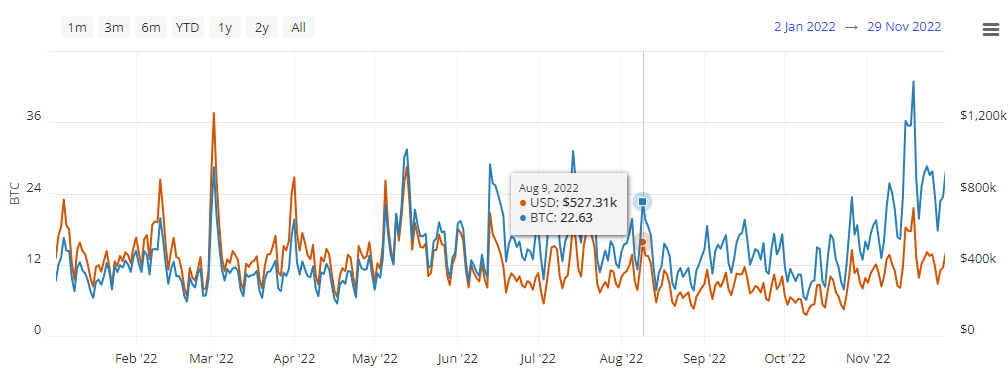
For instance, for most of 2022 daily fee income oscillated between 6 and 20 BTC (up to $720,000 a day at a $36,000 price). By comparison, in the same year Ethereum miners earned about 500 ETH a day in fees—roughly $1m at $2,000 per coin.
The picture changed in early 2023 with the release of the Ordinals protocol, which enabled token issuance on bitcoin, and with the introduction of Runes in late 2023. These experiments made it possible to mint fungible and non-fungible tokens on bitcoin, drawing in speculators. Hype around NFTs and memecoins pushed transaction fees sharply higher.


At the peaks of activity in these protocols—in late 2023 and just before the halving on April 20th 2024—miners’ daily fee revenue exceeded 540 BTC and 1,200 BTC, respectively.
In short, rising on-chain activity and demand for transactions materially increase miners’ income, creating clear incentives to develop DeFi atop the main cryptocurrency.
According to the managing partner of venture firm Dragonfly, Haseeb Qureshi, bitcoin miners hold vast troves of BTC that could be directed into DeFi.
One example is Marathon Digital Holdings, America’s largest publicly listed miner. In late February 2024 it presented Anduro, a bitcoin L2 network, and announced two sidechains on top of it:
- Coordinate, designed to provide a “cost-effective UTXO stack” for the Ordinals community;
- Alys—an Ethereum-compatible protocol for asset tokenization.
The company plans to use merged mining to earn additional income from processing transactions. A similar approach is used in LTC and DOGE via AuxPoW, a method intended to improve resistance to 51% attacks.
Where is bitcoin DeFi heading?
The largest bitcoin DeFi market remains the BTC micropayments network—Lightning Network (LN). In March 2024 network capacity reached a record $312m.
Adoption of bitcoin as a means of payment remains sluggish, likely because stablecoins are more convenient for users. Even so, several firms are building “stable” coins atop bitcoin. Taro, a protocol from Lightning Labs, is designed to issue stablecoins and other assets on the first cryptocurrency’s network.
Some in the market are betting on a different DeFi segment: staking.
Back in late 2023 analysts at Vaneck noted that locking bitcoin in Lightning Network could open new options for passive income.
Because bitcoin uses Proof-of-Work, holders of digital gold cannot stake natively. Synthetic approaches to the idea are now emerging.
In late May 2024 the first notable steps appeared. Babylon raised $70m to build a bitcoin staking application. Its developers want to use the first cryptocurrency for “staking” in Proof-of-Stake blockchains.
And startup Arch, which raised $7m in a round led by Multicoin Capital, is working on porting applications from Solana to bitcoin. According to Arch’s CEO Matt Mudano, around 20 developer teams are already building stablecoins, lending protocols on Ordinals and decentralized exchanges.
Also noteworthy is the RWA trend on bitcoin and Bitfinex’s efforts in this direction. In April 2024 tokenized-assets platform Bitfinex Securities issued debt to finance construction of a Hampton by Hilton hotel in El Salvador as a token on the Liquid Network sidechain.
DeFi Llama showed that from 2024 investment into bitcoin DeFi has multiplied. At least 17 startups have raised more than $100m.


The combined TVL in bitcoin-based DeFi amounted in June 2024 to just 1% of the overall market. Even so, there is broad interest in building “on top of” the main cryptocurrency—from familiar BTC micropayments to experimental routes for earning passive income via staking.
All these experiments could draw attention to bitcoin’s base layer which, as Runes and Ordinals have shown, pushes network fees higher. For now, this path for the first cryptocurrency looks a logical scenario—one being pursued not only by miners but also by crypto venture firms.
Text: Oleg Cash Coin