




Apple, X, Airbnb, and Google are in preliminary discussions with crypto companies about integrating stablecoins, according to Fortune, citing its own sources.
The companies are considering the adoption of these assets as a means to reduce transaction costs and optimize international payments.
Recent catalysts for the tech giants’ serious interest in the technology, as noted by the publication, include:
- the advancement of the GENIUS Act, a bill regulating “stablecoins,” in the US Congress;
- the acquisition of the infrastructure platform Bridge by payment company Stripe for $1.1 billion.
“[Stablecoins] are an old idea, but I think we’ve finally put all the necessary elements together, and now it’s really bearing fruit,” commented Chris An, a partner at venture firm Haun Ventures and one of the first investors in Bridge.
Rich Widmann, head of Web3 strategy at Google Cloud, confirmed that the company is exploring stablecoin integration. He described the technology as “the biggest update in payments since the advent of the SWIFT network.”
According to him, the cloud service has already processed two test transactions from clients in PYUSD from PayPal.
Airbnb stated that they do not plan to integrate crypto payments in the near future but are exploring all possible aspects of improving community interaction, including “developments in digital assets.”
According to Fortune’s sources, the short-term rental aggregator has been in talks about using stablecoins with Worldpay. The company hopes that the technology will reduce processing costs for Visa and Mastercard transactions.
Elon Musk’s social media platform X is considering integrating stablecoins into its payment service X Money, with Stripe mentioned as a potential partner.
According to the publication, Apple representatives have at least communicated with Circle’s senior director Matt Kevin. Among the top manager’s areas of work at the USDC issuer are strategic partnerships in payments.
The Stablecoin Segment Grows and Institutionalizes
In early June, the capitalization of “stablecoins” surpassed the $250 billion mark for the first time.
At the time of writing, USDT from Tether dominates the segment with a figure exceeding $154 billion, while USDC stands at $61 billion.


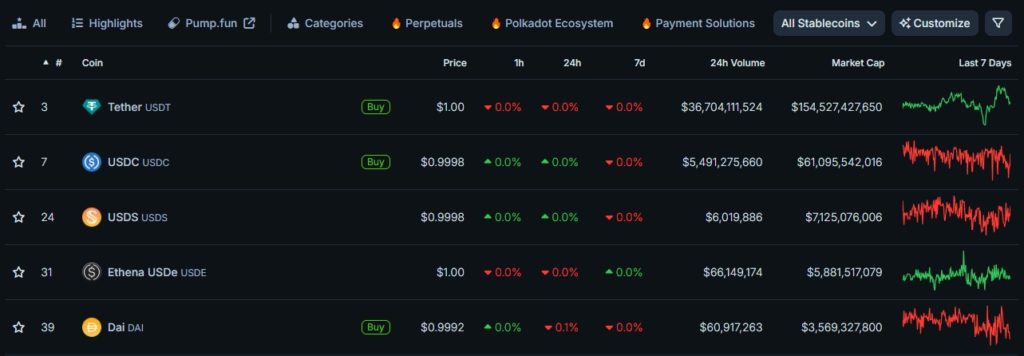
Hank Huang, CEO of Kronos Research, called the crossing of the quarter-trillion-dollar threshold a “turning point,” noting that “stablecoins are no longer an experiment but a necessity.”
He predicts that the market could double by 2026, with new players like the USD1, associated with former US President Donald Trump, potentially challenging the leaders.
According to media reports, a consortium of major US banks is in talks about jointly issuing a stablecoin. Participants include JPMorgan Chase, Bank of America, Citigroup, Wells Fargo, and others.
Fortune’s sources noted that one of the challenges for tech giants is choosing a coin for integration. Tether faces regulatory compliance issues in the United States. The company’s head, Paolo Ardoino, recently confirmed that the issuer is primarily focusing on developing markets.
Circle went public on June 5, and there are questions regarding the future owner of the firm.
Other coins in the segment, such as PYUSD, significantly lag behind the leaders in market adoption.
In March, FT journalists concluded that a “stablecoin race” had begun among the largest global banks and fintech companies.
Some institutions intend to launch their own tokens in a bid to capture a share of the growing segment. Among them could be the American investment giant Fidelity Investments, the Dutch bank ING, and the Japanese corporation Sumitomo Mitsui Financial Group under the management of SMBC.
Visa joined the USDG “stablecoin” consortium, created in 2024. Its competitor Mastercard partnered with Circle, Paxos, and Nuvei to integrate payments in fiat-pegged coins.
In the tech segment, Meta revisited the idea of implementing the technology. Three years ago, Facebook and WhatsApp’s parent company abandoned the Diem (formerly Libra) project due to regulatory pressure.
According to Standard Chartered’s estimate, stablecoin capitalization will reach $2 trillion by 2028. This aligned perfectly with the forecast from the US Treasury.