




On bitcoin’s weekly chart, the price fell below the 100-WEMA after slipping under $85,000. This signal has previously preceded a steep decline, noted analyst Ted Pillows.
$BTC has always retested 200W EMA after losing 100W EMA.
200W EMA currently sits at $68,400. pic.twitter.com/plIDepViox
— Ted (@TedPillows) February 4, 2026
He estimates the price could drop to the 200-WEMA around $68,400.
At the time of writing, bitcoin trades around $76,100, having slightly recovered after a drop to $73,000.


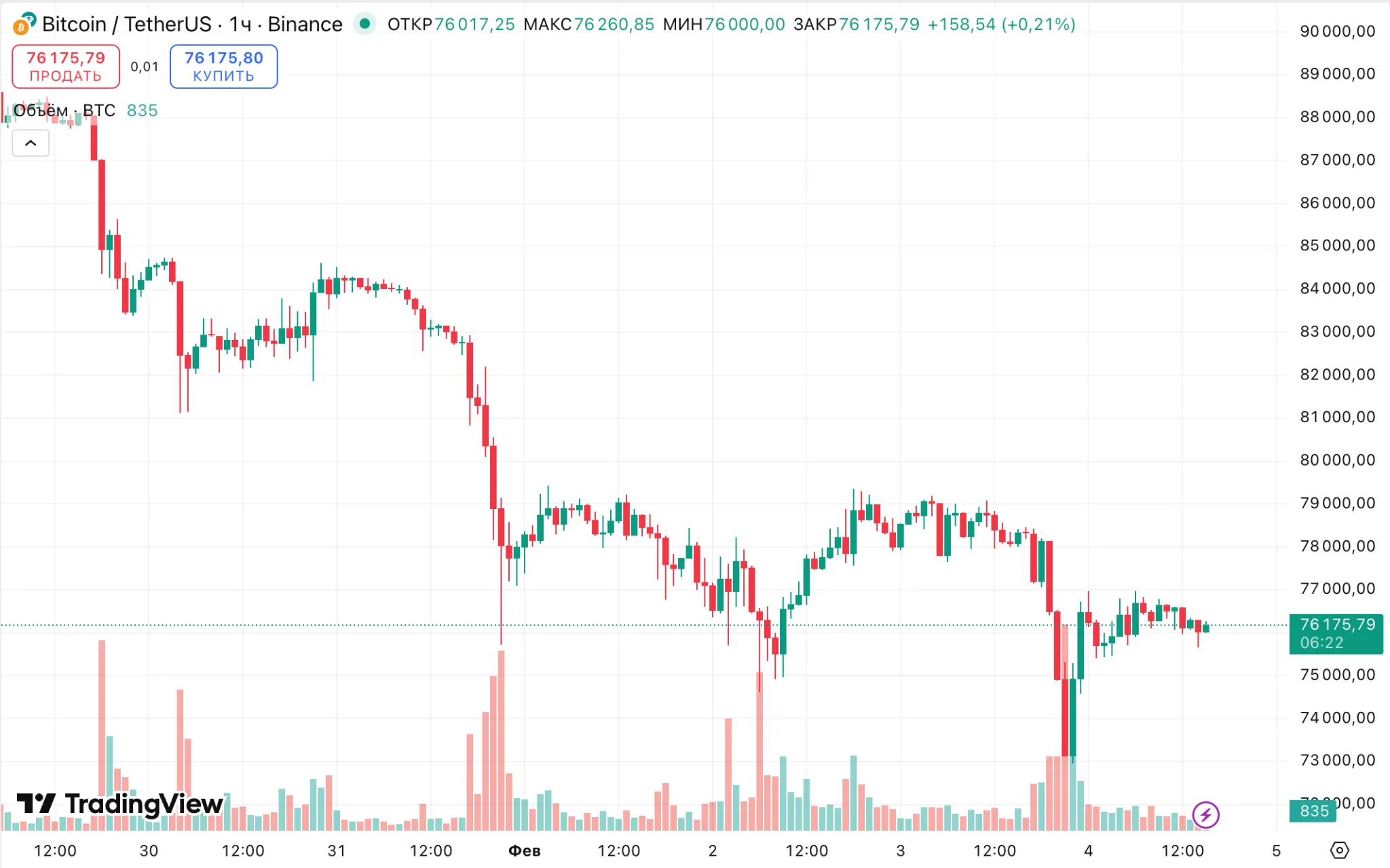
Over the past 24 hours, the price fell 2.9%; it is down 14.8% over the week.
An analyst going by Quinten called the current cycle “the most disappointing” in bitcoin’s history.
Most disappointing cycle in history pic.twitter.com/VvDa5fwewG
— Quinten | 048.eth (@QuintenFrancois) February 4, 2026
As the chart shows, after the 2012, 2016 and 2020 halvings, bitcoin mostly trended higher. Since April 2024, the pattern has been the opposite.
The analyst also pointed to record oversold conditions — the reading fell below levels seen during the COVID-19 crash.
Bitcoin is MORE oversold than during the COVID crash 🚨 pic.twitter.com/hCpz9uOMFN
— Quinten | 048.eth (@QuintenFrancois) February 3, 2026
Some believe bitcoin faces an even deeper correction in the coming days.
An analyst known as BitcoinHabebe called a slide toward the head-and-shoulders target at $60,000 “expected,” citing a number of macroeconomic factors.
An analyst under the pseudonym 0xLanister forecast an even deeper drop. In his view, the emerging chart pattern presents an “extremely alarming picture.”
Very scary picture: if this technical analysis figure “head and shoulders” works — Bitcoin price will drop to $40,000
It seems that Binance and CZ provoked a bear market in crypto. Again. pic.twitter.com/LukyEQ1vp9
— 0xLanister (@0xLanister) February 4, 2026
“The price of bitcoin could fall to $40,000,” he noted.
Earlier, an analyst known as Brett flagged a possible correction to this level.
New risks
QCP linked bitcoin’s latest rebound to the removal of the threat of another US government shutdown. The House of Representatives approved a $1.2 trillion funding package by a narrow margin.
The shutdown-related pressure has eased, but only temporarily, the firm stressed. Funding for the Department of Homeland Security was extended only until 13 February, creating a potential “trap” with a new deadline in the near term.
Tensions around the Fed have also risen. President Donald Trump’s nomination of Kevin Warsh as Federal Reserve chair has brought to the fore risks tied to a potential shift in the regulator’s policy stance.
If investors start to expect a more aggressive rate-cutting cycle in the second half of the year, that could lend limited support to risk assets and pressure the dollar.
But the focus will shift to the Fed’s balance-sheet policy. Warsh is known as a proponent of quantitative tightening (QT).
“Warsh has made clear his preference for a faster balance-sheet run-off, which directly affects the repo market. An unpleasant reminder: when reserves become scarce in the ‘wrong’ places, stress can surface abruptly,” the analysts warned.
Cautious sentiment
The options market confirms a broadly cautious mood. Key indicators suggest investors are bracing for elevated volatility in the near term:
- high short-term volatility: implied volatility remains elevated despite a local price bounce;
- term-structure shift: short-dated options priced richer than long-dated ones — a classic sign the market sees near-term risks as elevated;
- crash protection in demand: a sharp skew toward puts, and strategies geared to outsized moves remain expensive.
From a technical standpoint, $75,000 is a key psychological and technical level for bitcoin, QCP said.
If the price holds above that mark and related indicators (for example, funding rates in futures markets) normalise, that would set conditions for rebuilding positions and could be read as a signal to add risk selectively.
“If the level is broken, investor sentiment could quickly turn defensive,” the experts concluded.
Earlier, Bitwise CIO Matt Hougan said the current market downturn is closer to the end than the beginning.