



Tesla’s Robotaxi App, Apple’s Open Language Model, and Other AI Developments
We aim to keep our readers informed not only about events in the bitcoin industry but also about developments in related technological fields such as cybersecurity and artificial intelligence.
ForkLog AI has compiled the most important AI news from the past week.
- Tesla unveiled an app for summoning robotaxis.
- Qualcomm introduced the Snapdragon X Plus chip for AI laptops running Windows.
- Apple released the open-source language model OpenELM, capable of local operation.
- Adobe showcased AI for enhancing video quality.
- The head of Nvidia delivered the first DGX H200 accelerators to OpenAI.
- Ads for “AI girlfriends” flooded Facebook and Instagram despite Meta’s rules.
Tesla Unveils Robotaxi App
Tesla demonstrated what its robotaxi service will look like. At an investor meeting, Elon Musk referred to this service as Cyber Cab.

He showcased mockups of the upcoming feature, where users can “summon” a ride from the Tesla app. The service appears similar to Uber, with the option to remotely set the car’s temperature before it arrives.
According to Musk, Tesla owners will be able to make their cars part of the service and set rules for their use. Additionally, the company will maintain its own fleet of robotaxis.
Earlier in April, Musk promised to unveil Tesla’s robotaxi on August 8.
Tesla Robotaxi unveil on 8/8
— Elon Musk (@elonmusk) April 5, 2024
Qualcomm Introduces Snapdragon X Plus Chip for AI Laptops with Windows
Qualcomm announced the Snapdragon X Plus processor for entry-level laptops and revealed details about the Snapdragon X Elite chips. These will form the basis of what Microsoft calls the AI PC.
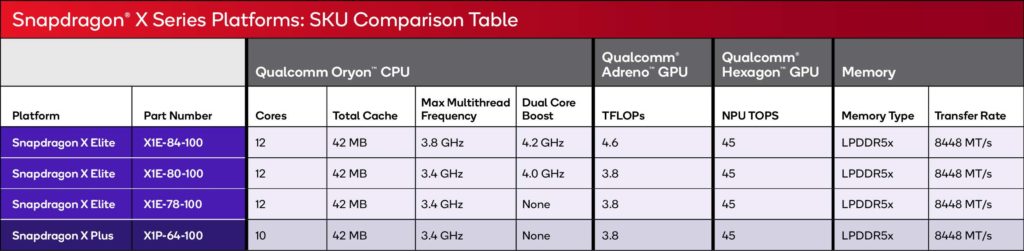
The Snapdragon X Plus features a 10-core processor with a maximum frequency of 3.4 GHz, LPDDR5x memory support, an Adreno graphics accelerator with 3.8 TFLOPS performance, and a neural processor at 45 TOPS. According to Qualcomm, the latter will enable running generative AI models directly on the device.
The 12-core Snapdragon X Elite lineup includes three modifications. The maximum frequency reaches 3.8 GHz, and the integrated graphics performance is up to 4.6 TFLOPS. All three models have the same neural processor and support the same LPDDR5x memory as the Snapdragon X Plus. Two of them feature Dual-Core Boost, dynamically increasing the frequency to 4.2 GHz under high loads.
The first Windows laptops with Qualcomm processors will be announced next month. The new models are expected to hit retail in the second half of 2024.
Apple Releases OpenELM Language Model Capable of Local Operation
Apple released the OpenELM language model, capable of processing user queries directly on the device without cloud connectivity.
There are eight configurations with varying numbers of parameters, ranging from 270 million to 3 billion. The models were pre-trained on public datasets totaling 1.8 trillion tokens from sites like Reddit, Wikipedia, and arXiv.org.
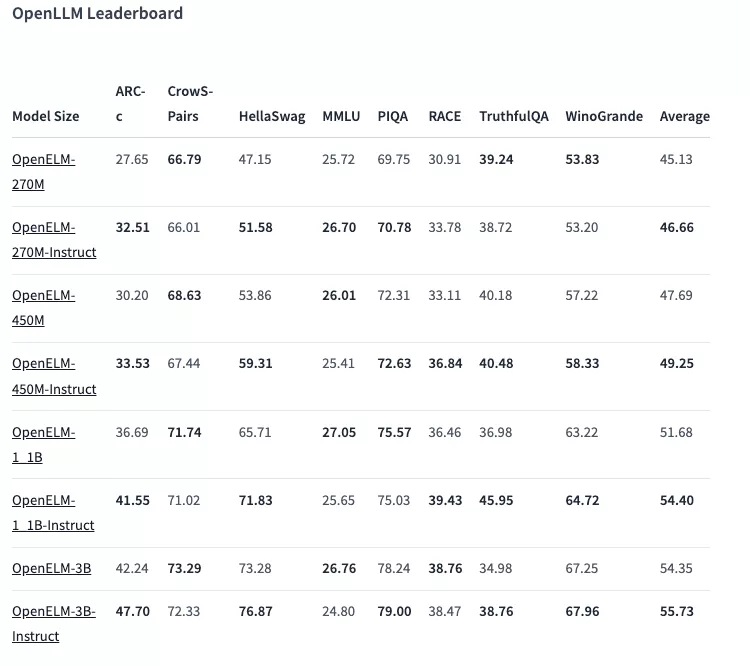
According to Apple, the models’ performance is comparable to competing solutions, especially the 450 million parameter instruction variant. Additionally, the OpenELM version with 1.1 billion parameters surpasses OLMo-1.2B by 2.36%, requiring half the data for pre-training.
In the ARC-C benchmark for knowledge and reasoning ability, the pre-trained OpenELM-3B variant achieved 42.24% accuracy. Its results on MMLU and HellaSwag were 26.76% and 73.28%, respectively.
Adobe Showcases AI Model for Video Quality Enhancement
Adobe introduced an experimental AI model, VideoGigaGAN, capable of increasing video sharpness and detail eightfold without typical artifacts like flickering or distortion.

Previous video super-resolution (VSR) models struggled to generate detailed clips. Therefore, Adobe combined several technologies:
- “temporal attention” to reduce accumulating artifacts;
- feature propagation for adding details;
- smoothing;
- “high-frequency shuttle” for moving fine details.
It is currently unknown whether Adobe plans to integrate VideoGigaGAN into its products or if it will remain an experimental feature.
Nvidia Chief Personally Delivers DGX H200 AI Accelerators to OpenAI
Nvidia founder and CEO Jensen Huang personally delivered the first DGX H200 AI accelerator to OpenAI’s office in San Francisco. The event was attended by the startup’s president Greg Brockman and CEO Sam Altman.
First @NVIDIA DGX H200 in the world, hand-delivered to OpenAI and dedicated by Jensen “to advance AI, computing, and humanity”: pic.twitter.com/rEJu7OTNGT
— Greg Brockman (@gdb) April 24, 2024
The DGX H200 is Nvidia’s latest and most advanced processor for artificial intelligence. Key improvements include a 1.4x increase in memory bandwidth to 4.8 TB/s and a 1.8x increase in memory capacity to 141 GB. These features are due to the use of HBM3e memory, which provides faster and more efficient data processing.
The enhanced computational power of the DGX H200 is critical for training large and complex AI models, especially generative systems that create new content: text, images, predictions, and more.
Waymo’s Self-Driving Car Goes Against Traffic to Avoid Unicyclists
A Waymo self-driving car in San Francisco attempted to bypass a column of unicyclists and ended up in the oncoming lane. The incident occurred on April 19 around 9:30 PM local time.
The footage shows a crowd of unicyclists crossing an intersection, with the Waymo taxi following them. Initially, it stayed in the right lane but then shifted left, trying to overtake or avoid the people. As a result, the robotaxi ended up in the oncoming lane.
After some time driving in the wrong lane, a unicyclist moved in front of the car, forcing it to stop. The crowd cleared the way, and the Waymo returned to the right lane.
The company claims the car moved into the oncoming lane for safety reasons. The system detected a potential fallen person in the crowd and decided to cautiously bypass the obstacle via the free lane. Waymo promised to learn from this incident.
Ads for “AI Girlfriends” Flood Facebook and Instagram Despite Meta’s Rules
Ads for “AI girlfriend” apps have flooded Facebook and Instagram. They often offer explicit images and texts, which are prohibited by Meta’s rules.
Journalists found tens of thousands of such ads. Some openly advertised adult content generated by AI. Others positioned themselves as “virtual companions” for conversations on any topic.
Meta stated that it is combating such publications and removing questionable ads. The company also continues to improve systems for detecting prohibited content.
Meanwhile, representatives of the sex industry pointed out Meta’s double standards. While Facebook and Instagram ban workers from posting similar content, the company allows AI companion developers to exploit model images.
Tupac Shakur’s Estate Threatens Drake with Lawsuit Over AI Track
Rapper Drake found himself at the center of a scandal over the track Taylor Made, which uses synthetic voices of hip-hop legends Snoop Dogg and Tupac Shakur.
The latter’s estate claimed that no permission was sought to create an AI copy of the late artist’s voice, and they would never have approved it. Lawyers demanded the track be removed from the internet within 24 hours, or they would take Drake to court.
As a result, the rapper removed the controversial track from his Instagram page. This likely confirms suspicions that he used artificial intelligence to synthesize Shakur’s voice.
This is not the first time the Canadian rapper has been embroiled in a scandal involving AI in music. A few weeks ago, a track allegedly recorded by Drake leaked online, though it was clearly AI-generated.
Also on ForkLog:
- Leading AI developers pledged to check datasets for CSAM materials.
- Coca-Cola will spend $1.1 billion on Microsoft’s cloud and AI services.
- Nvidia acquired the startup Run:ai. The estimated deal value is $700 million.
- Meta announced billion-dollar investments in AI.
- Media: Elon Musk’s xAI raised $6 billion, and social network X became a shareholder.
- Microsoft reported a shortage of cloud infrastructure for AI.
Weekend Reading Suggestions
ForkLog explored how Proof-of-Personhood is used in Web3 to protect against Sybil attacks and AI abuse.
Рассылки ForkLog: держите руку на пульсе биткоин-индустрии!