




The Tezos blockchain team has activated its milestone 20th protocol upgrade, named Tallinn.
Tallinn, the 20th Tezos protocol upgrade is live.
⚡ 6s blocks → lower latency, 12s L1 finality
🛡️ Once ≥50% tz4: all bakers attest every block → stronger security, more predictable rewards
🗂️ Address Indexing Registry → up to 100x gains in storage efficiency pic.twitter.com/EDAbpD6mbh— Tezos (@tezos) January 24, 2026
The upgrade was developed by experts from Nomadic Labs, Trilitech, and Functori.
The main changes to the network include:
- reducing the block interval from eight to six seconds;
- validation of each block by all bakers;
- an address indexing registry.
The reduction in block time has enabled first-level finality in 12 seconds. Developers noted that this solution maintains a low entry threshold for network validation in terms of hardware requirements.
The option for all bakers to validate blocks, rather than just a portion, is based on the BLS signature scheme used in tz4 addresses. This change will take effect once 50% of validators switch to the new format.
The address indexing registry allows for up to a 100-fold reduction in storage volume for enterprise applications in the Michelson execution environment. This is achieved by eliminating redundant address information in smart contracts. The team noted that widespread adoption of this feature will increase the network’s potential throughput.
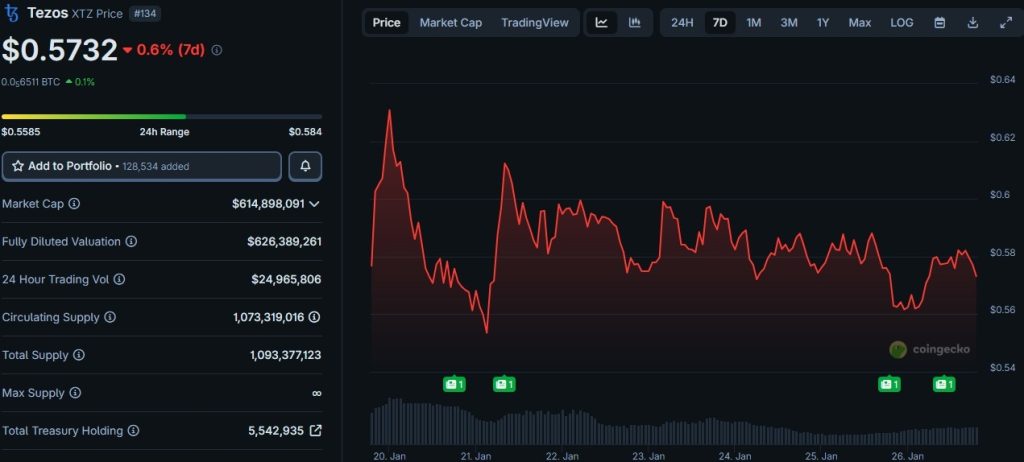
The native token XTZ’s price remained unaffected by the latest Tezos upgrade. Amid overall market volatility, the asset is trading at around $0.58 with a market capitalization of approximately $615 million. The price is nearly 94% below its all-time high of $9.12 reached in October 2021.


According to DeFiLlama, the total value locked in the protocol is $35.2 million. The synthetic assets platform Youves ($26.7 million) and the decentralized exchange Sirius ($5.9 million) dominate this figure. Another ~$1.3 million is attributed to the stablecoin Kolibri, issued against debt positions in XTZ.
Back in March 2025, Tezos co-founder Arthur Breitman identified the lack of “fundamentality” as a key risk for cryptocurrencies.