


The Allure of Greed: Why Decentralized Social Networks Have Yet to Succeed
Analysts explained why Farcaster and Lens failed to retain users.
Decentralized social networks (DeSoc) remain a niche product, unable to compete with traditional platforms. Experts interviewed by The Block attribute this to the industry’s skew towards monetization, which has overshadowed the value of genuine interaction.
The Pitfall of Financial Incentives
Jakub Rusecki, a researcher at 1kx and co-founder of Social Graph Ventures, noted that early Web3 projects attracted audiences primarily through financial incentives. However, these platforms failed to retain users due to a lack of quality content and genuine social connections.
Lex Sokolin, managing partner at Generative Ventures, described this approach as a “systemic error.” He stated that the industry mistakenly believed that introducing tokenomics would automatically enhance the social product.
“Platforms like TikTok, Instagram, and X have established such a strong connection with their audience that it is impossible to lure them away with speculative game mechanics,” he explained.
Alan Lau, Chief Commercial Officer of Animoca Brands, added that the focus on earning reduces content quality. This deters the mass audience, which values genuine interaction over financial gain.
Artificial Activity and UX Challenges
Brandon Kae, an analyst at The Block, described any visible activity on DeSoc platforms as artificial, driven by airdrops and other incentives rather than organic demand.
“Users do not migrate to platforms for ideological reasons. They want the app to be ‘interesting’ and for their friends to already be there,” he emphasized.
However, not only financially incentivized social networks remain niche. Open platforms like Bluesky and Mastodon have also failed to achieve widespread adoption.
David E., co-founder of Social Graph Ventures, explained this as a cultural gap. He noted that many developers in this field were “strong technologists but lacked social DNA.”
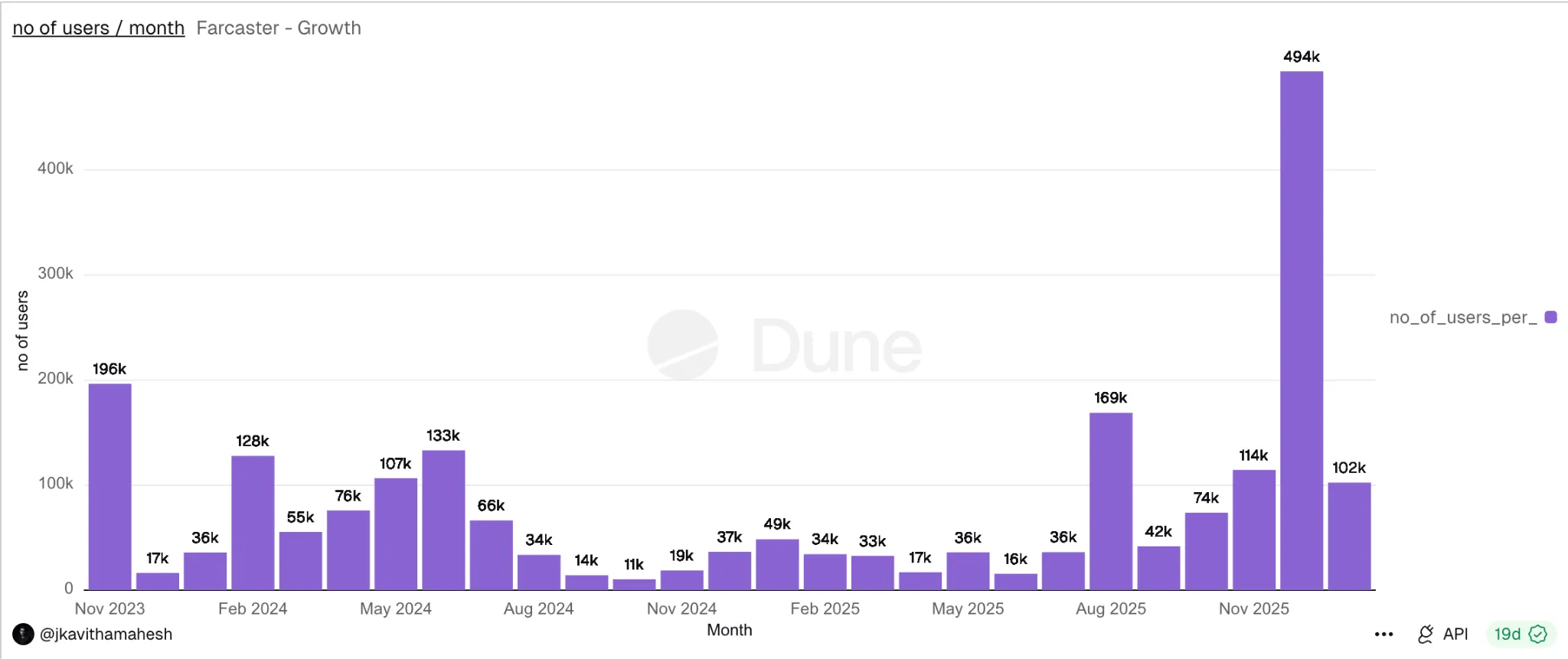
Farcaster and Lens have not achieved viral growth or high user retention. Without active brand engagement, working monetization models for creators, or short-form promotion mechanics, the critical “flywheel” has not been set in motion.

Creating a full-fledged advertising and creator economy on the blockchain is theoretically possible, but “orders of magnitude more complex” than in the established Web2 ecosystem, an expert stated.
Dmitry Kulechov, General Partner at Symbolic Capital, identified three key technical barriers:
- complex onboarding (requiring a wallet, gas fees);
- fragmented user experience;
- lack of Web2-level applications.
He noted that even the basic infrastructure has long been constrained by scalability issues.
The Future of DeSoc
Opinions on the prospects of decentralized social networks vary.
Optimists believe the next phase will focus on the product. Kulechov sees the solution in combining open infrastructure with user-friendly execution.
According to the expert, DeSoc projects will achieve mass adoption in the coming years if they become intuitive and straightforward.
David E. links a potential breakthrough to rethinking monetization mechanisms. He argues that decentralized social networks will not scale until they offer an alternative to the Web2 advertising economy.
He cited protocol auctions as an example, where brands compete directly for user attention, and revenue is fairly distributed between creators and the platform. If successful, social accounts could become assets generating cash flow.
“We do not believe the DeSoc/SocialFi narrative is dead, but the first phase is definitely over. The next iteration will require seamless UX, organically integrated monetization, and blockchain features that are invisible to the average user,” Lau also emphasized.
As AI content develops, digital ownership and verifiable trust may become key values, he added.
However, skeptics remain steadfast. Sokolin described current experiments in DeSoc as a “dead end”: financial functions have not improved user experience, and the network effects of Web2 giants remain insurmountable.
Even appealing concepts like portable identity and content ownership have failed due to a lack of proper incentives. The expert believes that DeSoc “will not return” in the foreseeable future.
Back in January, Ethereum co-founder Vitalik Buterin announced a full transition to decentralized platforms. He emphasized the need to create fundamentally new tools for mass communication.
Рассылки ForkLog: держите руку на пульсе биткоин-индустрии!