




The hype around the alternative DeFi ecosystem Binance Smart Chain (BSC) is gaining momentum amid record-high Ethereum network fees.
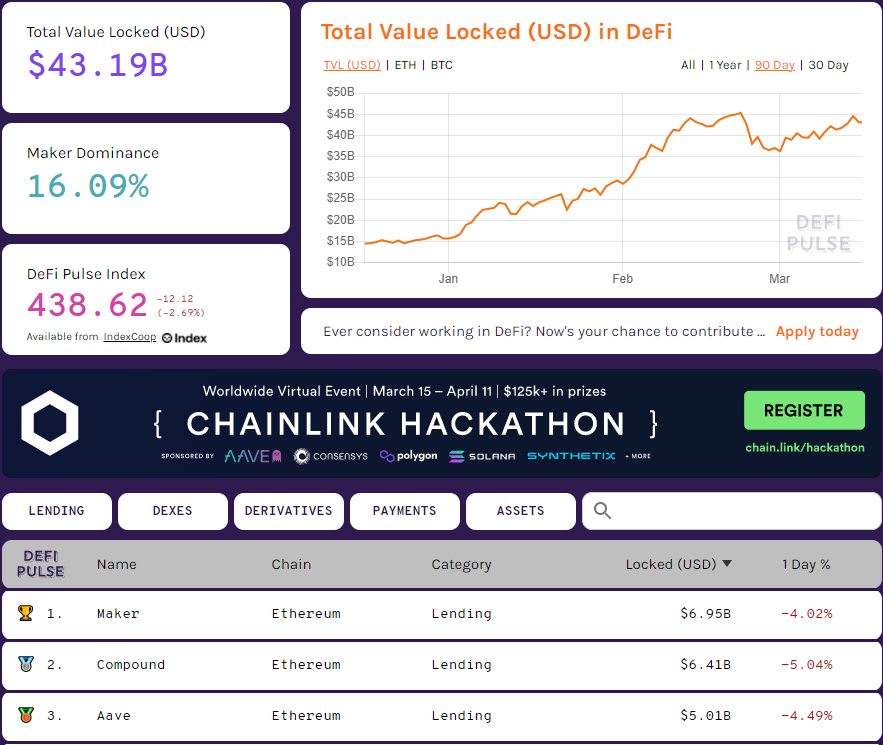
The total value locked (TVL) in BSC-based platforms exceeded $12 billion as of 15 March 2021. Binance’s leading DeFi ecosystem projects are comparable in scale to Maker, Compound, Aave and other well-known dapps built on the second-largest cryptocurrency.
If this growth pace continues, the TVL locked in applications on BSC could surpass Ethereum’s in a matter of months.
We analysed why the buzz around the new DeFi ecosystem has emerged, its pros and cons, and, most importantly, whether BSC has prospects after Ethereum’s scaling.
- In the face of Ethereum’s scalability problems, the BSC-based ecosystem quickly gained popularity thanks to inexpensive transactions.
- The main drawback of Binance Smart Chain is its high degree of centralisation.
- Some experts believe that BSC will not be able to surpass Ethereum in the long run.
A brief introduction: key features of Binance Smart Chain
In April 2018, the popular crypto exchange Binance launched the Binance Chain mainnet. The aim was to create a high-speed blockchain with significant throughput.
To implement the plan, the developers chose the mодель консенсуса Tendermint BFT. The result is a system tailored primarily for the network’s main application — the Binance DEX trading platform.
In early 2020, the Ethereum-based DeFi sector began to grow rapidly. In the run-up to a new boom, Binance realised what Binance Chain lacked — smart-contract support and the ability to launch its own applications by various projects.
Developers did not attempt to add smart-contract capabilities to Binance Chain at the expense of its performance. They cut the Gordian knot by launching a parallel network — Binance Smart Chain.
Launched in September 2020 the BSC platform became fully programmable and ready to work with smart contracts thanks to compatibility with the Ethereum Virtual Machine [Ethereum Virtual Machine, EVM]. This approach gave developers an easy path to port projects originally launched on Ethereum.
Interacting with BSC applications will be straightforward for users familiar with the “classic” DeFi world and the MetaMask wallet. The latter can easily be configured to work with Binance Smart Chain.
In the BSC system a hybrid Proof of Staked Authority (PoSA) model is used, derived from the cross of the Delegated Proof of Stake and Proof of Authority algorithms.
A short block interval makes transaction processing fast — around 3 seconds. The higher gas limit compared to Ethereum positively affects throughput, allowing more transactions to be included in blocks.
As of writing, Ethereum’s block gas limit sits at 12,5 млн, while Binance Smart Chain’s is 30 млн. With an average block size of 40,000 bytes, the growth of the new chain is roughly ten times faster than Ethereum — about 1,15 GB per day or 420 GB per year. This means that after a few years a would-be validator on the Binance Smart Chain would need an entire data centre.
Moreover, a candidate for validator on Binance must possess at least 10 000 BNB ($2,55 mln at the rate on 15.03.2021). Among candidates meeting this criterion, those with more coins (own and delegated) are chosen. The result is a kind of [simple_tooltip content=’Type of market structure of imperfect competition, dominated by a very small number of economic agents.’]oligopoly[/simple_tooltip] of 21 validators. The participant list is reviewed once a day.
To pay transaction fees in the new network, Binance Coin (BNB) is used. Thanks to BSC the latter has moved well beyond being a mere exchange token for discounts on trading fees and access to primary coin offerings. BNB has become a central element in yield farming.
A hype around the new ecosystem
In the second half of February, the TVL of the Binance Smart Chain ecosystem surpassed $10 billion.


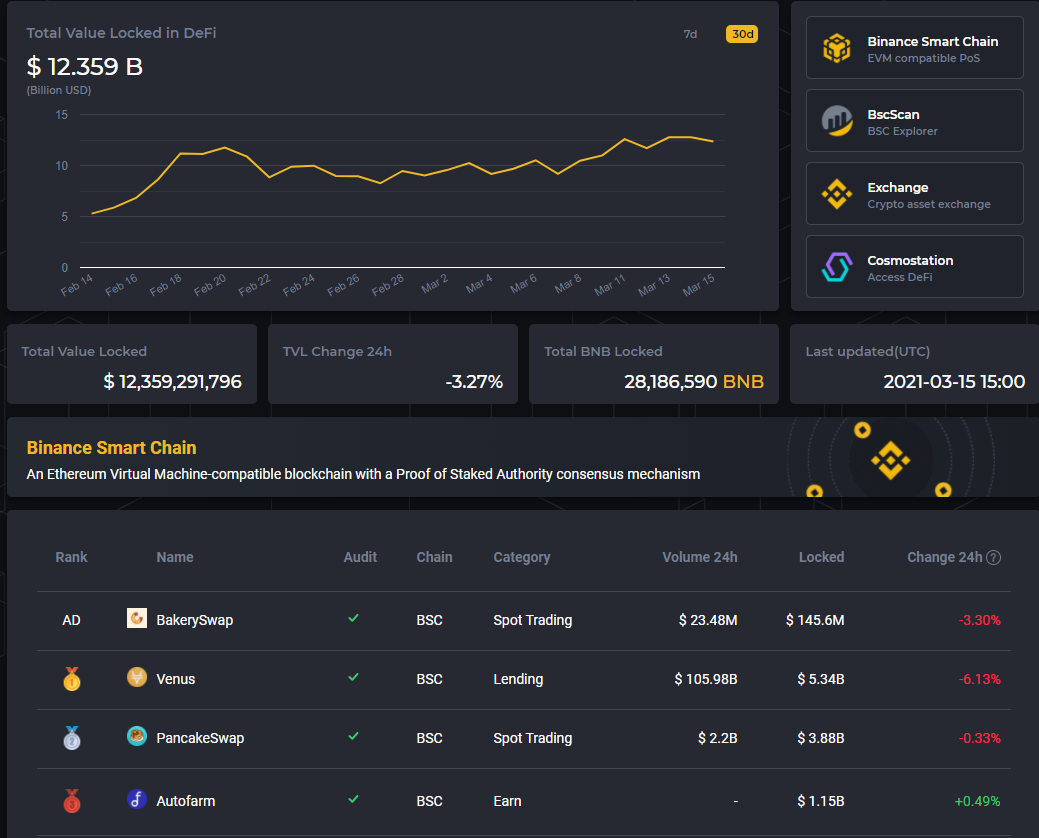
Leading projects on the BSC base:
- the lending protocol Venus — the Ethereum-based Compound analogue;
- PancakeSwap — a DEX similar to Uniswap;
- Autofarm — a project akin to Yearn Finance.
TVL of the above protocols totals $5,34 млрд, $3,88 млрд and $1,15 млрд respectively. For comparison, the TVLs of Maker, Compound and Aave on Ethereum stand at $6,95 млрд, $6,41 млрд and $5,01 млрд (as of 15.03.2021).


In terms of on-chain activity, daily BSC transactions exceed Ethereum’s by more than a factor of two.


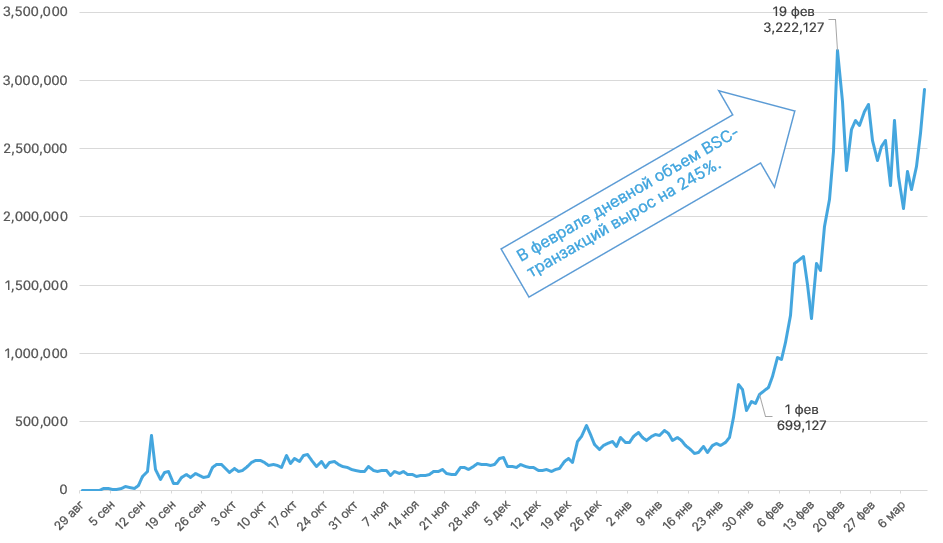
On 11 March the network processed 2,930,895 transactions. Ethereum registered 1,284,767.
Significant activity is also indicated by the rapid growth in unique addresses.


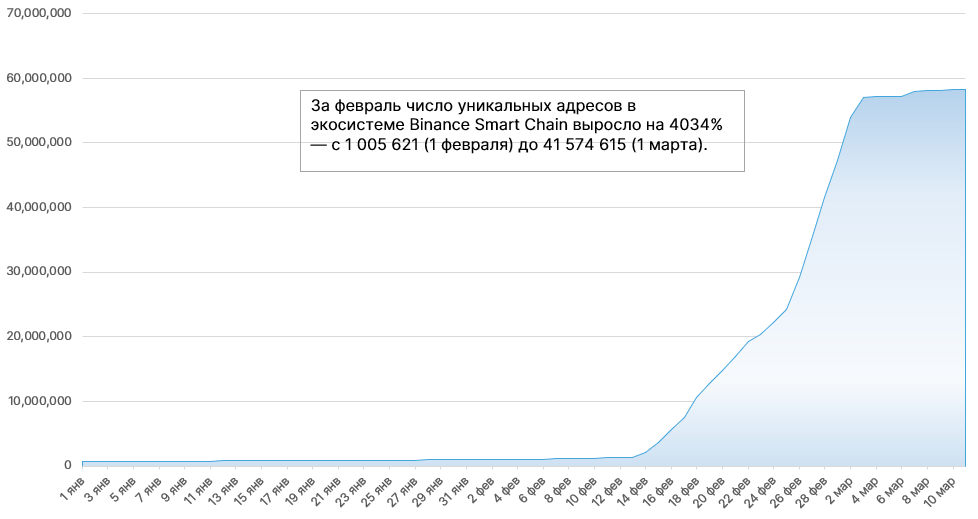
BSC remains popular despite its relatively centralised nature. Retail investors are clearly drawn by the high transaction speed and low network fees.
Below is a chart of the average gas price paid by Binance Smart Chain users for transactions.


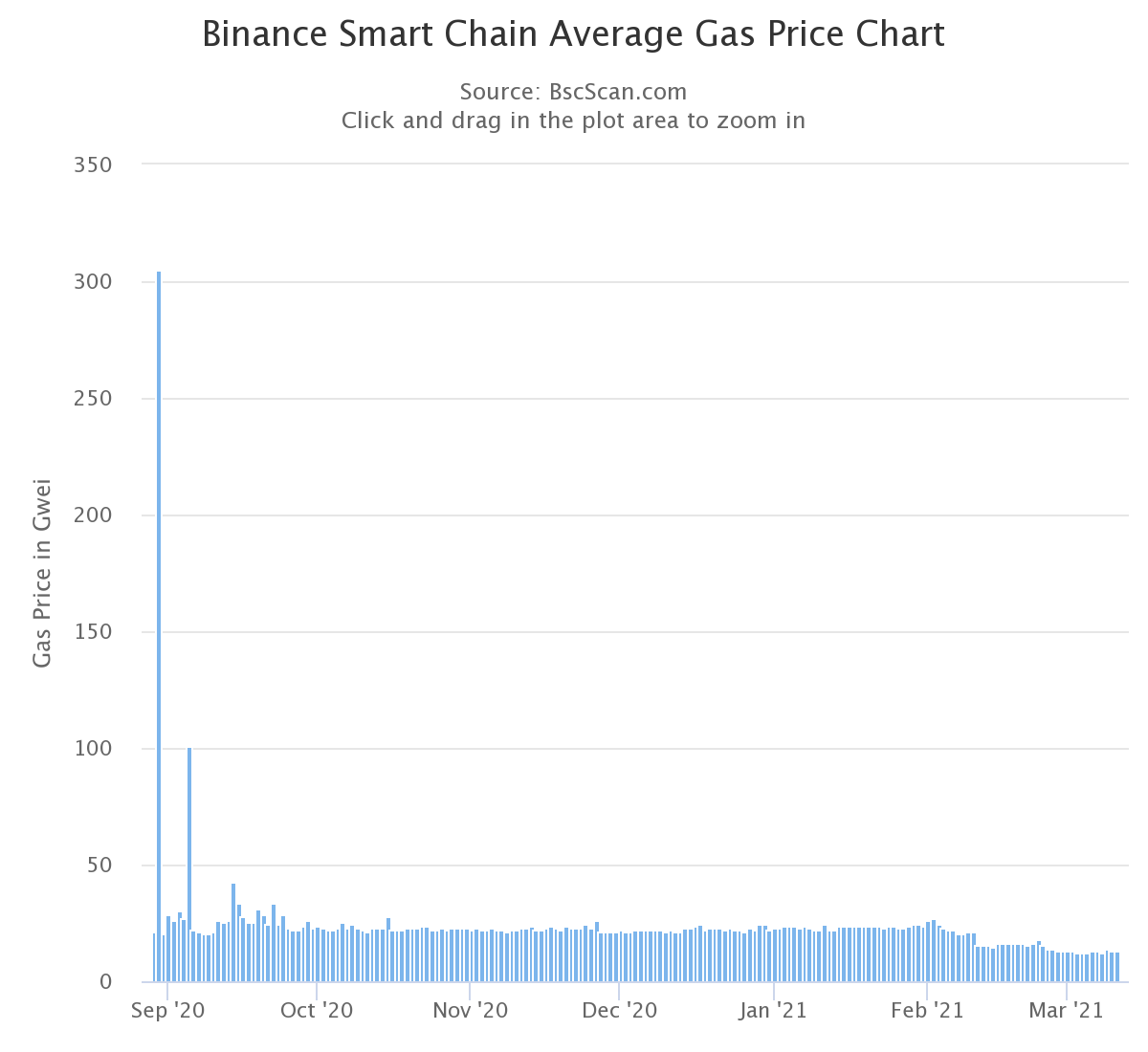
With BNB priced around $250 and gas costs at 13 gwei, a simple token transfer costs about $0.10. Interacting with a smart contract, usually involving several transactions, can exceed $1.
Ethereum fees are significantly higher — a simple ETH transfer can cost users $30 or more.


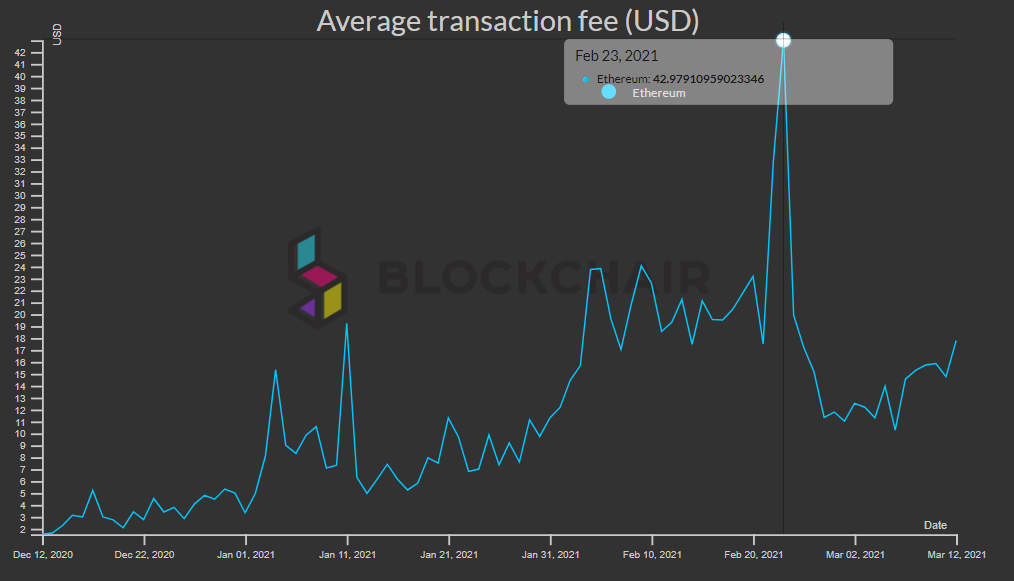
Interacting with Ethereum smart contracts can entail even higher costs. In periods of high on-chain activity and elevated ETH price, token swaps on Uniswap or deposits to Compound can reach $100 or more.


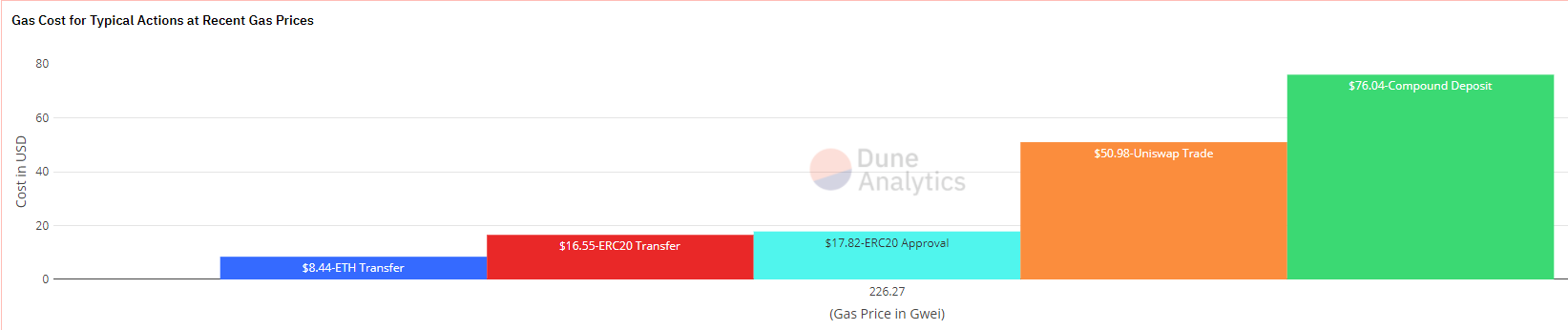
Attractive transaction fees and high speed have become the main reasons behind the popularity of BSC-based applications for many retail users.
Demand drives supply: the new DeFi ecosystem expands with projects and infrastructure. This happens not without generous support from Binance.


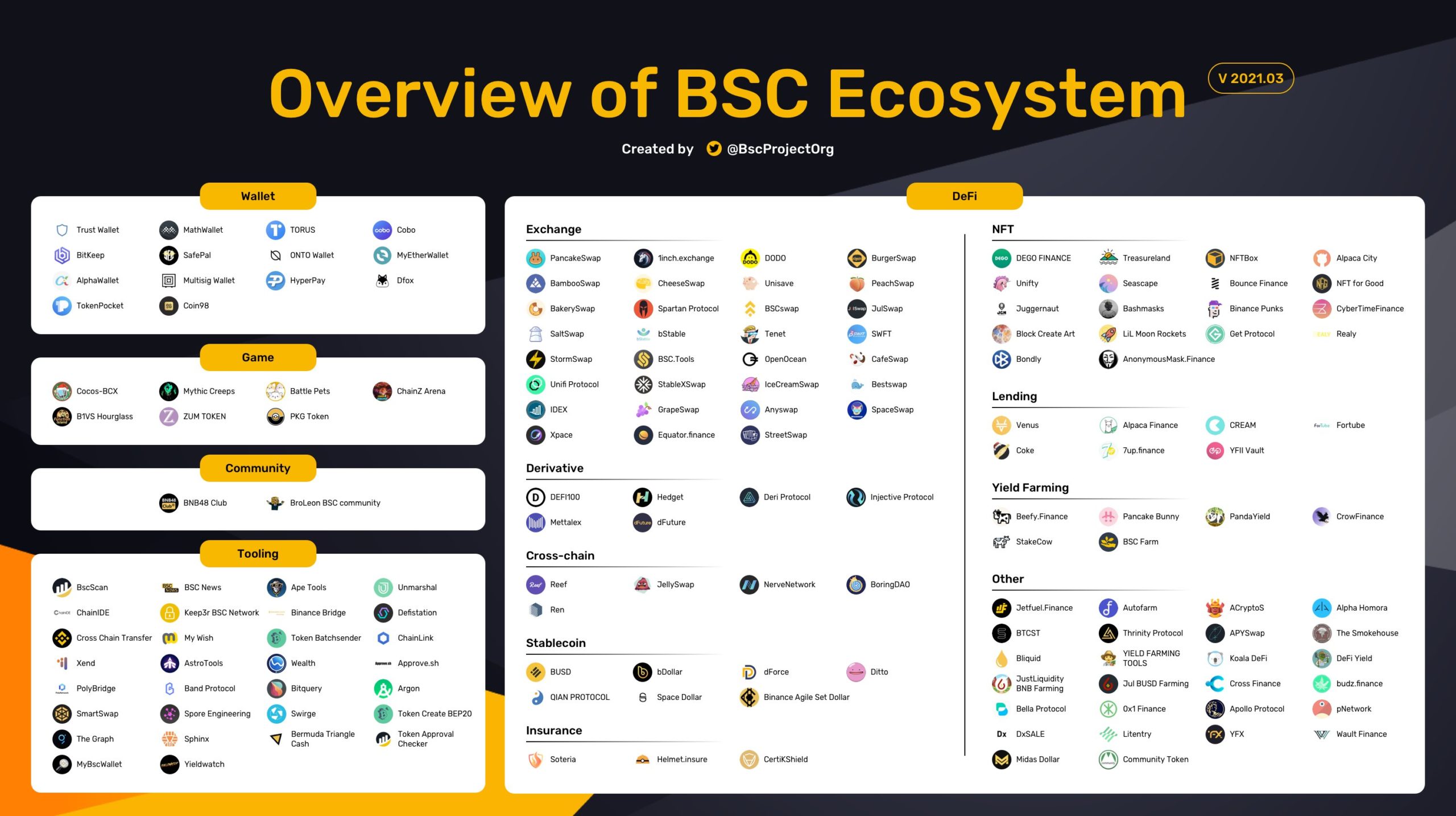
As of mid-March 2021, the range of BSC apps is not as rich as Ethereum’s. Yet new projects keep appearing. On the other hand, there has been a rise in hacker attacks and exit scams.
CeDeFi and the associated risks
Late last year Binance chief Changpeng Zhao proposed the term CeDeFi, signifying something between centralised and decentralised finance.
BSC is a typical CeDeFi example. In Zhao’s view, Binance Smart Chain is more of a complement than a competitor to the “classic” DeFi, intended to promote broad uptake of crypto assets and dapps.
Among CeDeFi’s advantages are low fees. Along with high speed, they motivate users to try various protocols — decentralised exchanges, lending apps, yield-farming tools and liquidity-aggregators.
Thanks to CeDeFi, some newcomers are encountering MetaMask and blockchain explorers for the first time, diving into the diversity of the crypto industry.
Low gas costs allow projects to reduce costs when deploying smart contracts and testing the ecosystem in real-world conditions. The architecture simplifies developers’ interactions with the new ecosystem. Some well-known projects have already opened bridges between Ethereum and BSC, allowing switching between networks.
Similar to Ethereum with its popular ERC-20 standard, Binance Smart Chain users can create BEP-20 tokens. The Binance Chain has its own standard — BEP2.
One of CeDeFi’s main drawbacks is high centralisation. A system controlled by Binance and supported by 21 validators is hardly decentralised. That is the flip side of low fees and fast transactions.
Notably, validators face a high entry barrier. As noted, they require Binance’s approval, a substantial BNB stake and significant disk space.
Binance invests substantial resources in developing the ecosystem, the success and popularity of which influence BNB’s price. The native asset of the BSC is used to pay transaction fees and is widely employed in apps offering high yields.
On the other hand, there is little emphasis on serious innovations as in Ethereum. The value proposition of the Binance-based ecosystem essentially amounts to a cheap alternative for yield farming.
The BSC infrastructure also lags behind Ethereum’s DeFi ecosystem development. Yet with the proliferation of new analytical services and wallets, the situation is improving over time.
Expert views on BSC
The head of Alameda Research and crypto derivatives exchange FTX Sam Bankman-Fried offered his views on the Binance Smart Chain ecosystem and its prospects in a series of tweets.
7) But BSC made a number of choices that seem pretty intentional to me.
They didn’t build a totally new chain; they basically forked ETH.
They didn’t collect tons of independent validators.
They didn’t build a new wallet: they made BSC work on Metamask.
— SBF (@SBF_Alameda) March 8, 2021
«Они не создали совершенно новую сеть; они, по сути, форкнули Ethereum», — подчеркнул эксперт.
Bankman-Fried added that there wasn’t even a wallet created for the new ecosystem initially. The developers “made BSC work with MetaMask.”
8) I would be pretty sad if BSC became the future of blockchain technology.
But again I don’t think it’s really trying to.
It didn’t build a totally new product, and it didn’t build a product for decentralized scaling.
It built a product which was cheap and easy to migrate to.
— SBF (@SBF_Alameda) March 8, 2021
«Мне было бы очень грустно, если BSC станет будущим технологии блокчейн. Но опять же, не думаю, что к этому есть стремление. Не был создан совершенно новый продукт, предполагающий масштабирование в контексте децентрализации. Был создан дешевый продукт, на который легко перейти».
Bankman-Fried believes most users are drawn to yield farming rather than a decentralised autonomous organisation.
10) And then there are yield farms.
No matter what we say about them, they never really needed to be decentralized, at least if the whole point is the yield.
You can drop yield anywhere. And no one who’s using @PancakeSwap is there for the governance.
— SBF (@SBF_Alameda) March 8, 2021
He argues that Binance has created the “perfect” platform for yield farming.
11) And what @binance built was the perfect platform for pure yield to migrate to.
A chain that’s cheap and easy to use and easy to migrate to, both for projects and traders.
And seeded with millions of users.
— SBF (@SBF_Alameda) March 8, 2021
The expert is convinced that BSC has brought competition to decentralised finance, without depriving the sector of its future.
12) It would be easy to be angry at BSC, for taking yield from more decentralized chains.
But I’m not. Because BSC isn’t stealing governance, and it’s not stealing the pillars of a decentralized future.
It’s stealing yield.
It’s making DeFi compete for its yield.
— SBF (@SBF_Alameda) March 8, 2021
In conclusion, Bankman-Fried highlighted the essential characteristics of a winning DeFi ecosystem.
15) Because for DeFi to win, it can’t be decentralized OR fast OR cheap OR sophisticated OR innovative OR well built OR have a large userbase.
It needs to be all of those.
— SBF (@SBF_Alameda) March 8, 2021
«Она не может быть децентрализованной или быстрой, или дешевой, или развитой, или инновационной, или хорошо сделанной, или обладать значительной пользовательской базой. Она должна обладать всем перечисленным».
The Block analyst Larry Cermak is convinced that BSC does not pose a long-term threat to Ethereum.
We all know BSC is not going to threaten Ethereum long term but it absolutely amuses me when Ethereum people start sounding just like Bitcoiners bitching about Ethereum. Just chill, take a breather and let the incentives play out 🤝
— Larry Cermak (@lawmaster) February 19, 2021
«Мeня поистине развлекает, когда сторонники Ethereum уподобляются биткоин-максималистам, жалующимся на вторую по капитализации криптовалюту».
Among the main drawbacks, the analyst noted the heavy centralisation and that “everything is funded by Binance”. He credited the substantial resources of Changpeng Zhao’s company as a strength of BSC. The main reason for the hype around BSC remains the opportunity to maximise profits.
Why is this happening? In retrospect, it was inevitable. Retail wants to gamble in DeFi and the vast majority of newcomers are priced out of Ethereum. Do they care about decentralization? Nope https://t.co/SqWOcgM9Q1
— Larry Cermak (@lawmaster) February 19, 2021
In Cermak’s view, the emergence of a platform for “DeFi gambling” was inevitable, as many newcomers to the industry were deterred by Ethereum’s high transaction costs.
«Does decentralisation bother them? Not really», — the researcher noted.
Conclusions
Binance Smart Chain has achieved impressive traction in a short time, given user counts, trading volumes and TVL. The decision to build a system mirroring Ethereum, with similar tools and protocols, seems well justified.
BSC emerged at the right moment — the growing popularity of Ethereum, with its ongoing scaling issues, has produced extremely high transaction fees. The high costs have pushed many retail users away from the ecosystem, prompting them to seek alternative ways to access DeFi.
As one of the largest crypto exchanges, Binance has enabled many users to move BNB and other crypto assets directly into the BSC ecosystem. The BEP-20 standard, cross-chain interoperability and network effects have done their part.
The PoSA model ensures fast transactions and low fees. The price is a low level of decentralisation and security. Yet few worry about this — most care about yield farming with low transaction costs.
The rapid growth of the BSC ecosystem is likely to continue to support the price of Binance Coin. The native asset is required to pay transaction fees and is widely used in applications offering high returns on invested capital.
It is unlikely this trend will reverse in the short- and mid-term. Yet the question remains: can BSC become the leading DeFi ecosystem in the long run?
Layer-2 scaling solutions, as well as a full move to the second version, could significantly reduce costs when interacting with Ethereum, without sacrificing decentralisation and security.
The intrigue is likely to grow as technologies like Optimism, Plasma and Rollups mature and spread. The winner in the DeFi vs CeDeFi race will become clear with time.
Subscribe to ForkLog news on Telegram: ForkLog FEED — the full feed of news, ForkLog — the most important news and polls.