



The Economist charts the rise of an agentic AI web
AI agents are set to take on the web, as standards and platform wars take shape.
Artificial intelligence could make British computer scientist Tim Berners-Lee’s dream a reality—AI agents will take on much of the drudgery. So writes The Economist.
In 1999, a decade after inventing the World Wide Web, the pioneer described a future in which planning and information retrieval would be delegated to “intelligent agents”—machines able to read, interpret and act.
Since then the internet has changed markedly, yet it still demands people’s direct attention.
Modern large language models (LLMs) are shifting that. They can summarise documents, answer questions, search for information and reason. But they lack one ingredient: action.
The internet must change
Microsoft’s chief technology officer, Kevin Scott, reckons fully autonomous digital assistants are “not that far off”. The main obstacle is language: they need ways to communicate with online services and with one another.
Web services typically talk to the outside world through an application programming interface (API). It tells visitors what a system can do, such as booking a doctor’s appointment or providing a map location.
The trouble is that APIs are made for people, each with its own quirks and documentation. That is a thicket for AI agents. Every new piece of software requires learning its “dialect”.
For digital helpers to act independently online, their mode of communication needs standardising. That is the aim of the Model Context Protocol (MCP) from AI startup Anthropic.
Solutions exist
The American company’s chief product officer, Mike Krieger, said the idea for MCP arose while wiring Claude into Gmail and GitHub. Rather than integrate every app with a chatbot, the firm wanted a common rulebook.
An agent can ask an MCP server what a system can do—book a flight, cancel a subscription, pay compensation, and so on—then perform the action on the user’s behalf.
Consider a user booking a trip from London to New York. The sequence runs as follows:
- They tell a travel agent their plans.
- The assistant parcels the work out to specialised AI helpers that can search flights, hotels and cars;
- Those helpers contact MCP servers of airlines, hotels and car-rental firms, gather information, compare options and compile a list of good itineraries.
- The user chooses, and the travel agent books what is needed.
Such coordination requires rules for how digital helpers identify one another, communicate and establish trust. Google proposes an agent-to-agent (A2A) protocol to let agents agree who does what.
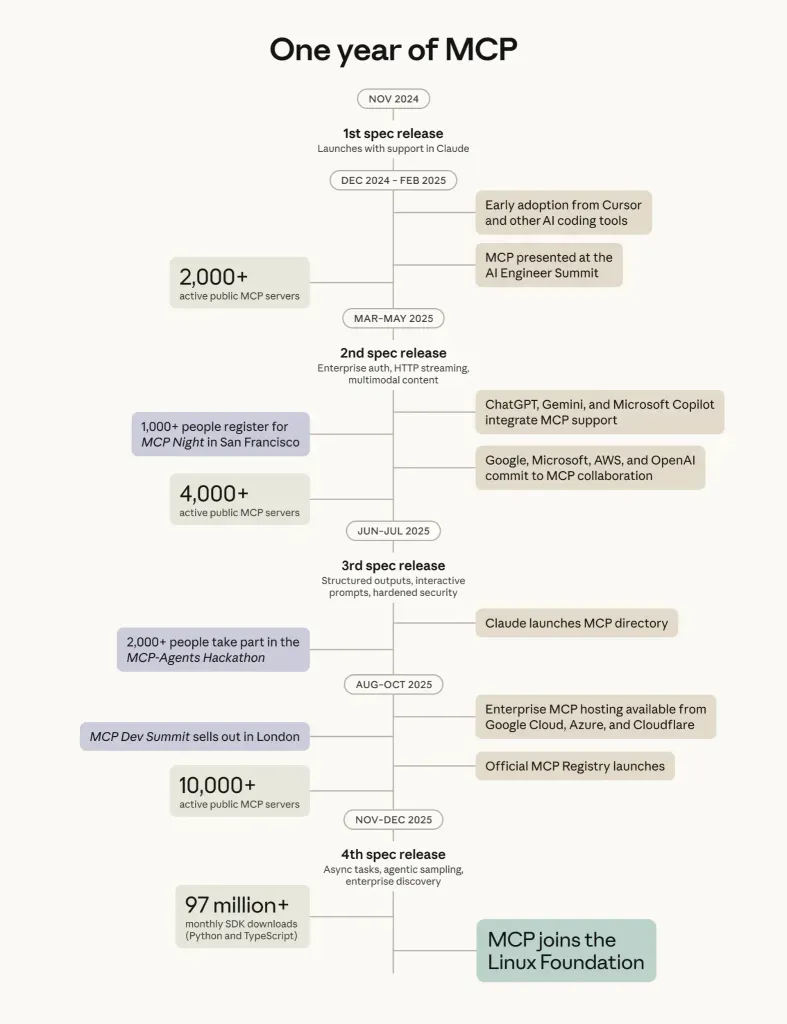
In December, the Linux Foundation set up the Agentic AI Foundation (AAIF). Its goal is to prevent the AI-agent segment from fragmenting into incompatible, closed products.
The foundation will be a neutral home for developing open projects in digital assistance. Key contributions to the launch came from:
- Anthropic — provided the Model Context Protocol (MCP), a standard for connecting models to external data and tools;
- Block — opened the Goose platform for digital helpers;
- OpenAI — proposed AGENTS.md, an instruction file that streamlines tool configuration in repositories.
The MCP ecosystem already spans more than 10,000 active public registries.
Other AAIF members include AWS, Bloomberg, Cloudflare, Google, Cisco, Datadog, Docker, IBM, Oracle, SAP, Snowflake, Twilio, Hugging Face, Uber, SUSE and more.
Most websites that agents will browse are made for human eyes. Finding a product still means clicking through menus.
Microsoft has created the Natural Language Web (NLWeb) to make it easier for LLMs to access resources.
The tool lets people “talk” to any web page in ordinary speech. On a travel site, users can ask about preferred holiday options with three children; NLWeb grasps the intent and answers in natural language.
Any site connected to NLWeb can act as an MCP server, exposing its content to agents. The tool therefore bridges today’s visual web and the one AI assistants need.
Platform wars
As AI agents mature, a platform battle is taking shape, reminiscent of the browser wars of the 1990s.
Then, firms fought to control access to the internet. Now browsers are being reimagined as digital assistants are built in. OpenAI and Perplexity have launched their own AI assistant-based offerings that can track flights, analyse documents and manage email.
Their ambitions do not stop there. OpenAI has added to ChatGPT the ability to buy directly from certain sites and integrated support for various services such as Spotify and Figma.
Such moves worry incumbents. Amazon demanded that Perplexity remove its browser with a built-in AI agent from its online store. The Airbnb rental app decided not to integrate with ChatGPT because “the feature is not quite ready yet”.
Advertising will have to adapt
Advertising must adapt. Today’s internet runs on monetising human attention. Alphabet and Meta are among the biggest tech giants and chief beneficiaries.
Dawn Song, a computer-science expert at the University of California, Berkeley, believes marketers will have to target not people but “agents’ attention”. Tactics may stay the same—rank optimisation, preference targeting, paid placement—but the audience will be algorithms.
Digital assistants could greatly expand online activity. Parag Agrawal, founder of AI startup Parallel Web Systems, notes that the web was built for people reading at human speed. Agents have no such constraints. They can scan thousands of pages per second, follow links people skip and juggle multiple tasks at once.
There are risks. AI can be wrong, just like people. There is also the prospect of external attacks, such as hidden malicious commands in web pages or files.
Security measures are meant to reduce such problems. One is to restrict agents to services worthy of trust. Another is to grant them narrowly scoped privileges. For the most sensitive tasks, a human can be kept in the loop.
In November, Microsoft experts introduced a test environment for AI agents and identified vulnerabilities inherent to modern digital assistants.
Рассылки ForkLog: держите руку на пульсе биткоин-индустрии!