



In 1955 the Joint Economic Committee of the US Congress published a report on the economic consequences of automation. Analysts warned that new technologies threatened workers unable to adapt to a changing labour market. Seventy years on, the warning rings true again.
The industrial era automated manual work and squeezed factory hands. Generative artificial intelligence is reshaping the post-industrial economy. Now highly skilled specialists and knowledge professionals—once thought shielded from automation—are in the firing line.
Drawing on a Tufts University study and corporate trends, we assessed the scale of the shift.
“Wired belts”
Prestigious diplomas and jobs in innovation clusters no longer guarantee career or financial stability.
Many specialists in STEM, applied mathematics, law and the humanities are at risk. Key risk factors are tight coupling to digital technologies, standardised workflows and information-heavy tasks.
Researchers at MIT estimate that in the near future AI is capable of displacing 11.7% of workers in the US labour market. In pay terms, that equates to $1.2trn across finance, health care and professional services.
This is a sizeable chunk of household income and of municipal tax receipts. Automation could trigger a large-scale reallocation of global capital.
Cutting-edge intellectual hubs that once generated most added value are rapidly turning into so-called “wired belts” (Wired Belts). There is a risk that innovation regions will become the new depressed zones—marked by structural unemployment, weaker consumer demand and prolonged stagnation.
Occupational vulnerability to AI
Analysts at Tufts University’s Digital Planet distinguish two notions: “exposure” and “vulnerability”.
Exposure is the technical ability of LLMs to perform tasks within a given occupation.


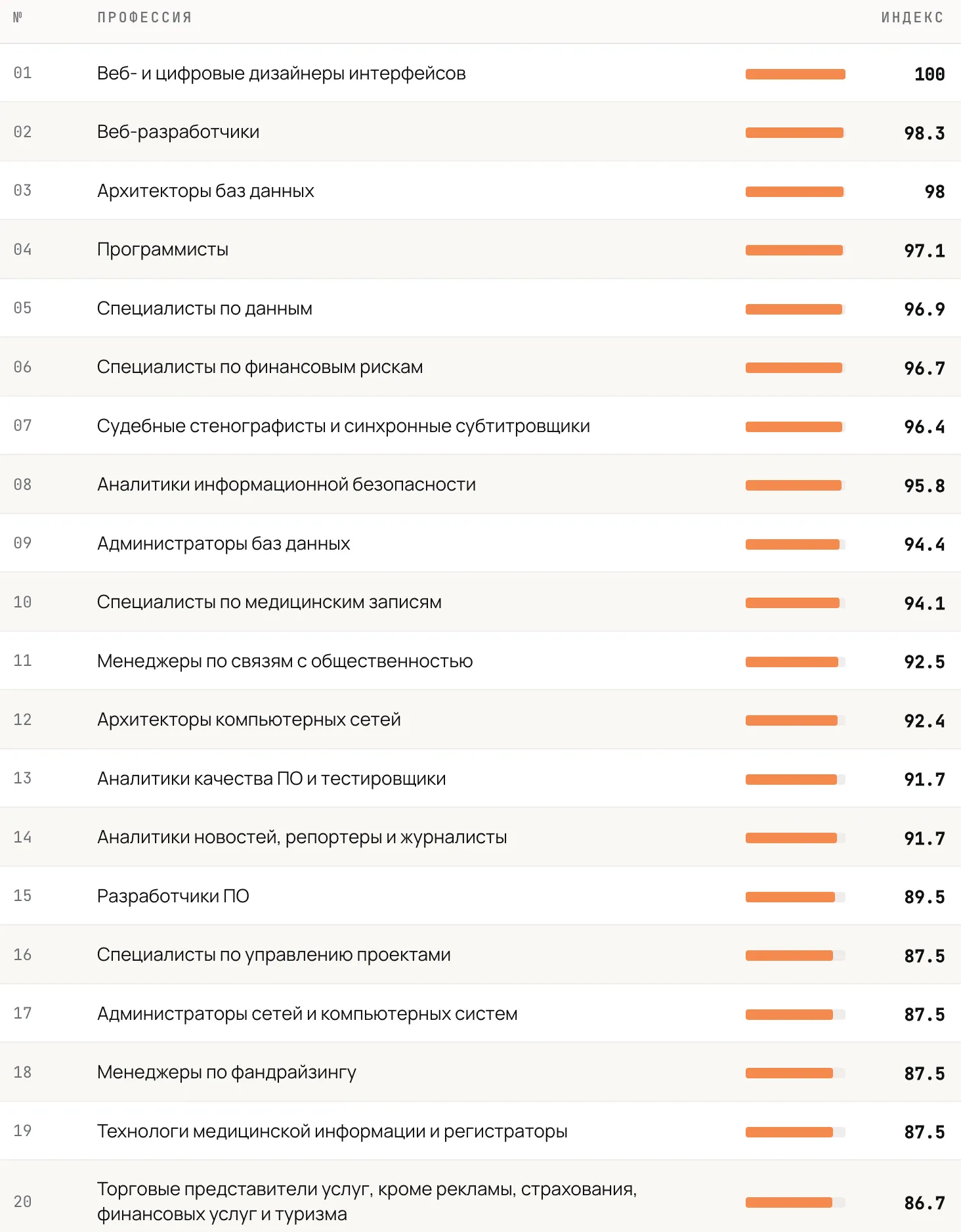
Vulnerability is the real economic risk that a human will be replaced by an algorithm. It factors in the cost of deployment (ROI), available infrastructure, regulatory barriers and firms’ readiness to rewire processes.
Indices such as the American AI Jobs Risk Index rest on three metrics:
- Task-Based score — the ability of large language models to cut task time by at least 50% without loss of quality;
- Suitability for Machine Learning — the applicability of machine-learning methods to business processes;
- Advances in AI — the pace of progress in adjacent fields.
The data undercut the belief that complex, creative or intellectual work is protected from automation. For modern neural networks built on the Transformer architecture, there are no sacred barriers such as human intuition, abstract logic or creativity.
Labour-market statistics record a persistent pattern: a 1% automation of tasks in a sector is followed by a 0.75% reduction in jobs.
Pressure is greatest on specialists whose work involves generating and processing digital content. The most vulnerable:
- writers and copywriters (57.4%) — mass text generation leads to platform monopolisation and falling incomes for freelancers;
- software developers (55.2%) — demand for juniors is declining and the outsourcing market is narrowing as boilerplate code and refactoring are automated;
- web-interface designers (54.6%) — displaced by no-code tools used directly by managers.

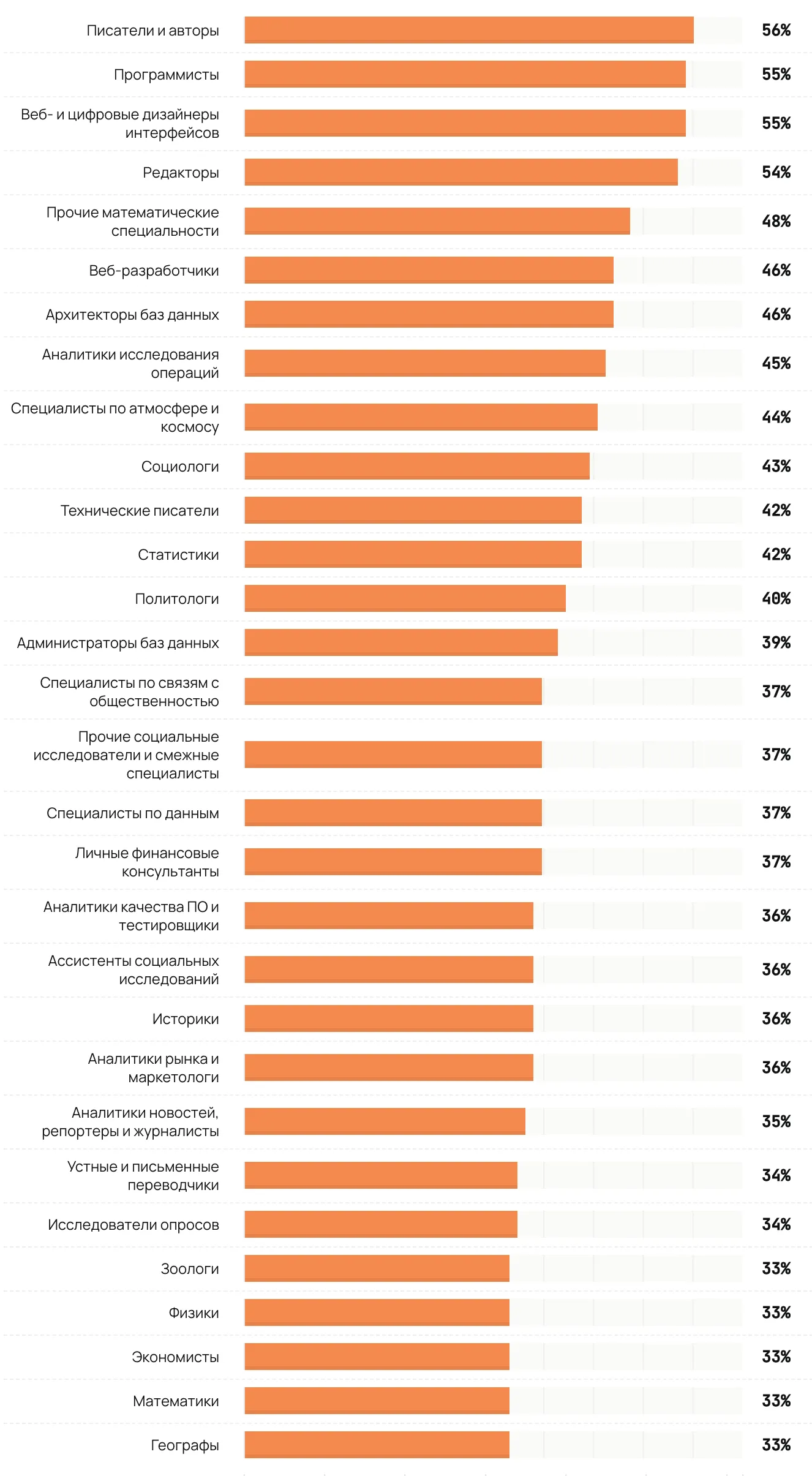
Applied mathematicians and sociologists are also in the danger zone, as statistical modelling and semantic analysis of big data absorb their tasks.
The productivity trap: from augmentation to substitution
In expert circles and in Silicon Valley’s PR, a soothing line prevails: AI is augmentation—tools that extend human abilities. Algorithms will complement people, freeing them from cognitive drudgery for strategic and creative work.
Corporate practice suggests otherwise. In most cases the line is classic AI-washing—an attempt to mask structural headcount cuts as a concern for innovation and productivity.
If generative AI halves the time needed for a task, staff are unlikely to gain leisure. In a market economy, freed capacity is either redeployed to new tasks or becomes a rationale for layoffs.
The Block case: the market favours substitution
A clear example of the era of “cognitive automation” is Block’s restructuring under Jack Dorsey.
In February 2026 the company announced nearly 4,000 job cuts. Headcount fell almost by half—from more than 10,000 to under 6,000. The stated aim was a leaner, flatter structure with an emphasis on AI.
Markets moved quickly: by the end of the same day’s trading Block’s shares rose by 20%.


SaaSpocalypse and the return of Taylorism
Macro research shows an approaching tipping point for 4.9m highly skilled US workers. In affected segments, the share potentially replaceable could rise from today’s 10% to 40% within two years.
In tech this is already dubbed SaaSpocalypse—a term for the rapid devaluation of traditional software-development models. The arrival of autonomous software agents has erased about $285bn in market capitalisation from legacy software firms.

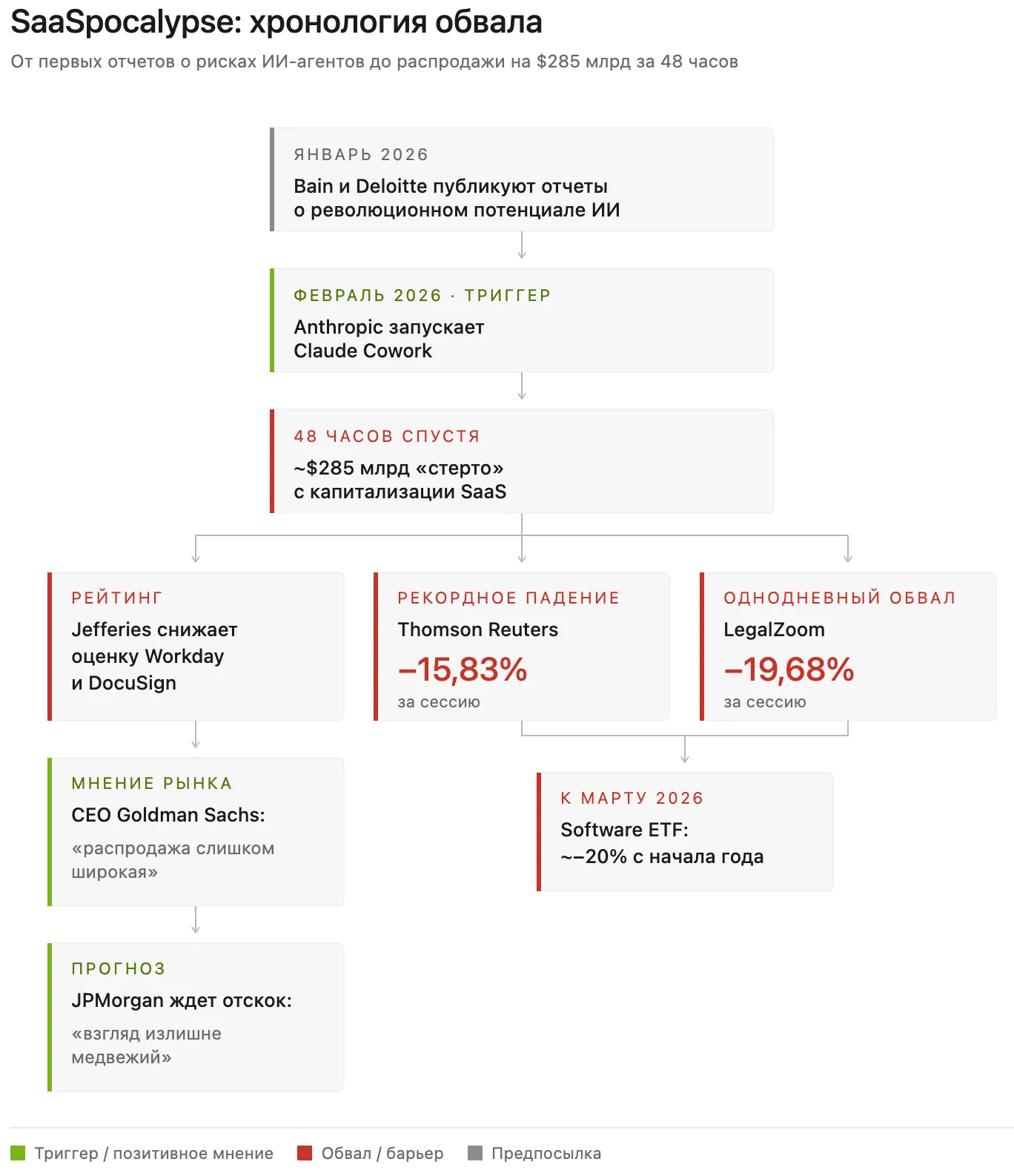
For decades these models rested on reselling routine intellectual labour by large developer teams. When code is generated by machines at near-zero marginal cost, such models lose their edge.
Taylorism for white-collar workers
Big corporations are reviving the principles of Taylorism for office staff.
Tech giants are shifting from recommending to mandating AI use. Amazon Web Services introduced digital dashboards to track how often staff use AI. Google and Microsoft have folded this metric into performance reviews. An engineer’s or manager’s refusal to use AI tools is treated as professional inefficiency.
Those who designed this technological shift have been hit hardest. Output of complex content and software is soaring, yet its market price is trending towards zero—steadily undermining middle-class incomes.
The geography of risk and the “ghost GDP” paradox
Adaptation to technology is already reshaping economic geography. The greatest risks sit in leading tech centres with historically high concentrations of well-paid cognitive jobs.
Analysts have built the Iceberg Index—a digital twin of the US labour market modelling employment for 151m workers, each treated as an independent agent. It shows how neural networks reconfigure task structures long before changes appear in unemployment data.
Spatial modelling yields an unexpected result. San Jose, the heart of Silicon Valley, tops the anti-ranking—with 9.9% of jobs at risk of displacement.
Small university towns are especially vulnerable, their economies built around serving knowledge workers. The loss of even 7–8% of jobs there threatens reduced consumer demand and falling property markets.


At the other end are regions historically dominated by manual labour, where AI substitution risk is statistically minimal. Ironically, areas long deprived of high-paying jobs may suffer least from their disappearance.
This produces what analysts call “ghost GDP” (Ghost GDP). Headline GDP keeps rising on corporate productivity, but less of it reaches households: money pools in corporate profits rather than circulating in local communities.
The militarisation of AI
In the corporate sector, AI roll-outs often serve as a pretext for job cuts. In the military the logic differs: AI is a tool to boost capability, not merely to trim costs. Integrating AI into intelligence and defence is declared a strategic priority.
In December the US military launched the GenAI.mil platform to apply Google’s Gemini for Government to national security. The initiative sits within the Trump administration’s plan, unveiled in July: federal agencies must accelerate the adoption of advanced AI systems.
The US Army has initiated a retraining drive—introduced specialty 49B. AI officers will manage high-tech systems, speed decision cycles and work with autonomous platforms.
Unlike private business, the army is not laying people off but investing in retraining.
Strategies for the transition
Classic trade unions, unemployment insurance and other social institutions were built for the industrial age. Can they cope with large-scale displacement of functions and rungs of employment?
Researchers at Tufts University argue that fundamentally new mechanisms are needed:
- wage insurance — the state compensates the income gap for a specialist whom algorithms have pushed into a lower-skilled role;
- corporate transparency — public companies should regularly disclose how AI affects headcount; investors and regulators must see the balance between productivity gains and job cuts;
- an “augmentation-first” model — corporate deployment of neural technologies is tied to mandatory funding for staff retraining; in Germany and France there are already state subsidies for reskilling workers whose tasks are automated;
- “stack qualifications” — four-year degrees give way to short micro-modules refreshed every few months; emphasis shifts to meta-skills: systems thinking, ethical arbitration and empathy.
What next
The mass diffusion of generative AI has outgrown the frame of corporate efficiency. It is a structural shift of global scale that ends humanity’s centuries-long monopoly on complex mental labour. The formation of a new digital “rust belt” is becoming a painful socio-economic problem.
The window for soft, preventive adaptation has almost shut. Digital transformation is spreading far faster than legislation and education can adjust.
Future stability will not hinge on trying to slow adoption. But productivity gains and technological progress will lose their humanist purpose if the price is the destruction of the global middle class and the conversion of innovation hubs into zones of chronic decline.