


The Fed’s pivot: when to expect it and how rate cuts could affect crypto
At the end of July, the US Federal Reserve kept the key rate at a historic 5.25–5.5%. Many market participants nonetheless expect a “Fed pivot” as early as September. What it is—and why lower rates will not necessarily benefit crypto—explains Oleg Cash Coin.
COVID correlation
For most of the time, the crypto market correlates with traditional finance. The dependence on America’s stock market took hold in 2020 amid the coronavirus pandemic.
The trend of “looking alike” has strengthened as classic traders, venture investors, institutions, hedge funds and others entered the sector with the habits and rules of TradFi.
Larger capital flows, more trading instruments and broader use cases tie cryptoassets to traditional income strategies, including portfolio investing, lending and hedging via futures and options.
The chart below shows the correlation between total crypto market capitalisation and the S&P 500 index. Since the pandemic began, the lines have moved almost in tandem.
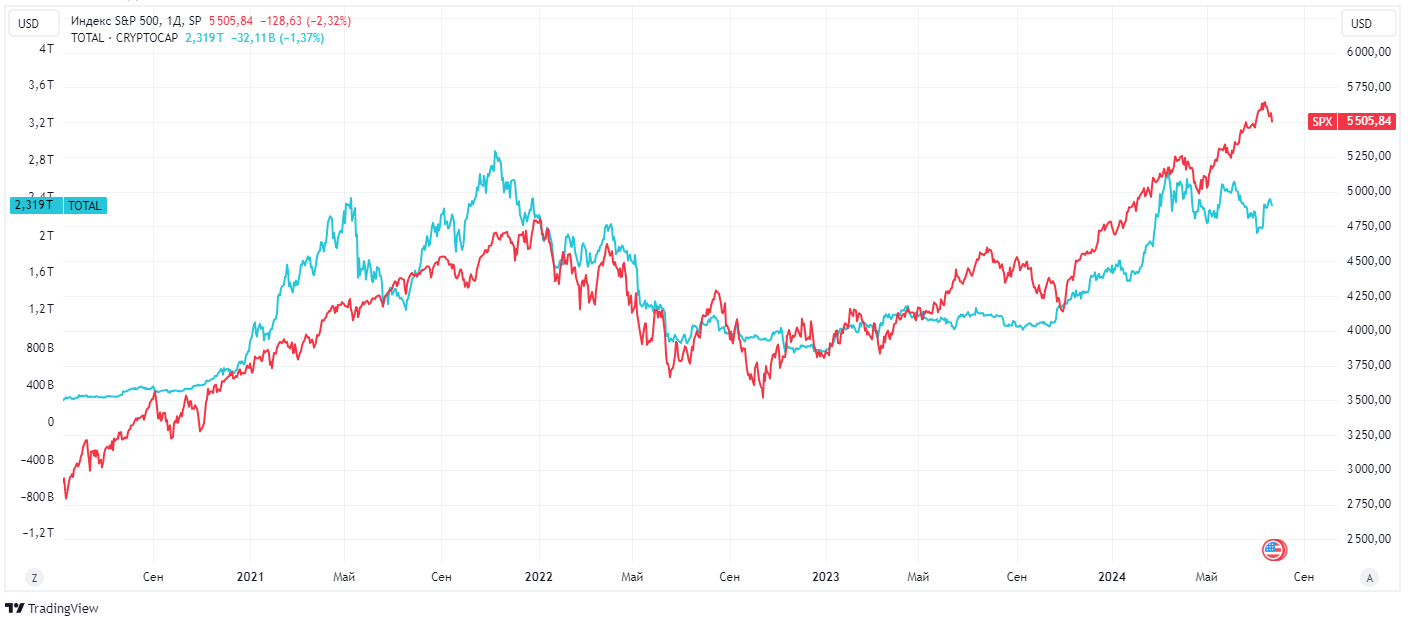
All this has led to the US equity agenda increasingly swaying a relatively small blockchain sector.
As a result, a sizeable slice of the speculative community has adopted the rules of traditional macroeconomics, shelving the drive for autonomy and decentralisation.
What is the Fed pivot
One of the Fed’s most potent tools, with global reach, is its setting of the policy rate.
Raising it means tighter policy—harsher conditions for borrowing, doing business and long-term planning. Cutting it signals cheaper credit, easing long-term planning and development.
In mid-2023, after the “pandemic” shock of 2021, the Fed halted its rate-hiking cycle. For more than a year since, the financial world has awaited a shift to easier policy.
The turning point in monetary policy is called the Fed Pivot.
The Fed pivot theory
Monetary easing typically has a positive effect on the economy. It implies the Fed will lower rates by injecting additional money into the banking system.
As a result, banks can extend cheaper loans to households and firms, improving access to capital. The aim is to spur domestic economic activity. Businesses can hire and expand production, while consumers can make big-ticket purchases on more lenient credit terms.
Taken together, that improves corporate results, leaves households with more cash and whets investors’ appetite for riskier bets such as equities or start-ups. In turn, exchange-traded asset prices can rise. Hence, many see a “Fed pivot” as a buy signal or the start of a bull market.
What is the downside
A Fed Pivot is, in effect, an acknowledgement that the economy is slowing—recession or stagnation. Policy changes not because the crisis has passed, but because conditions have worsened and action is needed.
Because the Fed works with macro indicators, by the time it shifts stance the monetary climate has already deteriorated and companies are posting weak results. Poor numbers at public firms are a reason to sell assets and seek safer allocations.
Thus, while a rate-cutting cycle carries positive long-term expectations, the very fact of a policy shift signals damage already done. A Fed pivot is not a “pleasant” moment for markets.
How markets react to a “Fed pivot”
Over the past 25 years there have been three moments when the Fed reversed course. The chart below shows the correlation between the S&P 500 (orange) and the Fed’s policy rate (red).
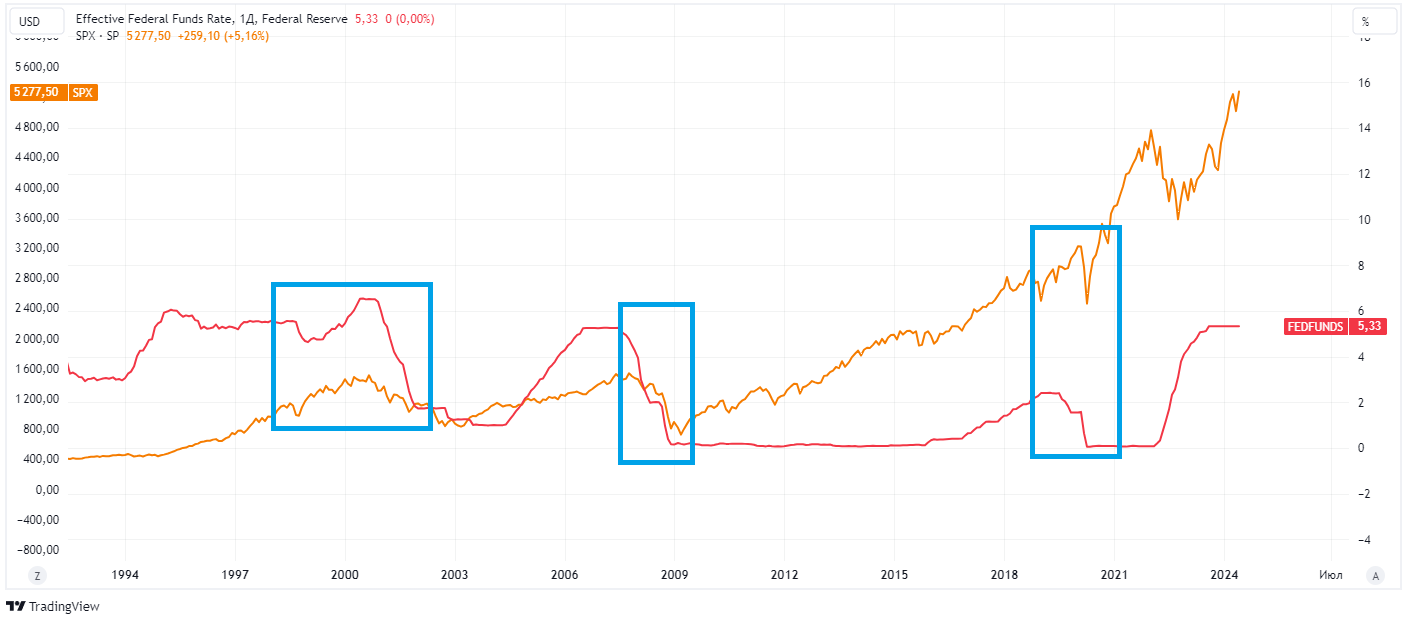
Each time, trading markets have shown a similar medium-term reaction to the policy turn.
Although cryptocurrencies lack the long history of US equities, they are risk assets subject to the same cycles as traditional instruments. For that reason, they should not be expected to react markedly differently to a Fed pivot.
When the Fed might pivot—and what next
According to FedWatch on the Chicago Mercantile Exchange, traders and investors are voting for September.
With an 86% probability, the Fed will start cutting after its 18 September 2024 meeting.
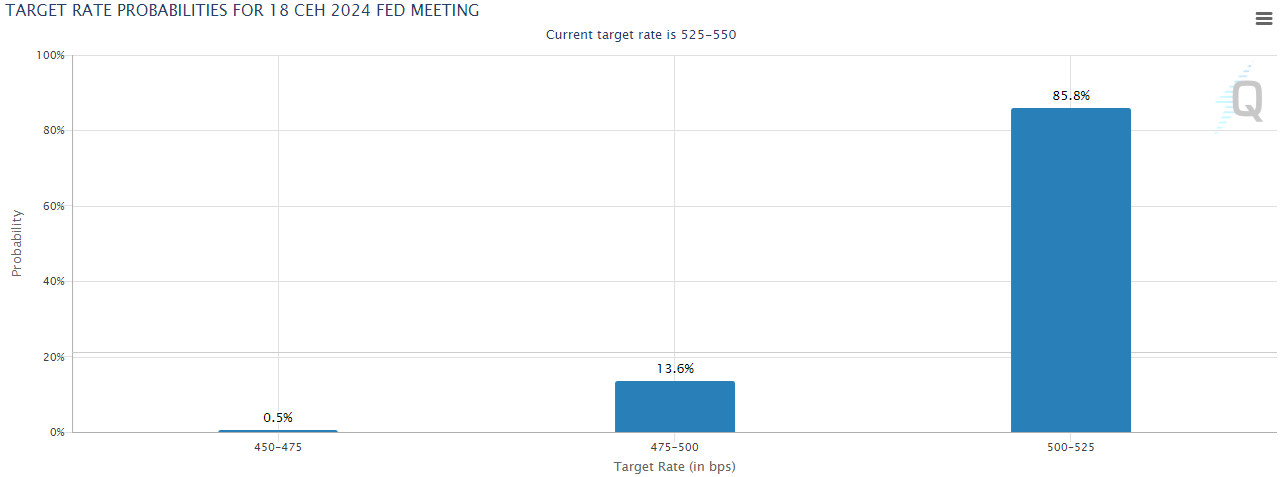
This suggests investors already see economic dynamics that leave little room for other scenarios.
Of course, markets can change tack in a single day, but that would require new data, which could emerge, for instance, after the US elections in November.
It is also worth noting that, alongside a possible “Fed pivot”, markets are flooded with expectations tied to the presidential race. Some predict that gold, silver and bitcoin will rise if Donald Trump wins. Others expect his opponent, Kamala Harris, to have a positive effect on the technology sector, including cryptocurrencies.
But whatever the outcome, macro indicators—such as the Fed’s rate—that influence prices and trends across almost all global markets will take months to absorb new conditions.
Рассылки ForkLog: держите руку на пульсе биткоин-индустрии!