



As blockchain technology evolves, the range of attractive applications broadens. One concept that has gained community support in recent years is the model DAO.
In 2022, decentralized autonomous organisations were part of the World Economic Forum’s Davos agenda. Brinly Llir, chief legal officer at cLabs (developing the Celo network), noted that these structures could improve the corporate world for the better.
«While DAOs are not without problems, they have the potential to modernise the style of corporate governance that has undergone little change for centuries», — wrote him.
ForkLog разобрался в преимуществах и недостатках распределенной модели управления, а также выяснил, являются ли DAOs эффективной альтернативой традиционным компаниям.
- The classic corporate governance structure is outdated and cannot provide the necessary level of business coordination.
- Smart contracts automate routine processes, improving their efficiency. DAOs can leverage the benefits of dapps and the modular Web3 architecture.
- The practical DAO approach to decision-making faces several serious drawbacks that threaten their resilience.
- DAOs also confront challenges at the levels of scaling, security, interaction with the external world and building a “healthy” community.
The Prerequisites of Decentralisation
People tend to create emergent structures with properties not inherent in individual actors. This process is part of evolution, and the tendency to scale these groups has only intensified as technology progresses.
Such collaborations helped give rise to traditional corporations, a form that has hardly changed since the seventeenth century. They still take capital from investors in exchange for obligations to maximise shareholder value.
There are two sides to this approach. On the one hand, it raises business efficiency; on the other, often to boost profits, companies are willing to pay a high price, including causing environmental harm and reducing workers’ conditions.
1/2 You don’t really believe the peeing in bottles thing, do you? If that were true, nobody would work for us. The truth is that we have over a million incredible employees around the world who are proud of what they do, and have great wages and health care from day one.
— Amazon News (@amazonnews) March 25, 2021
Some participants in the traditional economy recognise the shortcomings of a capital-maximising structure, as evidenced by the emergence of B Corporations.
From a utilitarian perspective, the classic model is also not ideal. In the information era it no longer ensures the necessary level of business coordination — hence the growth of the gig economy sector and the outsourcing services market.
The trend also appears in the development of the “orbital” cooperation model, where the line between internal and external members of organisations fades. Andreessen Horowitz partner Chris Dixon noted that as centralised structures grow, it becomes harder to align incentives among participants in such systems.
According to Dixon, at the outset any centralised platforms do everything possible to attract users and external participants such as developers, business representatives and the media. They need to increase the value of services as they are highly susceptible to network effects.


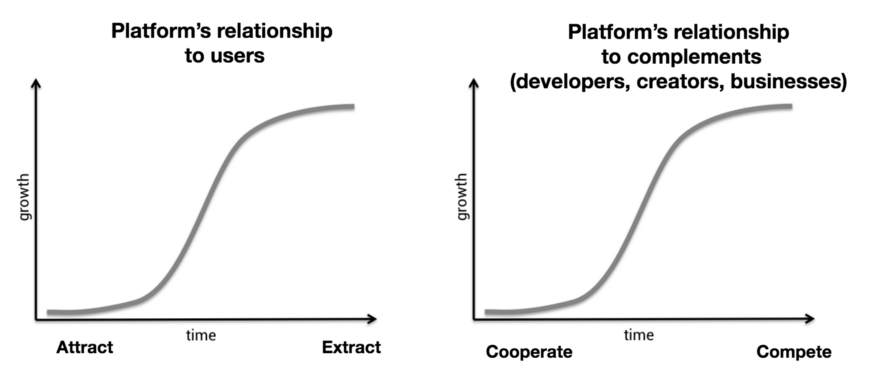
«As platforms progress along the S‑curve of adoption, their power over users and third parties steadily grows. When they peak, relationships with network participants become a zero‑sum game. The simplest way to sustain growth is to extract value from user data and compete with contractors for audience and profits», — Dixon wrote.
The resilience of the classic governance model, effective in the industrial age, has faltered in the age of information technology. Hence some community members argue that DAOs could offer an alternative form of cooperation.
Corporations organized the Industrial age
DAOs will organize the Internet Age
— Aaron Wright (@awrigh01) September 12, 2021
Advantages of Automation
In 2014, Ethereum founder Vitalik Buterin outlined the key attributes that distinguish DAOs from other coordinated systems:
«Automation at the centre, people on the periphery. […] Another important characteristic is internal capital».
At the core of any DAO lie smart contracts, which govern the structure, financial management and workflow organization.
Algorithms reduce operating costs by automating routine processes such as payroll and bookkeeping. They also simplify interaction between DAOs and all stakeholders, both external and internal.
As part of the broad blockchain ecosystem, DAOs can exploit the benefits of interoperability of dapps and the modular Web3 structure.
Dapps can efficiently integrate with one another, and their software components (tokens, messages to be transmitted, and so forth) can interact. This “Lego” allows combining apps into larger constructs with expanded functionality.
The modular Web3 architecture is characterised by the relative independence of its primitives. This increases system resilience and allows updating individual components without interfering with others.


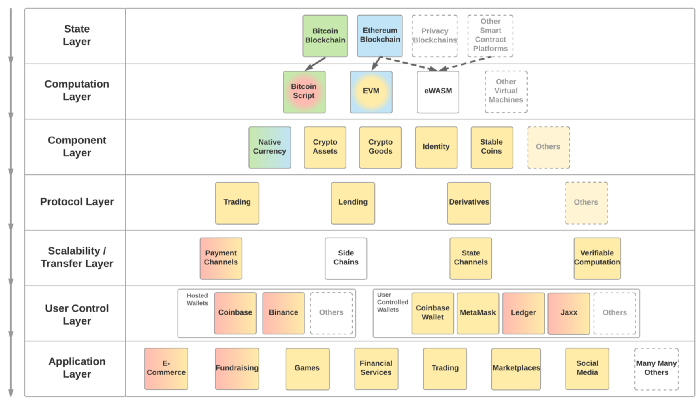
Anatomy of a DAO
Contrary to popular belief, not all participants in a DAO have equal influence; their weight varies depending on economic, reputational or other factors. They can be roughly divided into several groups:


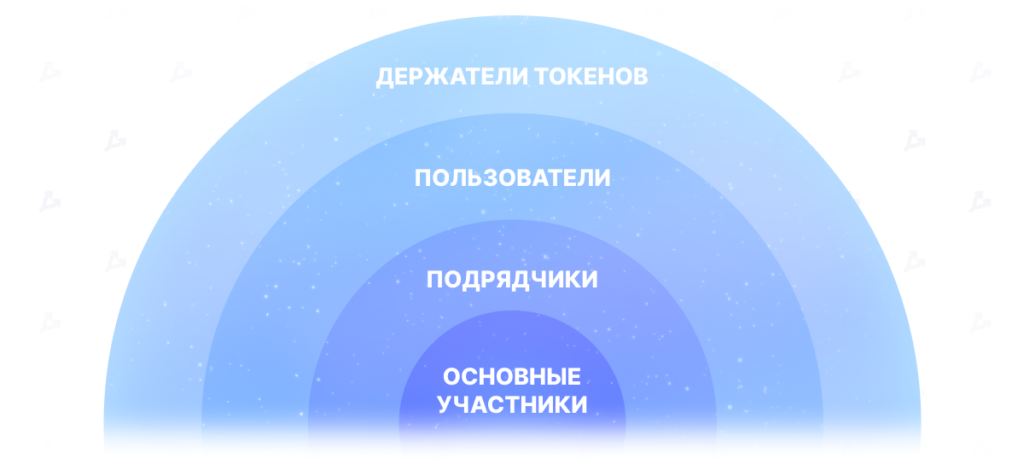
The core of a decentralised organisation is formed by “core participants” — people who contribute the key input to the project, effectively full-time staff. The interests of this group are closely tied to the DAO’s success and resilience, so their activities resemble those of a traditional model.
“Contractors” perform clearly defined work for an agreed price over a finite period. These people are often experts in finance, law, development and design, who provide services to multiple DAOs. Sometimes they act collectively, forming service DAOs such as VectorDAO or LexDAO.
While contractors and service DAOs resemble traditional outsourcing firms, their activities differ for several reasons:
- because smart contracts automate most routine tasks, the remaining peripheral work is clearly defined and narrowly specialised;
- DAOs benefit from delegating certain duties — this helps preserve decentralisation and avoid a complex hierarchy;
- the transparency of DAOs reduces the cost of coordinating third parties.
“Users” — the largest group of DAO members. Decentralised organisations reward individual contribution irrespective of its source. This means that everyday actions that create value for the network become opportunities to earn income.
The shell of a DAO is formed by “token holders.” This group spans all the categories above, because blockchain democratises investment opportunities. Anyone with a crypto wallet and Internet access can buy or earn digital assets.
This architecture resembles the structure of traditional corporations with a dash of decentralisation, but it is rather conditional. There is currently a process of diversification of DAOs, and their organisation can differ substantially from one another.
Meritocracy of Ideas
Theoretically, DAOs could become instruments by which coordinated groups grow and develop while remaining flexible enough to adapt to a changing environment.
However, the main advantage of this concept over traditional hierarchies is the primacy of the meritocracy of ideas — a decision-making system in which the best proposals win.
In most traditional companies, proposals from ordinary employees do not reach top management because of bureaucratic obstacles and middle managers. This reinforces top-down governance.
In a DAO, the principle works that decisions are taken based on the community’s view. Proposals are processed through concentric rings — from soft consensus to hard consensus:
- soft — a signal of preferences that comes from the liveliest channels such as Discord;
- hard — achieved by collective approval of a proposal through a voting mechanism (for example, a Snapshot platform).
DAOs must balance between these two forms of consensus, or risk getting bogged down in bureaucracy (hard consensus only) or turning any discussion into a chaotic debate (soft consensus only).
To make this work, organisations should implement appropriate governance structures. A popular approach is coin voting governance, which allows any DAO participant to propose an idea and use their tokens to back it.
However this tool has a number of serious drawbacks:
- vulnerability to direct or disguised attacks (e.g., manipulation of the governance economy);
- inequality in voting rights among DAO members;
- illusory decentralisation of power;
- unfair distribution of incentives;
- conflicts of interest.
Some of these might be mitigated by a delegation of votes, but that does not eliminate problems such as governance attacks and member inequality.
In Buterin’s view, there exist several solutions, all related to limiting or abandoning monetary voting. For instance, instead of tokens, reputation metrics anchored on the blockchain could be used.
Not Governance Alone
Technically launching a DAO is fairly straightforward. One must draft a manifesto, establish communication channels, invite people to join, issue a governance token, and connect voting and stake-registration tools.
What is harder is scaling the organisation. The growth and prosperity of a DAO largely depend on community engagement, so it is vital to maintain a fair incentive system.
Teams should also be mindful of the low decision-making speed in a DAO — a problem that grows with scale. Centralised companies are much more agile in this regard.
DAOs allow more users to participate in governance, but they come at a price. Due to a lack of expertise, reluctance to dive into complex technical questions and other factors, the community may spend more time debating a new logo than on truly important issues.
Another key aspect is security. Given the hefty technical stack required for effective operation, ensuring protection can become burdensome and costly.
Founder Dmitry Budorin of security-focused smart-contract firm Hacken told ForkLog that the cost of auditing the codebase grows exponentially with its size. He noted that the initial cost depends on the company; Hacken’s minimum is $7,000.
Budorin explained that audits not only help verify developers but also achieve certain marketing objectives.
«For the community, audits are mandatory. Investors, launchpads, centralised exchanges require [audits] from auditors, often specific ones», — he added.
Legal issues stand apart for DAOs. The rights of traditional companies are codified by law, but in the vast majority of jurisdictions decentralized organisations lack such privilege.
For them remains a number of questions: how to participate in commercial agreements, hire service providers, resolve disputes, use courts to defend rights, split assets and allocate responsibility among members.
Without official recognition, a DAO has no legal form. The community may authorise a particular person to enter into agreements on behalf of the organisation. Yet in some jurisdictions an organisation may be classified as a general partnership, which implies personal liability for the participants.
Thus some DAOs create traditional corporate structures. But this approach does not deliver high efficiency — virtually all decentralisation benefits are nullified.
When Are DAOs Effective?
In general, for successful development a DAO must engage in the same activities as traditional companies. They must manage their assets, assess risks, forge advantageous partnerships and so on.
At a certain stage each of these aspects will require its own governance structure. This, in turn, threatens decentralisation, returning the organisation to a traditional model.
Proof of this thesis are the initiatives of some large DAOs such as Yearn Finance, which in 2021 the community discussed a proposal to delegate certain powers to small teams.
Decentralisation is not a panacea for the corporate world. DAOs are effective when the costs associated with scaling can be reduced faster than the growth of coordination costs. It is therefore crucial for project teams to clearly articulate their real goals.
Read ForkLog’s Bitcoin news in our Telegram — cryptocurrency news, prices and analysis.