



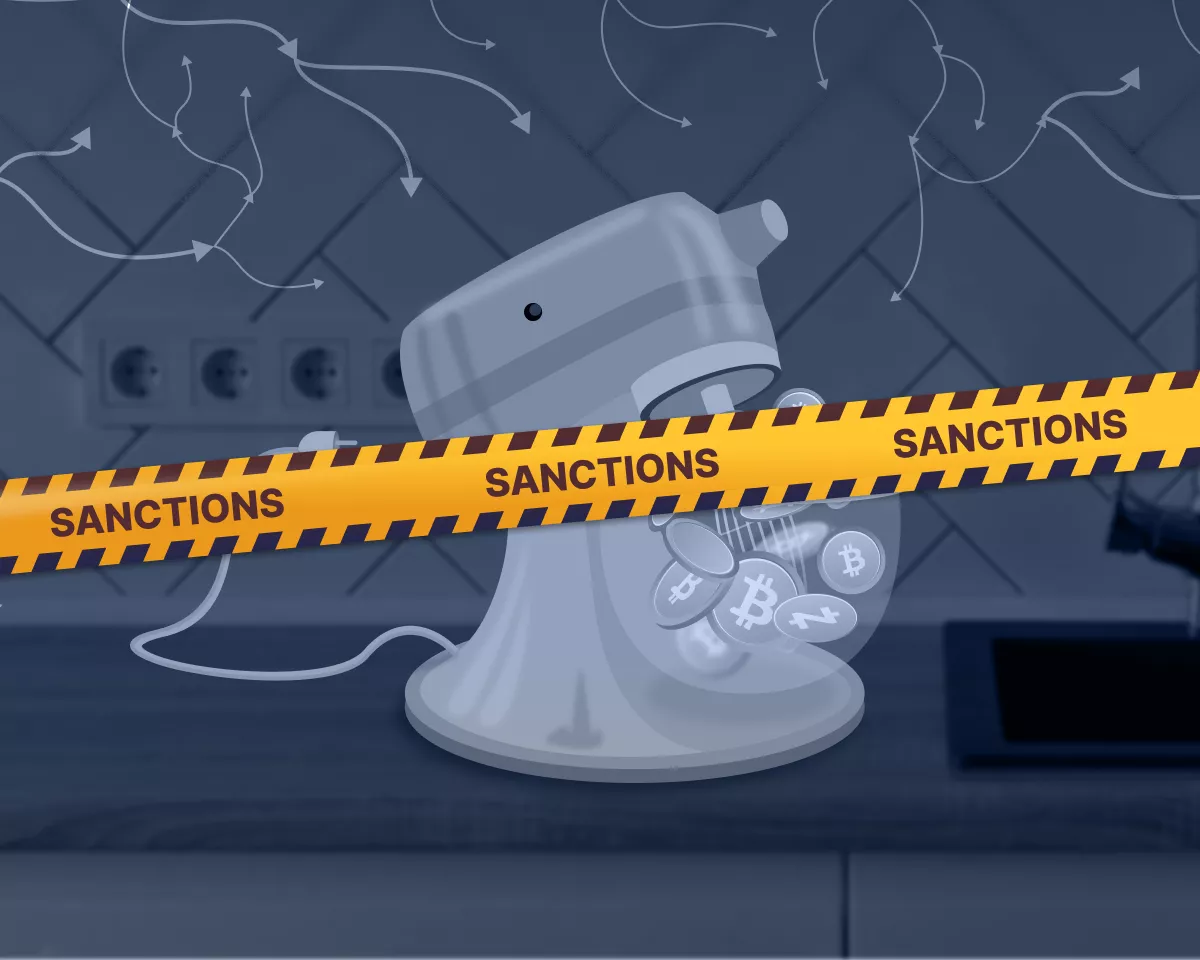
The tougher rhetoric from US authorities toward cryptocurrency mixers could potentially bring criminal charges against their developers, but is unlikely to solve the problem of financing terrorism in practice, experts told ForkLog.
Developers to Prison, Software Banned
CCO Mark Letsyuk, the chief communications officer at HAPI, argues that regulators will not stop at mandatory reporting of operations. He says that probable ways to pressure mixer services can be forecast by analogy with the case Tornado Cash:
«One can arrest developers around the world and throw them in jail, one can declare the software malicious and even push to remove its code from GitHub».
He added that the crypto community once defended Tornado Cash, arguing that it protected decentralisation and privacy. But in the fight against financing of terrorism, authorities will evidently not compromise and will resort to tougher methods.
«If cryptocurrency mixing itself is outlawed, all public developers will be jailed until resolution, long, protracted lawsuits will begin. Most private developers can also be deanonymised and exposed,» — Letsyuk.
Although mixers are decentralised, they could have their web interfaces disabled, and interaction would be possible only via a smart contract. This will require certain skills from ordinary users, but it won’t hinder hackers, the expert believes.
Furthermore, being under arrest, developers would not be able to update code or push updates. And if the mixer’s open-source code were removed from GitHub, no one could create forks or do anything new based on it.
According to Letsyuk, a significant role in tarnishing mixer services will be played by giants of the crypto- AML industry: Elliptic, Chainalysis, TRM Labs, Ciphertrace and others.
The data they provide on the volume of criminal cryptocurrency transactions on mixers cannot be independently verified — each company has its own methodology, clusters, and closed-source tooling.
Thus, mixer representatives will have to prove in private, through the courts, that their services are designed for privacy rather than fraud.
«[In this context] what happened with Tornado Cash will seem like flowers,» the expert believes.
How will operations be controlled?
Letsyuk expects that U.S. authorities will push for AML checks of user addresses before a mixing operation.
«A wallet passes a risk score via a conditional Chainalysis, and if it is not linked to money laundering or dubious services, it is allowed into the mixer. At the exit this address will already be mixed,» the expert explained.
This measure would affect users from any jurisdiction and most developers, as the latter tend to host the mixer’s backend in civilised countries, for example Ireland.
«And they themselves tend to spend time in similar places. The same Tornado Cash developers were caught in the Netherlands and the United States. They did not hide in Africa, Venezuela or Cambodia,» Letsyuk added.
Overall, he believes that when it comes to policy, it’s no longer about user convenience or adherence to decentralisation principles.
Will there be an effect?
The measure may seem useful on paper in the fight against terrorist financing, but in practice it will not solve the problem, says Dmitry Machikhin, founder and CEO of BitOK.
«Crypto mixers will always find ways to mask their addresses and evade reporting. Otherwise, what is the point if there will be control».
The expert does not expect significant consequences for users.
«Undoubtedly, some platforms will take a more cautious approach toward crypto mixers and may even block users, but in most cases this will not change much,» Letsyuk said.
According to him, some services are already considering a demixing service, but they are still in development.
«For such an implementation there must be an organization that would file reports. Also, in our experience we have not encountered a single mixer that was registered anywhere,» explained the BitOK CEO.
Earlier, Israeli authorities confiscated millions of shekels from crypto accounts suspected of ties to Hamas and other militant organisations in the Middle East, The Times notes.
According to The Wall Street Journal, Palestinian militants received at least $134 million in cryptocurrency.
Because of concerns about the use of digital currencies by cybercriminals and terrorists, FinCEN plans to declare cryptocurrency mixers “money-laundering hubs”, which threaten national security.
This form of sanction will require services to report on any financial operation.