


Bitcoin held near $67,000; a North Korean group was suspected of the Drift Protocol attack; an Anthropic leak exposed details of a new AI coding tool; the US began implementing the GENIUS Act; and other events of the week.
Subdued bitcoin
The past seven days brought little price action for the first cryptocurrency. The asset started Monday just below $67,000 and ends Sunday around the same level.
Bitcoin repeatedly probed local support and resistance, only to reverse each time. Trading volumes stayed high in the first half of the week, as digital gold tested the $65,000–$70,000 range.


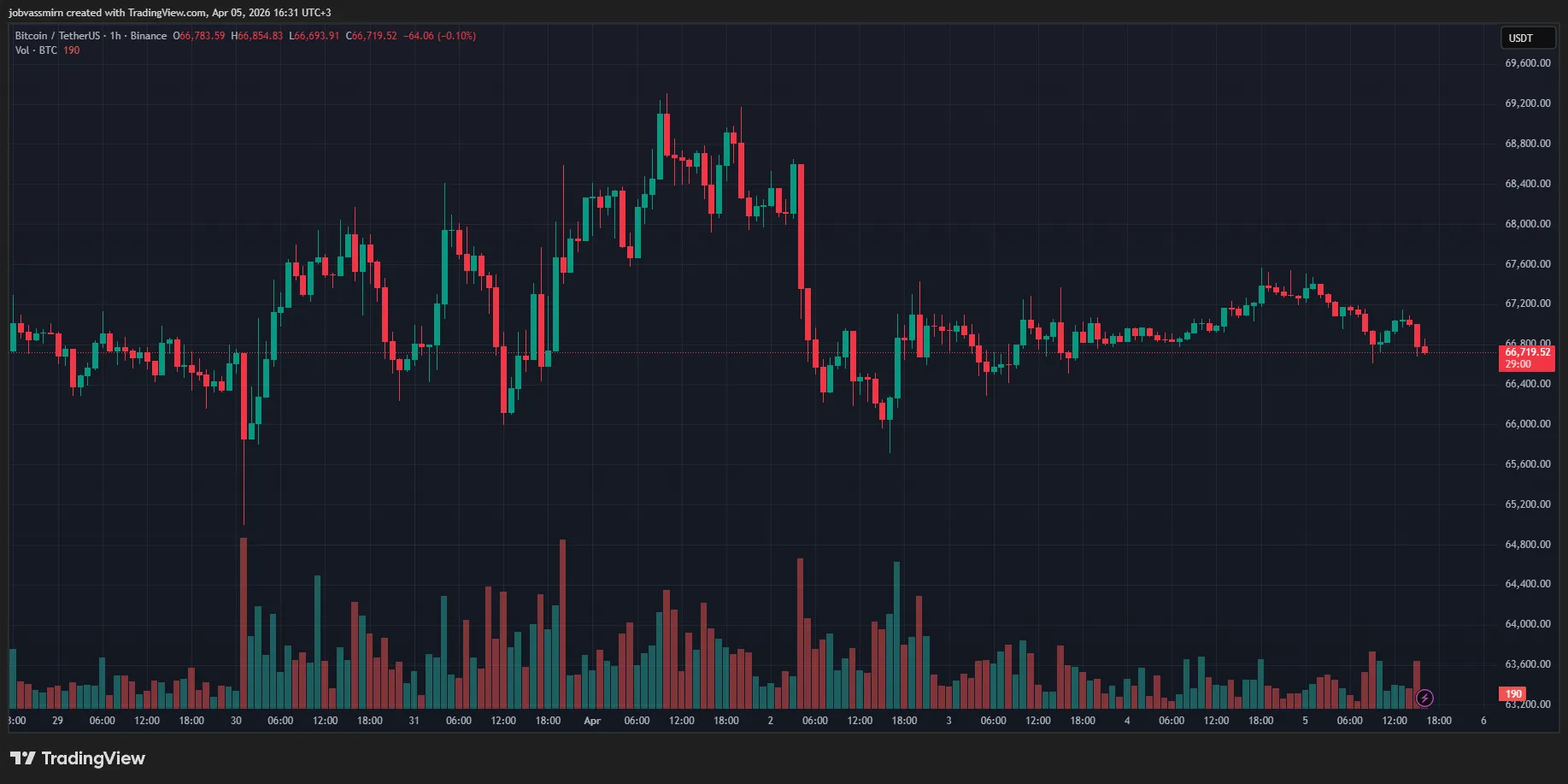
By Thursday the cryptocurrency had lost all positive momentum and resumed falling. In a matter of hours, bitcoin plunged from $69,000 to $66,000. The same day the asset briefly tested a local low near $65,000.
From Friday the coin stabilised around $67,000 and showed no sharp swings.
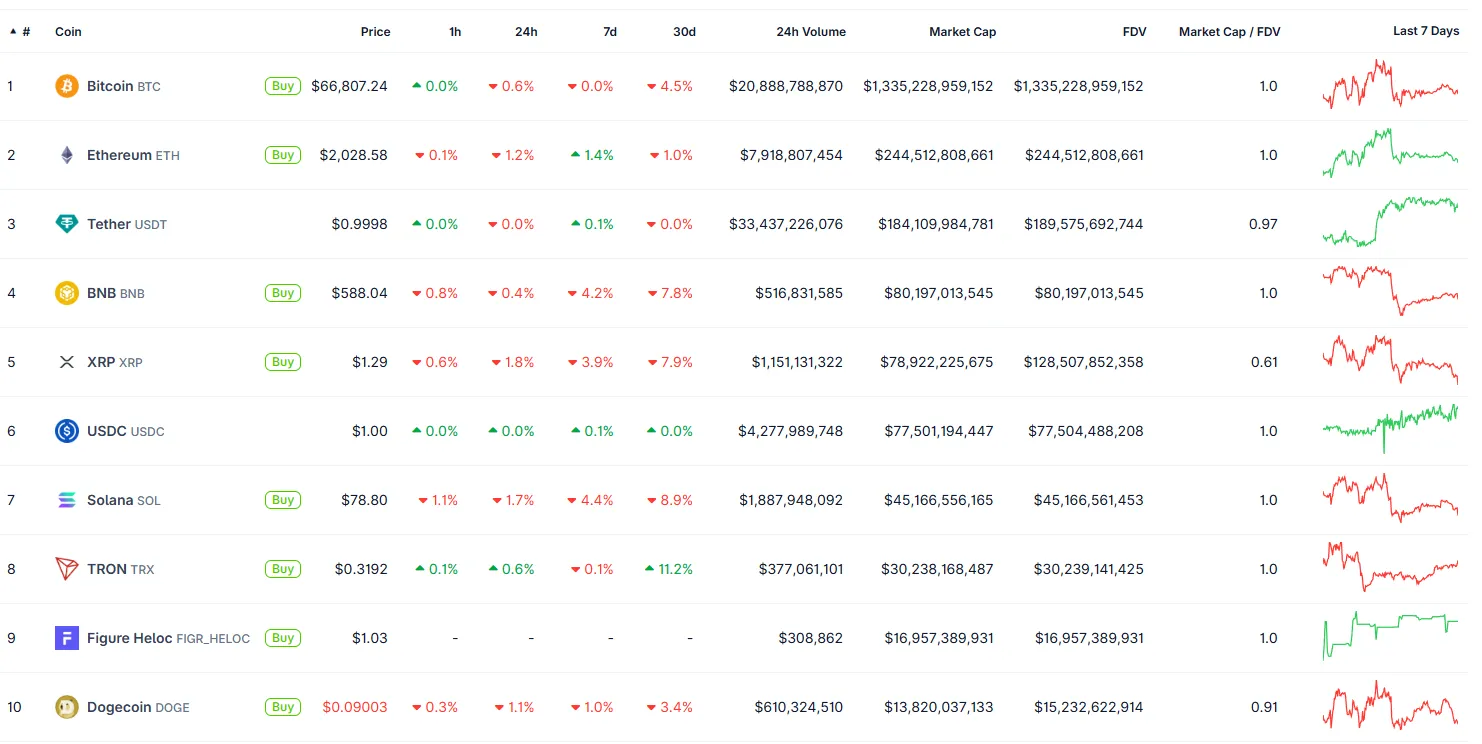
The rest of the market followed the flagship with small divergences. Ethereum added 1.5%, while BNB and SOL slipped 4% apiece.

Digital assets, like other markets, remain acutely sensitive to the conflict in the Middle East. Investors also face extra stress from US President Donald Trump’s equivocal comments on when the war with Iran might end.
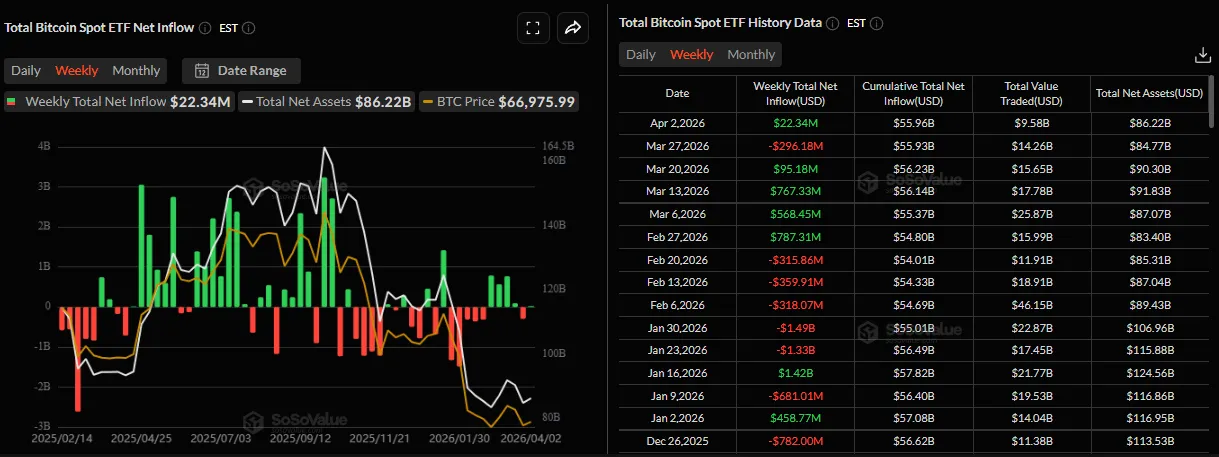
Inflows into bitcoin ETFs were almost neutral. Spot funds took in $22m net, while ethereum funds saw outflows of $42m.

Total crypto market capitalisation stands at $2.37trn. BTC dominance is 56.3%, ETH 10.3%.
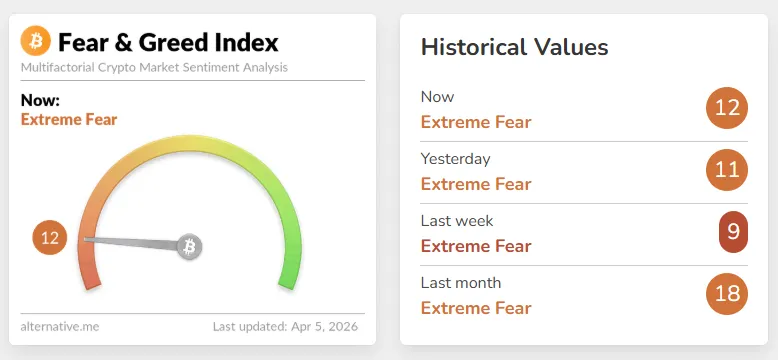
The Crypto Fear and Greed Index remains in extreme fear at 12.

Breaking and entering
On April 1 the Solana-based DeFi platform Drift Protocol was hit by a hack. Attackers siphoned about $280m by compromising a multisig.
The attack affected all deposit types—lending, trading and vaults. Untouched were DSOL tokens outside the Drift ecosystem and the Insurance Fund. As a safety measure the protocol froze operations.
In time, cybersecurity analysts concluded that North Korean hackers were behind the breach. The attackers not only compromised the multisig once; they re-breached it after system changes and exploited a delayed-signature mechanism.
Over the weekend the Drift team published details of its own investigation, which also points to the DPRK. The company says the culprits prepared the attack for half a year.
According to the protocol’s representatives, in the autumn of 2025 at one of the industry conferences they were approached by people acting on behalf of an unnamed trading firm who expressed a desire to collaborate.
“They had technical skills, a proven professional background and were familiar with how Drift works. After the first meeting we created a group in Telegram, followed by months of substantive discussions of trading strategies and potential vault integration,” the company noted.
Close communication between developers and the attackers continued roughly until late March. After the hack, all shared chats and contacts were deleted.
Data obtained during the probe linked the attack to UNC4736, a North Korean state-backed outfit also known as AppleJeus or Citrine Sleet. The same criminals are believed to have been behind the Radiant Capital hack worth more than $50m in October 2024.
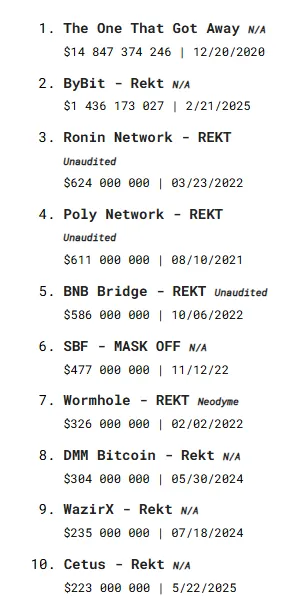
The Drift incident could enter the ranks of the largest crypto hacks by losses.

What to discuss with friends?
- A bitcoin whale booked a $55m loss selling 1,102 BTC.
- A glitch in Apollo Go robotaxis led to road accidents.
- Riot Platforms sold $289m of bitcoin to build out AI infrastructure.
- Buryatia and Zabaykalsky Krai banned bitcoin mining for five years.
Anthropic’s spoiler leak
Anthropic suffered a leak of part of the source code of its programming tool, Claude Code.

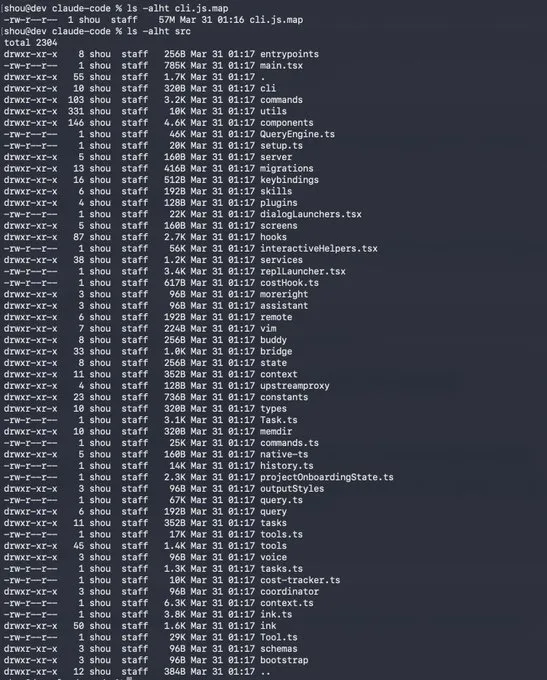
The published data fully revealed the solution’s architecture. In particular, how the service:
- manages requests to models;
- coordinates multiple assistants;
- controls access and permissions;
- handles authentication.
In addition, 44 functions not yet announced were found in the code. Among them are an always-on background system, Kairos, and an AI pet, Buddy.
Enthusiasts have already launched the open project OpenClaude, based on Anthropic’s code. The fork added support for the Anthropic API and models compatible with OpenAI’s interface.
The company said the leak did not expose customers’ confidential data. The error occurred during release packaging. During the “cleanup” of the leaked data another problem arose: the project team accidentally deleted thousands of repositories on GitHub.
The incident was Anthropic’s second leak in recent weeks. Earlier, a description of a forthcoming AI model and other documents appeared in the public domain.
At the time, company representatives said the new development is “a step change” in performance and “the most powerful solution to date”. It is now being tested among a limited group of users.
Regulatory moves in America
The US Treasury has begun implementing the GENIUS Act, publishing an 87-page document explaining how stablecoin regulatory regimes are determined.
Under the GENIUS Act, issuers of “stable coins” with less than $10bn outstanding may choose state-level oversight provided they meet federal standards. The rules set common criteria for assessment while leaving states latitude over licensing, supervision and enforcement.
The document splits requirements into two types:
- uniform—reserve backing, compliance with AML/CFT;
- state-calibrated—where local regulators retain discretion (for example, capital and risk-management standards).
Issuers are also obliged to publish reserve-composition reports at least monthly—the same frequency as at the federal level.
In parallel, the Department of Labor proposed new rules for 401(k) retirement plans, allowing the addition of alternative assets, including cryptocurrencies.
The initiative aims to cut regulatory uncertainty by scrapping a 2022 constraint. Fiduciaries’ responsibility will now depend on the quality of instrument valuation, not on eventual returns.
The document does not directly promote digital assets but creates a “safe harbour” concept for market participants. Investment funds will be able to add bitcoin, real estate and other non-standard products without fear of lawsuits.
Additionally, senators Bill Cassidy and Cynthia Lummis unveiled the Mined in America Act. The bill would reform the US mining industry, create a strategic bitcoin reserve and localise equipment production.
Also on ForkLog:
- Nakamoto sold 284 BTC at a 40% loss.
- Ethereum developers proposed solving L2 fragmentation by creating an “economic zone”.
- Fidelity analysts called bitcoin’s 52% decline a sign of market maturation.
- A solo miner found a bitcoin block and earned $210,000.
Quantum jitters
Google researchers concluded that fewer than 500,000 physical qubits may suffice to break the protections of bitcoin and Ethereum—20 times fewer than earlier estimates.
The team assembled two circuits for testing on a superconducting, cryptographically relevant quantum computer. One used 1,200 logical qubits and 90m Toffoli gates, the other about 1,450 logical qubits and 70m gates.
Under standard hardware assumptions the computation would take nine to 12 minutes, within bitcoin’s average block time of ten minutes. That makes possible an “on-spend attack”—a hypothetical threat in which an attacker derives a private key from the public key revealed during a transaction.
The researchers also warned that Ethereum’s account model is structurally susceptible to “at-rest attacks”. Unlike bitcoin, this threat does not require a timing window because public keys are permanently stored on-chain after a transaction.
“This is a systemic, inevitable vulnerability that cannot be eliminated by user behaviour without a network-wide transition to post-quantum cryptography,” the experts said.
Google estimated that the 1,000 largest vulnerable addresses (with ~20.5m ETH) could be cracked in less than nine days.
Co-author and Ethereum researcher Justin Drake said his confidence in the arrival of a so-called Q-Day by 2032 “grew significantly”. He puts the probability at roughly 10% that by 2032 a quantum computer will be able to recover a private key from a public one.
What else to read?
ForkLog explained the stage of the brain–computer interface industry and who is really carving up the young market.
In a new piece we explain why a French thinker’s concept still holds today—just read Donald Trump’s tweets, among others.
In the new episode of the podcast “Deconstruction”—Russia’s mining ban, Google’s quantum calculations, Iran’s strikes on Amazon’s servers, a historic Moon flight and the grim truth about neural interfaces.