



The week: an Aave rescue and a quantum vulnerability laid bare
Bitcoin holds $78k; DeFi rallies for Aave; a quantum key demo; and more from the week.
Bitcoin held around $78,000, the community raised over 100,000 ETH to shore up the DeFi ecosystem, a researcher cracked a 15-bit key on a quantum computer, and other events of the week.
Bitcoin steadies
Over the past seven days the leading cryptocurrency firmed up. Although Monday opened with a drop to $73,000, bitcoin managed to confirm a local positive trend.
By Tuesday, April 21, the coin had already returned to $76,000. On Wednesday morning the asset again pierced resistance around $78,000, which it had tested the previous week.
That same day the digital asset hit a high of $79,500.
Afterwards bitcoin moved into consolidation, trading in a narrow $79,000–$77,000 range from Thursday through the week’s end.
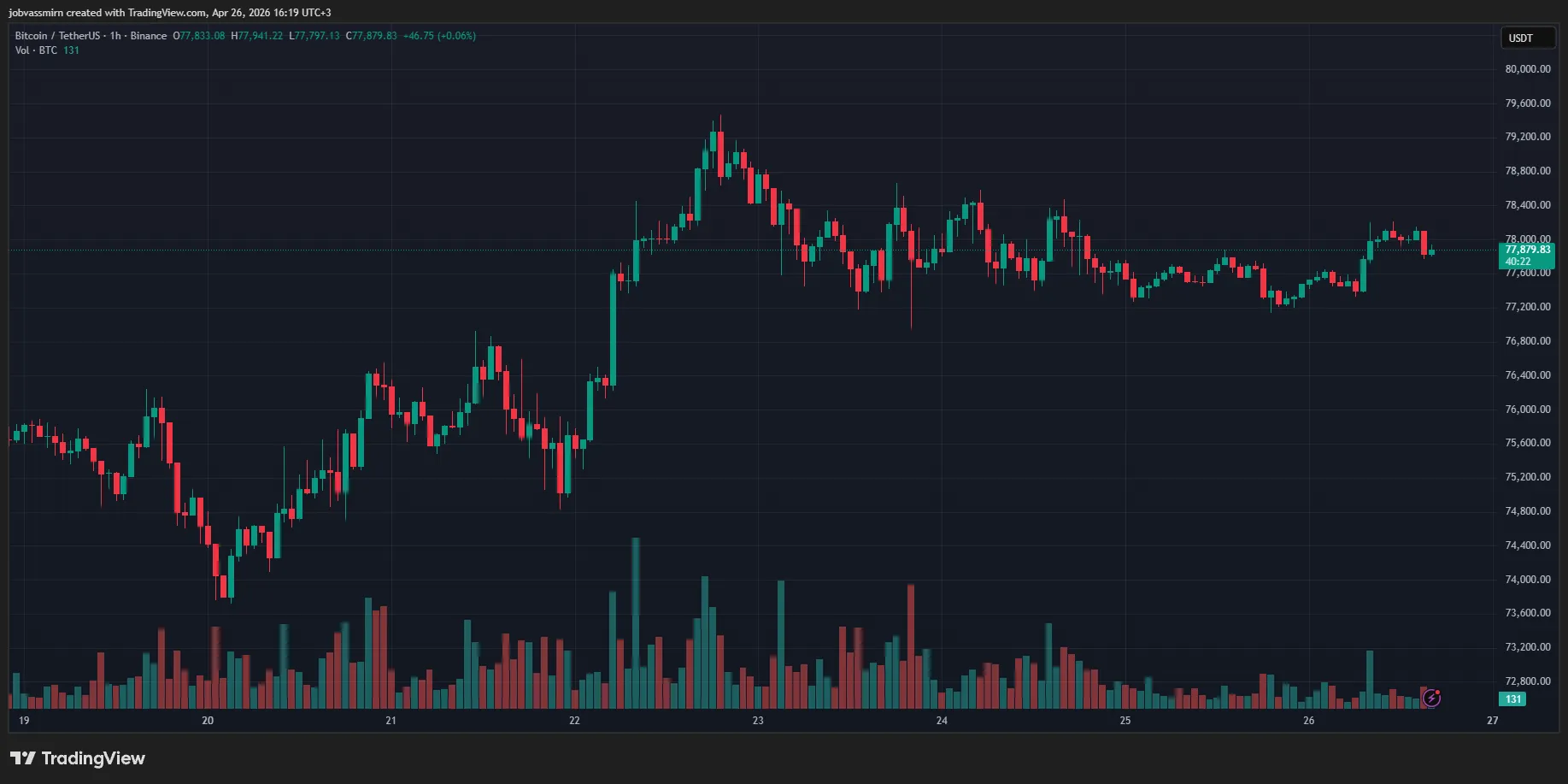
At the time of writing the price is $77,800 — up 1.5% on the week.
Several analysts reckon the rally was driven mostly by the derivatives market rather than spot demand. During the run to $79,000, the market saw a cascade of short liquidations totalling roughly $1.1bn.
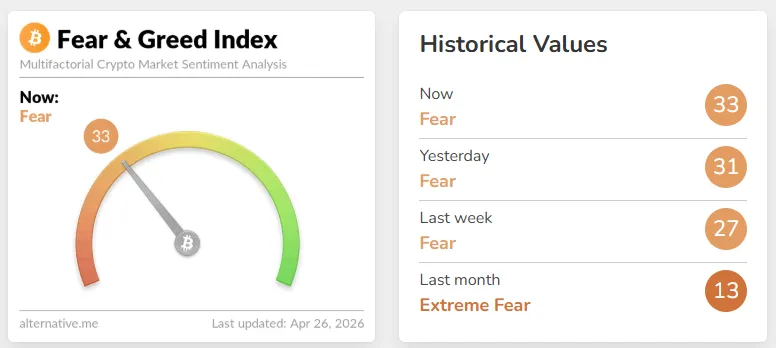
A shift in sentiment was confirmed by the crypto Fear and Greed Index. At one point the gauge climbed to 46 — a first since January. It now sits at 33, signalling “fear”.
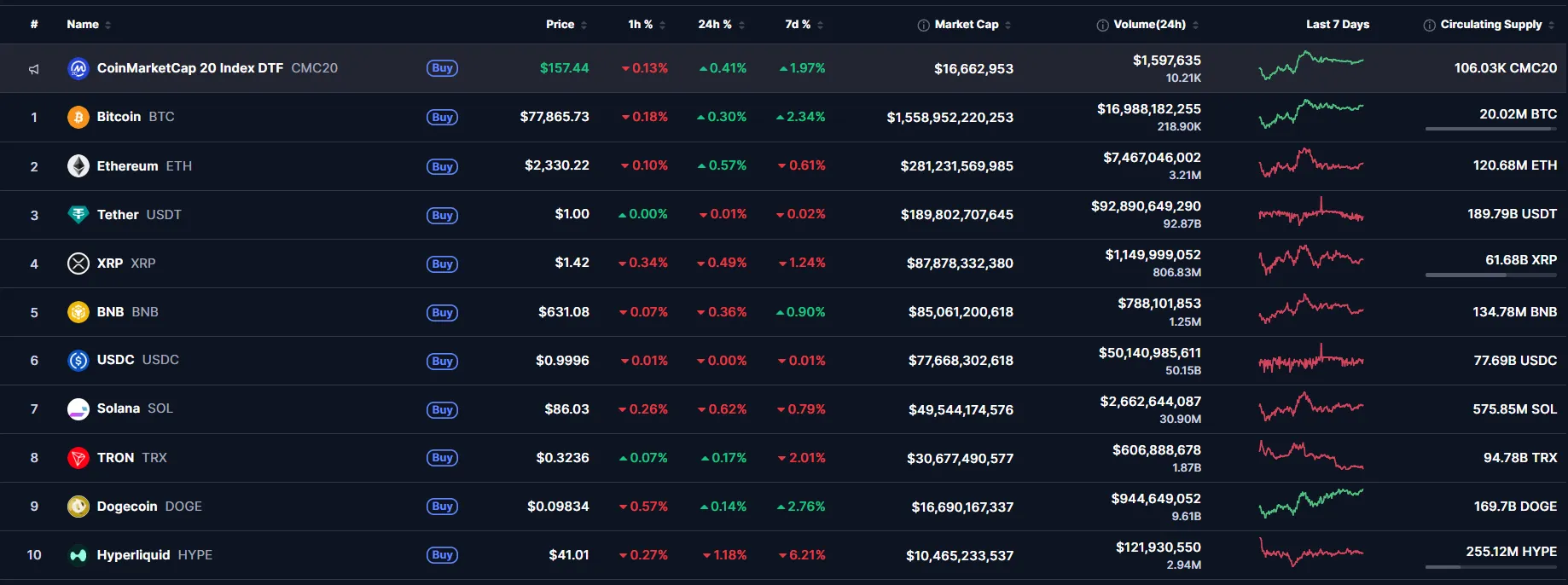
Other top-ten cryptocurrencies lagged the bellwether. Ethereum is stuck at $2,300 (-0.5% over seven days), XRP trades at $1.4 (-1.2%), and BNB at $631 (+1%).
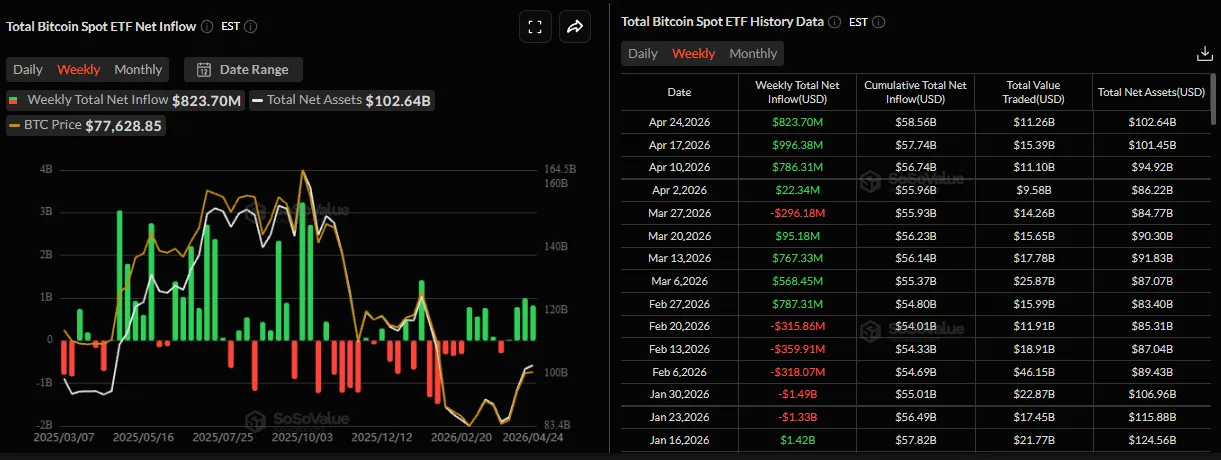
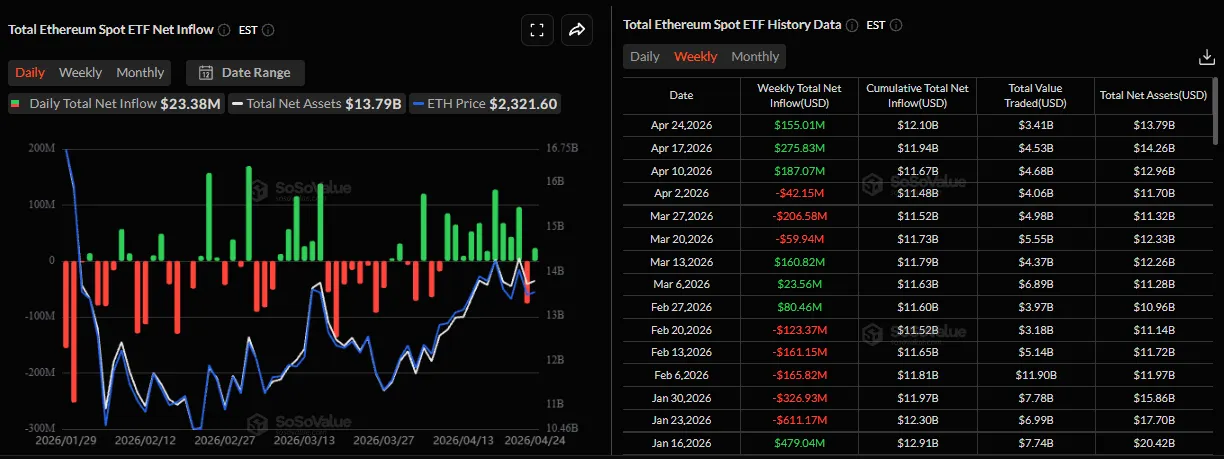
Meanwhile, spot bitcoin-ETFs notched a fourth straight week of inflows. The products took in $823m.
Ethereum funds attracted $155m — a third consecutive “green” week.
Total crypto market capitalisation stands at $2.68trn. BTC dominance is 58.2%, ETH — 10.5%.
A collective DeFi rescue
The community is still dealing with the fallout from the Kelp hack. The main task has been to plug the shortfall in the rsETH token.
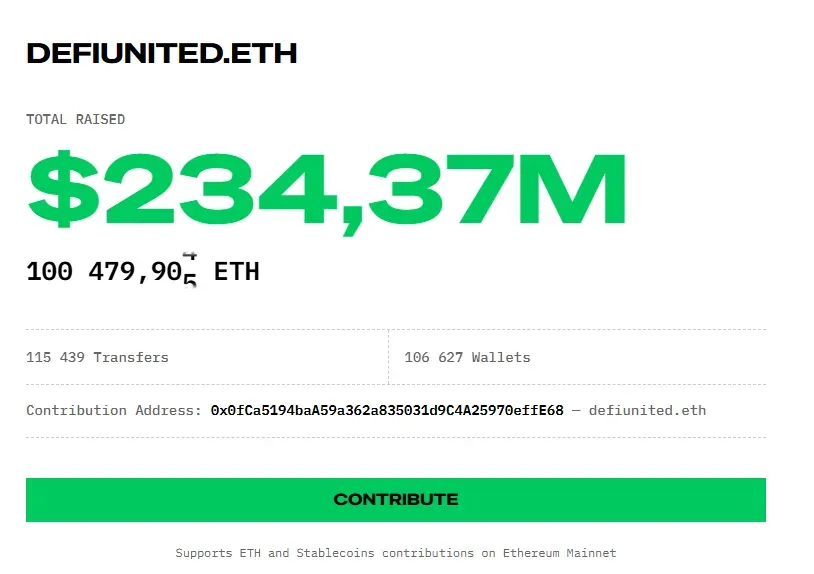
On April 23 the affected lending protocol Aave teamed up with leading DeFi platforms and launched the DeFi United initiative. The campaign opened a fund-raising drive to restore the ecosystem, which other projects joined.
“We believe that collaboration matters most in such moments, and our priority is to achieve the best possible outcome for users,” the Aave statement said.
In the days after launch DeFi United raised more than 100,000 ETH (~$230m). The sum nearly covered the ~ $290m loss from the hack.
The largest donors included:
- Mantle — 30,000 ETH;
- Aave DAO — 25,000 ETH;
- founder of Aave Stani Kucherov — 5,000 ETH;
- Ether.fi — 5,000 ETH;
- Lido Finance — 2,500 ETH.
Roughly 30,700 ETH was recovered via the freezing of stolen funds on Arbitrum.
Nearly 400 ETH came in as community donations.
As part of protective measures Aave and partners created a dedicated fund to rebuild collateral for the affected rsETH token. Kelp also set up a separate vehicle to compensate users.
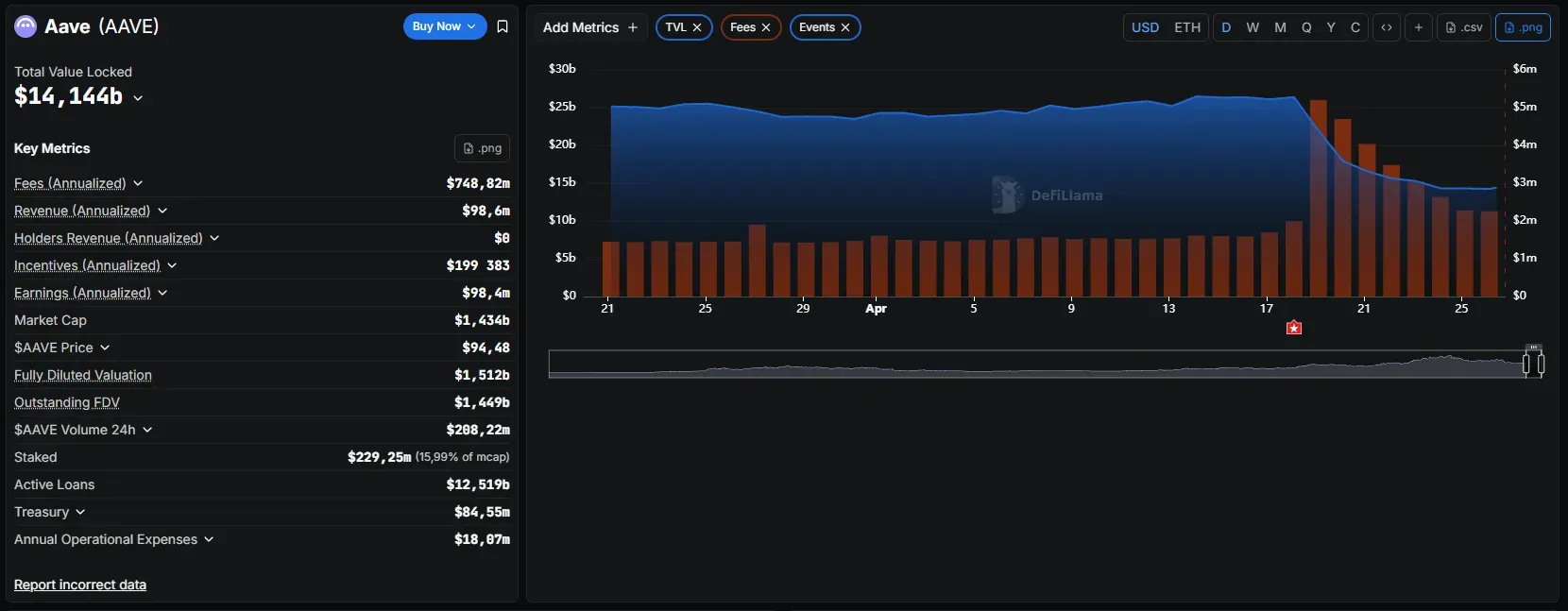
The protocol’s TVL decline has been stabilised. As of April 26 the metric hovered around $14bn. Even so, since the attack deposits on the platform have fallen by more than $12bn.
What to discuss with friends?
- The community marked Dogecoin Day.
- Reporters learned of a new scheme extorting bitcoin for passage through the Strait of Hormuz.
- A wave of DeFi hacks put Wall Street’s crypto plans into question.
- Belarus outlined rules for crypto banks.
A show of quantum strength
This week brought a reminder of the approaching quantum threat. Independent researcher Giancarlo Lelli managed to compute a 15-bit cryptographic key on ECC using a publicly available quantum computer.
For this the startup Project Eleven awarded the expert 1 BTC under its Q-Day Prize programme.
Lelli applied a modification of Shor’s algorithm to a search space of 32,767 combinations. The method targets the discrete logarithm problem on elliptic curves — the mathematical basis of digital signatures used across most blockchains.
Previously, engineer Steve Tippekonnik had extracted an ECC key on IBM’s 133-qubit machine, but it was six-bit.
Lelli’s result topped the prior demonstration by a factor of 512. Project Eleven’s team called it the largest elliptic-curve break using quantum technologies.
While the scale is nowhere near real systems — bitcoin uses 256-bit ECC — Project Eleven noted the gap is narrowing quickly.
Programmers deem the transition more an engineering task than a fundamental physics problem.
The project has its critics. Former Bitcoin Core developer Jonas Schnelli said that in this case quantum computing contributed nothing useful. The result was obtained via classical verification of outputs indistinguishable from random noise. The method is equivalent to classic guessing, like flipping a coin.
According to the developer, Lelli’s approach cannot be scaled to the bitcoin blockchain. Schnelli also reproduced the experiment with 20 lines of Python code, without any quantum computer.
Several experts agreed with his conclusions, including cryptographer Adam Back. Analyst Jacek Czech suggested Project Eleven’s reward payment was merely a marketing ploy.
Fresh conjectures
On April 22 a second documentary this month appeared on the mystery of Satoshi Nakamoto. Finding Satoshi, by directors Tucker Tooley and Matthew Miele, summarises a four-year investigation led by American business writer William D. Cohan and private detective Tyler Maroney.
The film concludes that the pseudonymous creator of bitcoin was a duo: cryptographers Hal Finney and Len Sassaman. The former handled code and technical implementation; the latter handled the textual and academic side, including the white paper.
The case rests on analysis of the candidates’ digital activity. The authors compared Satoshi’s online behaviour with that of known early crypto figures and concluded Finney and Sassaman most closely match the profile.
The filmmakers offered several circumstantial points for Finney, the first recipient of bitcoin from Satoshi. They also noted a pause in his repository activity between the white paper’s publication in October 2008 and mainnet launch in January 2009 — a period in which Finney could have worked on bitcoin.
For Sassaman the film cited other arguments: academic writing style, ties to cypherpunks and expertise in anonymity.
The documentary also features dozens of interviews. Among the participants are Bill Gates, Gary Gensler, Michael Saylor, Joseph Lubin and Fred Ehrsam.
Tooley and Miele stressed the film does not claim to resolve Nakamoto’s identity. What Finding Satoshi presents is merely a hypothesis.
Also on ForkLog:
- Cybersecurity experts warned of a new wave of attacks by North Korean hackers.
- A robot set a world record in the half marathon.
- Tether blocked $344m in USDT at the request of the US.
- US politicians were sanctioned by Kalshi for insider trading.
An updated GPT
On April 23 OpenAI released a new language model, GPT-5.5. It is billed as “a new level of intelligence for real work and agentic control”.
The neural network is “built to understand complex tasks, use tools, verify outputs and carry more tasks to completion”.
GPT-5.5 can also:
- understand user intent;
- plan work autonomously and drive tasks to an end result;
- write and debug code;
- search the internet for information;
- analyse data;
- create documents and spreadsheets;
- control software and switch between tools.
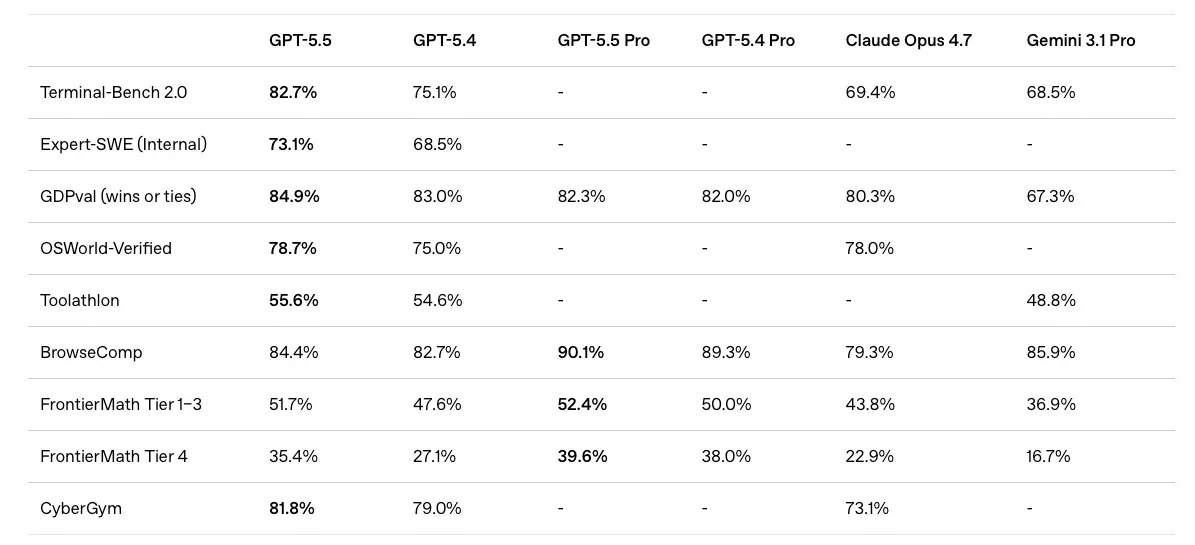
OpenAI noted the new model is particularly effective in agentic programming, computer control, knowledge work and early-stage scientific research — areas that require long chains of reasoning and action.
The model “noticeably outperforms” GPT-5.4 and Claude Opus 4.7 in reasoning and autonomy: it anticipates issues, predicts needs for testing and review, and does so without explicit prompting.
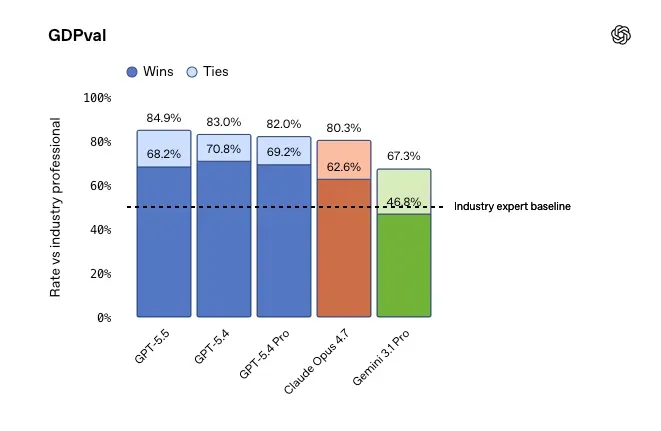
GPT-5.5 is available in ChatGPT and Codex for Plus, Pro, Business and Enterprise plans. A separate GPT‑5.5 Pro version is available for Pro, Business and Enterprise.
Both variants will soon be available via the API at $5m per 1m input tokens and $30m per 1m output tokens. Context window — 1m tokens.
What else to read?
How cutting corners on intelligence-gathering backfires, what governments will pay to crack a smartphone, and how to trust researchers who unearth bugs decades later. Answers in ForkLog’s new feature.
The end of the monopoly on intellect — how algorithms displace the cognitive elite.
Рассылки ForkLog: держите руку на пульсе биткоин-индустрии!