



We aim to inform readers not only about happenings in the bitcoin industry, but also about what is going on in related technology fields — cybersecurity and the world of artificial intelligence (AI).
ForkLog AI has gathered the most important AI news from the past week.
- Nvidia unveiled a suite of AI products at the GTC 2023 conference.
- Microsoft added a chat-bot function and voice input to GitHub Copilot.
- Opera added in-browser smart prompts AI Prompts, powered by ChatGPT and ChatSonic.
- Coinbase tested ChatGPT for conducting automated token checks.
- TikTok banned posting deepfakes without proper labeling.
- Researchers ‘copied’ an AI algorithm from ChatGPT for under $600.
- Roblox released two generative AI tools for game developers.
- The most significant AI deals of the past week.
Nvidia unveiled a suite of AI products
At the GTC 2023 event, Nvidia unveiled a set of cloud services—AI Foundations—for AI development.

According to the tech giant, these tools will enable companies to create, refine and deploy large language and generative AI models, training them on their own data to tackle unique tasks.
AI Foundations include the language service NeMo and the Picasso platform for generating images, video and 3D. Both products include pre-trained models, APIs, optimized inference engines, data processing frameworks and Nvidia’s engineering support.
At GTC 2023, the company also unveiled a number of other AI systems. These include:
- DGX Cloud, a cloud service that lets users rent Nvidia’s powerful AI infrastructure and software via a browser;
- L4 inference platform for video performance, L40 for creating 2D/3D images, NVL for deploying large language models and Grace Hopper for building recommender systems;
- Isaac Sim for collaborative work on smart devices;
- Omniverse workflow for automakers;
The company also opened access to the H100 Hopper AI accelerators.
Microsoft updates GitHub Copilot and Loop
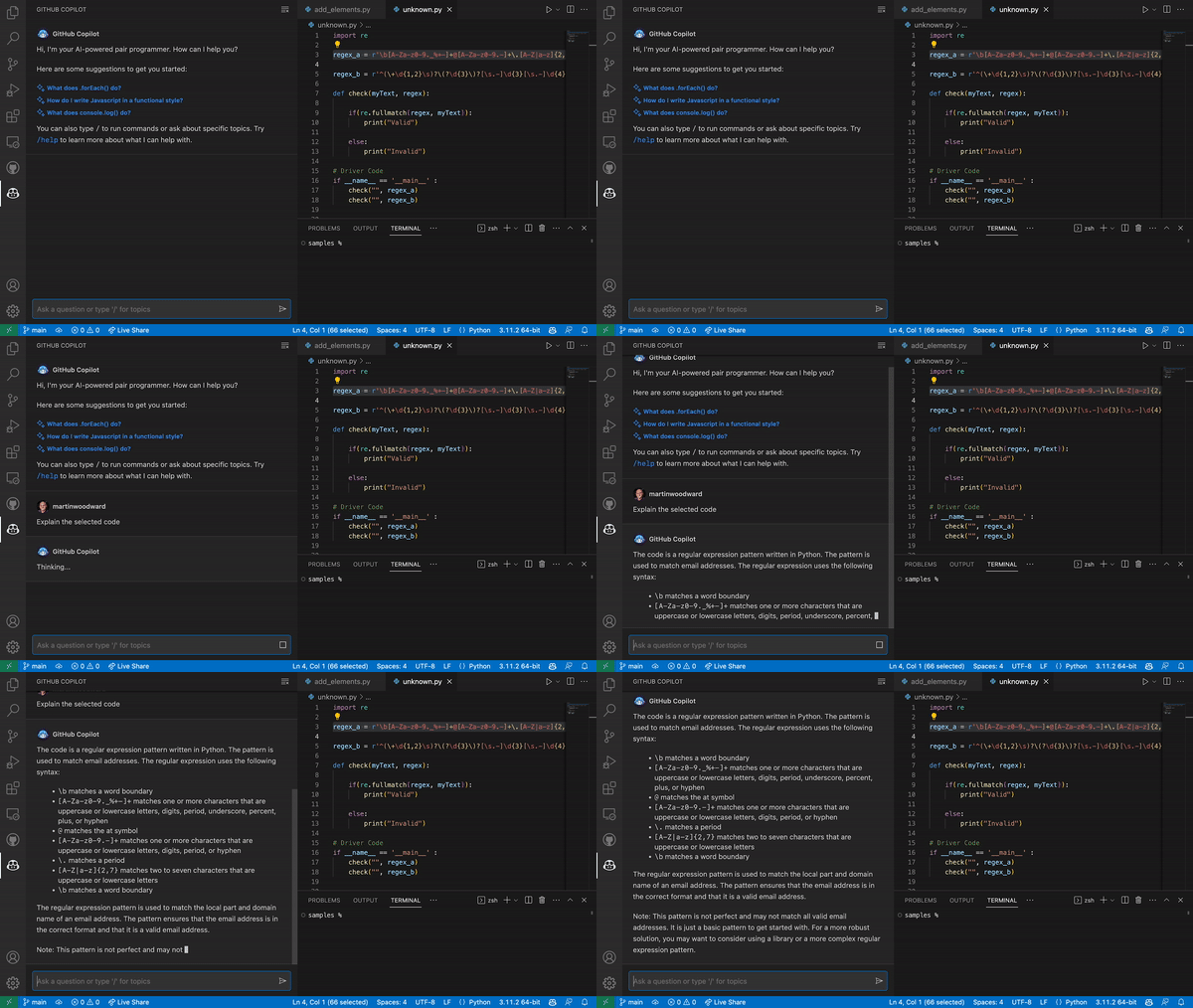
Microsoft added a chat-bot function and voice input to the code-writing tool GitHub Copilot. It also integrated AI into the collaboration service Loop.
The new GitHub Copilot X uses the GPT-4 language model and offers a ChatGPT-like interface inside code editors. The AI assistant can recognize, analyze and explain code fragments, and also suggest changes, rewrite lines, add helpful comments and fix errors.


The Loop service gained support for Microsoft 365 Copilot. The AI assistant can help draft text, brainstorm ideas, answer user questions, and summarize content within the workspace.
The company also announced that Loop is now available to all users.
Opera integrates ChatGPT and ChatSonic in the browser
Opera added in-browser smart prompts AI Prompts, powered by ChatGPT and ChatSonic.

To use AI assistant tips, highlight text or a phrase and choose a suitable query for one of the bots, for example, ‘Summarize’, ‘Rewrite in other words’ or ‘Explain’. A results panel will then open on the left.
You can also use prompts for the entire page. To do this, click the corresponding button near the address bar.
ChatGPT and ChatSonic in Opera are available after registration.
Coinbase used ChatGPT for token-security checks
Coinbase specialists tested ChatGPT for automated token checks.
They compared the bot’s results with the Blockchain Security team’s reports. Blockchain security engineers use internal tools to analyse each token smart-contract function and derive a risk-based assessment.
To compare AI with manual checks, the team supplied ChatGPT with additional information. In particular, they taught the bot to identify risks uncovered by the ERC20 security-analysis framework.
They then compared 20 scores generated by AI and by engineers. They matched in 12 cases. In five of eight categories, ChatGPT incorrectly labelled a high-risk asset as low-risk.
According to Coinbase, the bot shows promising ability to rapidly assess smart contracts, but does not meet accuracy requirements. In the future the team plans to improve the tool’s effectiveness but does not intend to rely on it alone.
TikTok bans posting deepfakes without labeling
TikTok banned posting deepfakes without the corresponding label.
Under the updated rules, creators of such content must indicate that the video was created or edited with AI tools — via a watermark over the video or in the description. Posts without labels will be banned.
Additionally, moderators may remove videos that use realistic synthetic voices of both famous and non-public figures.
The platform also banned political and promotional AI-forgeries. However, moderators will not remove artistic or educational deepfakes involving celebrities.
Ernie Bot from Baidu accused of political censorship
Baidu’s Ernie Bot refuses to speak about China’s Xi Jinping, the Tiananmen Square events, and the plight of the Uyghurs in China.
According to Reuters, the AI system cannot converse on sensitive political topics related to China. In such cases Ernie Bot says it has “not yet learned to answer this question” or suggests changing the topic.
It also refuses to discuss U.S. President Joe Biden and his predecessor Donald Trump. However, the AI can discuss international relations if topics like “Should China use military force to reunify with Taiwan?” are avoided.
Researchers created a ChatGPT copy for $600
Stanford researchers ‘copied’ the AI algorithm from ChatGPT for under $600.
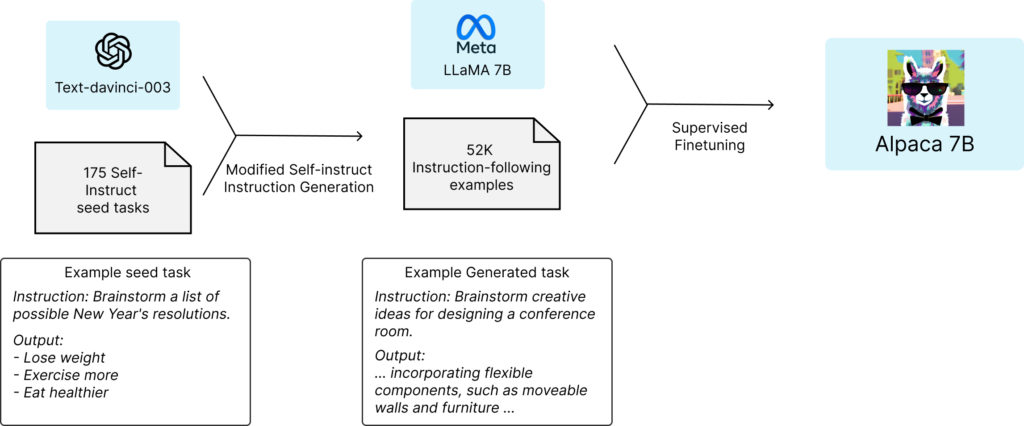
They used Meta’s 7-billion-parameter language model LLaMA. They wrote 175 prompt-response pairs and asked GPT-3.5 to generate more data. The resulting about 52,000 conversation examples were used to fine-tune LLaMA.
The researchers spent less than $500 to create the dataset.
Then the experts used the data to fine-tune Meta’s model. The process took about three hours. They used cloud infrastructure based on A100 chips, costing another $100.
The resulting algorithm, named Alpaca, was compared with ChatGPT on tasks such as writing emails, creating social-media content, and boosting productivity. The Stanford model succeeded on 90 tests, while GPT-3.5 did 89.


Ubisoft developed an AI ghostwriter to craft NPC dialogue
Ubisoft unveiled an AI ghostwriter for generating dialogue lines for non-player characters.

The tool can generate crowd-voice lines and various minor NPC cues during interactions based on given parameters. After generating texts, a designer can freely edit them and mark the best variants for further neural-network training.
The company says the tool will boost the efficiency of scriptwriters and narrative designers, and create more realistic NPCs.
Runway unveils Gen-2, a new AI video-generation algorithm
Runway has developed an AI algorithm Gen-2 for generating three-second videos from short text prompts.
The technology builds on the existing Gen-1 model, which the company unveiled in February 2023. It allows changing the style of a finished video from a textual prompt or image.
Gen-2 is not yet available to everyone. To test the algorithm, interested users must sign up on Runway’s Discord server.
According to a company spokesperson, in the coming weeks developers will provide broader access to the technology.
Roblox rolls out generative AI tools for game developers
Roblox launched beta versions of two generative AI tools for game developers.
The first helps modify object textures on demand, the second writes code from natural-language prompts. The systems are available to Roblox Studio developers.

The texturing tool can be used even without programming skills. The second will require some coding experience from a game designer, Roblox added.
The most notable AI deals of the past week
From March 19 to 25, 2023, AI startups raised more than $287 million. Here are the most notable deals.
- AI startup Character AI, founded by former Google employees, raised $150 million at a $1 billion valuation.
- Web3 AI-powered social network OP3N attracted $28 million in a Series A round.
- Drone maker Wingtra received $22 million.
- Numbers Station attracted $17.5 million to build a platform for automating the data-stack.
- CodiumAI raised $11 million to build tests for code logic using generative AI.
- IPRally, a knowledge-graph patent search startup, received $10.8 million.
- Tavus attracted $6.1 million to develop generative AI for personalized deepfake videos.
- MVision AI, a startup in medical visualization and AI, raised $5.85 million.
- Aspecta, developers of a profiler for programmers, attracted $3.5 million.
- Bionic Health raised $3 million to create a “medical AI clinic” to improve preventive care.
Also on ForkLog:
- Sam Altman acknowledged the risks of ChatGPT.
- CertiK researchers suspected Harvest Keeper of stealing $1 million amid AI hype.
- OpenAI: GPT models will affect 80% of jobs in the United States.
- Google launched a preview version of the Bard chatbot.
- Bill Gates called GPT the most important breakthrough since 1980.
- Microsoft integrated an image generator into Bing and Edge.
- ChatGPT gained plugin support.
- TikTok chief testified before the U.S. Congress.
- In Paris AI surveillance will be deployed ahead of the 2024 Olympics.