


Tim Berners-Lee’s Vision for the Future of the Internet
- On March 12, the World Wide Web officially turned 35 years old.
- Tim Berners-Lee shared his vision for the future of the internet.
- The inventor believes it will be significantly transformed by artificial intelligence.
March 12 marked 35 years since the invention of the World Wide Web. Its creation is attributed to Tim Berners-Lee, who introduced the modern model of the internet while working at CERN.
In 1989, the scientist proposed an information management system to help colleagues exchange data. He continued to develop the approved idea, and two years later, the World Wide Web became accessible to the general public.
In an interview with CNBC, Berners-Lee highlighted the negative aspects of the technology and offered predictions about its future.
He pointed out the downsides, such as:
- AI-generated content that provokes people to “feel anger, distress, or hatred”;
- the loss of ownership rights over personal data, which has become the property of large tech corporations.
However, Berners-Lee also sees positives in the future of the World Wide Web. Here are some of his key predictions about how the internet will look in the next 35 years.
Prediction #1: Emergence of Personal AI Agents
The scientist believes that neural networks will change our interaction with the internet. With the advent of generative AI tools, users will increasingly turn to chatbots for information and assistance in creating content or code.
Berners-Lee envisions a future where people will have AI assistants working for them. He compares them to personal doctors, lawyers, or accountants.
“Some people worry that in 35 years, AI might become more powerful than us. I predict one thing — you will have an AI assistant you can trust, and it will work for you,” Berners-Lee clarified.
Robert Blumofe, CTO of Akamai, agrees. He believes the internet will cease to be something people use directly. AI agents will interact online on our behalf.
“Imagine a world where the internet becomes a territory for AI assistants, and we stop visiting it so often,” said the executive.
Blumofe suggests that we will go online for entertainment, while AI will handle the everyday functions of our online lives in the future.
“People will finally be able to return to life in the physical world, meeting each other face-to-face,” added Blumofe.
Prediction #2: Ownership of Digital Data
Berners-Lee believes that in the future, we will fully control our data instead of transferring ownership rights to Google, Meta, Amazon, Apple, Microsoft, and other tech giants.
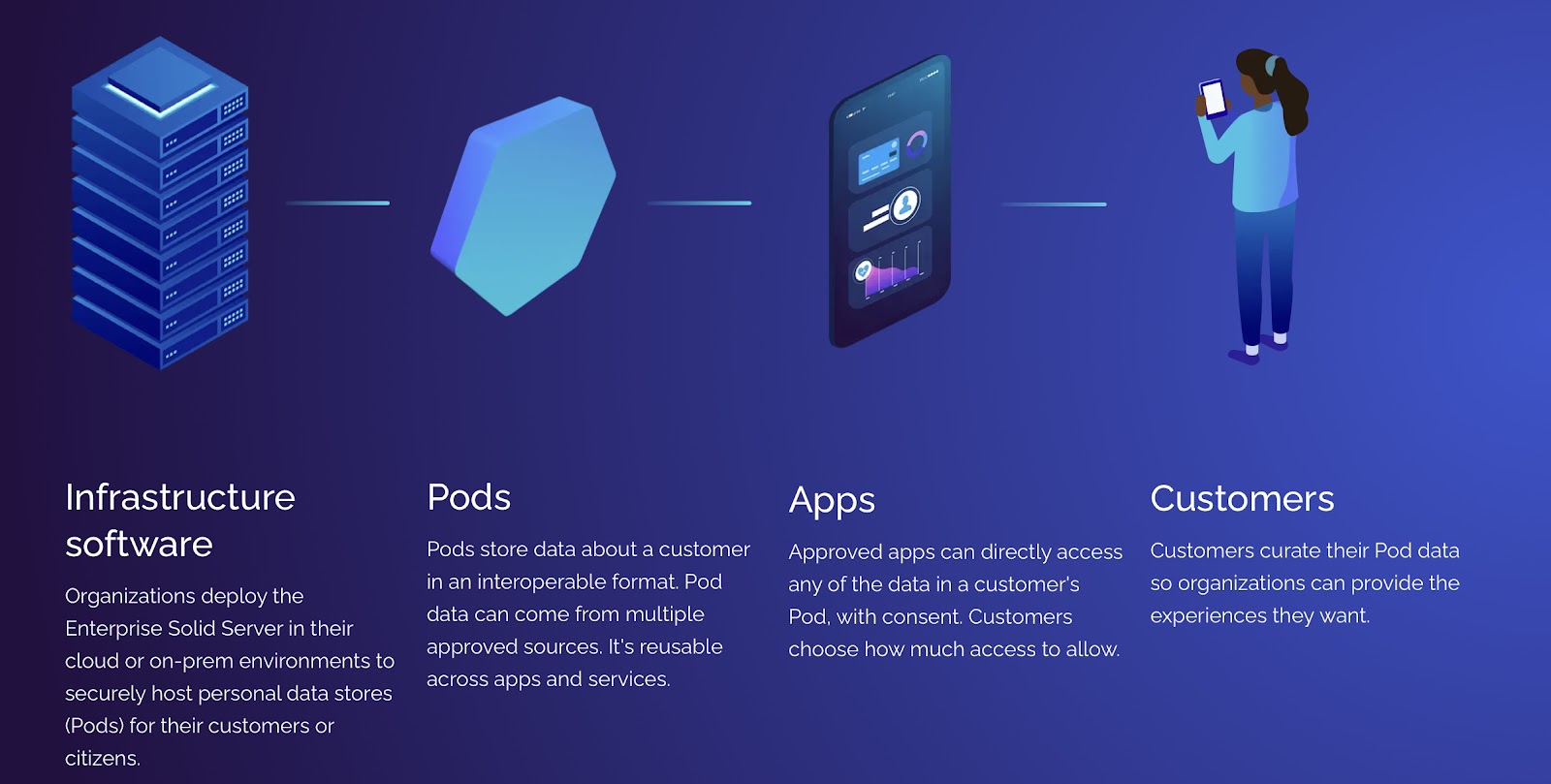
Pod is a technology Berners-Lee is developing with his startup Inrupt. The company has created the Solid protocol, “designed to radically change the way web applications work today, providing true data ownership and enhanced privacy.”
The scientist predicted that humanity will increasingly use virtual and mixed reality, with physical and digital worlds interacting through headsets.
“You can do something with a VR headset, and then, when you take it off, continue working on a TV screen. At any moment, you can transfer the task to a smartphone, and all gadgets will be perceived as a single entity. The transition from one device to another will be very smooth and comfortable,” explained Berners-Lee.
Chintan Patel, CTO of Cisco, believes the network will become open, making information sharing easier.
“While the internet is becoming more fragmented, with more disparate platforms, more information is being collected, sold, and even misused in many cases,” stated Patel.
Prediction #3: The Breakup of Big Tech Companies
On March 6, 2024, the EU’s Digital Markets Act (DMA) came into force. It requires tech giants to transform their platforms to allow competition.
If a corporation violates DMA obligations, the European Commission can impose serious legal measures: fines of up to 10% of total annual revenue and 20% for repeated violations.
“Everything is changing very quickly. AI is changing very, very quickly. Monopolies are already forming in this area. In the future, authorities may have to break up large companies,” concluded Berners-Lee.
The scientist approved of the “right steps” taken by tech giants before regulatory intervention. He cited the DTP, launched in 2018 and supported by Google, Apple, Meta, and other corporations.
Back in June 2021, Berners-Lee sold the original source code underlying the internet as an NFT. An error was later discovered in it.
Рассылки ForkLog: держите руку на пульсе биткоин-индустрии!