




By 2026, the total market capitalisation of the stablecoins segment surpassed $311bn, and its structure grew markedly more complex as institutional investors and politically connected players entered the field.
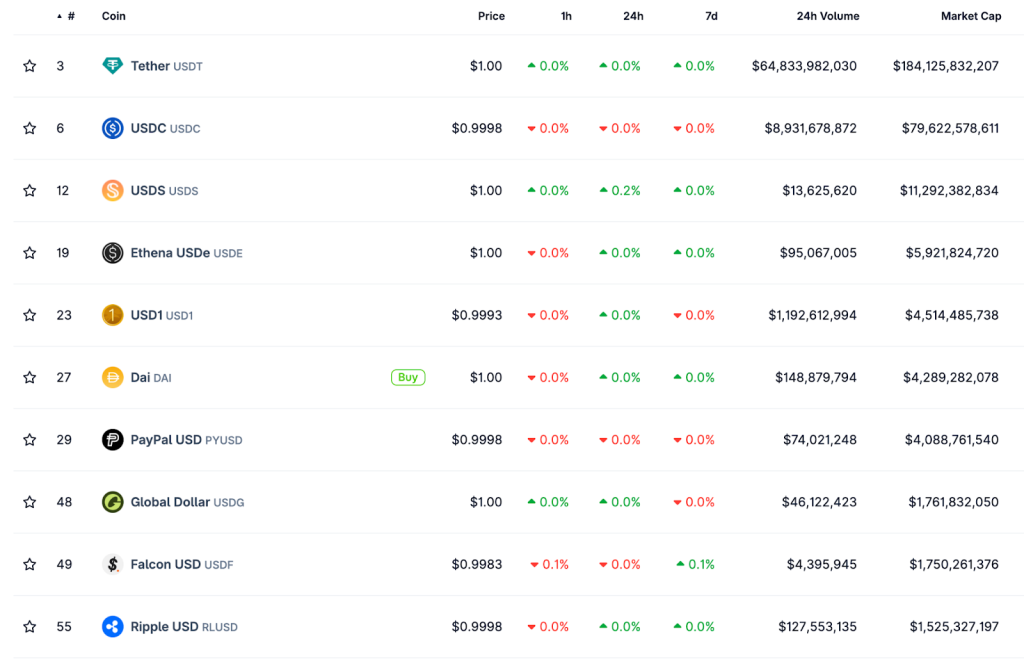
ForkLog reviews the technological and economic traits of the leading dollar-pegged “stablecoins” and their current standing in the market-capitalisation league table.
This analysis is based on stablecoin market-capitalisation data from aggregator CoinGecko as of 18 March 2026. Information on 24-hour trading volumes is also sourced from the service.


1. Tether (USDT)
Launch year: 2014
Issuer: Tether
Market cap: ~$184.1bn
A turning point for stablecoins was Tether’s long-running legal dispute with the New York Attorney General, which ended in 2021. The company was accused of opaque bookkeeping and of concealing information on the revenues and losses of its affiliated exchange, Bitfinex. The court ordered the USDT issuer to publish regular independent attestation reports.
That forced Tether to overhaul the composition of its reserves. The company disposed of commercial paper and shifted a large share into short-dated US Treasuries.
Subsequent diversification into gold was a response to fiat depreciation. As of February 2026, the USDT issuer held about 148 tonnes of the metal—among the world’s largest non-sovereign gold hoards. Tether also invests in mining by acquiring stakes in royalty companies. The accumulated fund backs reserves for USDT and Tether Gold (XAUT).
2. USDC
Launch year: 2018
Market cap: ~$79.6bn
In March 2023, following the collapse of Silicon Valley Bank, where Circle held part of its reserves, USDC lost its dollar peg. The company’s management quickly raised capital and guaranteed coverage of the shortfall. The 1:1 parity was restored within days.
Where Tether’s core users are retail, the second-largest stablecoin targets institutions for whom strict regulatory compliance is paramount. USDC remains the instrument of choice on DeFi platforms.
In 2025 the value transferred via USDC was higher than that of USDT. Circle’s product overtook its main rival by adjusted transaction volume in March 2026.
A significant portion of USDC’s reserves, consisting of government bonds and bank deposits, is managed by BlackRock.
3. USDS
Launch year: 2024
Issuer: Sky (formerly MakerDAO)
Market cap: ~$11.3bn
USDS is the result of MakerDAO’s transformation. It forms part of the Endgame strategy, designed to simplify the protocol’s architecture. The upgrade allowed the Maker (MKR) governance token to be converted into 24,000 SKY, and the early “stablecoin” DAI into USDS.
The project is now successfully pulling liquidity from ageing pools and integrating into lending protocols. USDS’s main feature is a compromise between decentralisation and traditional financial yield. Sky Protocol is governed by a DAO, yet earns income from a mix of fiat-world instruments such as RWA and DeFi lending.
4. Ethena USDe (USDe)
Launch year: 2024
Issuer: Ethena Labs
Market cap: ~$5.9bn
USDe styles itself a “synthetic dollar”, with stability achieved through a delta-neutral trading strategy. An investor locks bitcoin, Ethereum, stETH or USDT in a smart contract, receiving sUSDe in return. Potential returns then come from two sources: base rewards from staking the collateral and regular funding fees collected from traders on futures exchanges.
The model worked in its early stages, but problems emerged in November 2025. As yields fell, USDe’s market capitalisation plunged by 50% in a month, even as real-world use continued to grow.
In March 2026, capital deployed by Ethena in market-neutral strategies collapsed from $2bn to $800m over the month.
USDe is not primarily a medium for everyday transactions but an investment instrument that does not guarantee returns. It is therefore used chiefly by institutions and seasoned DeFi participants.
5. USD1
Launch year: 2025
Issuer: World Liberty Financial
Market cap: ~$4.5bn
The World Liberty Financial DeFi platform is directly linked to the family of US President Donald Trump. The project’s USD1 runs on Ethereum and BNB Chain, and was built to handle large transactions for traditional financial institutions.
The coin is backed by short-term US Treasuries, deposits and other cash equivalents. BitGo acts as custodian, and its brokerage arm, BitGo Prime, provides liquidity for USD1.
The Trump family’s involvement raises concerns about potential conflicts of interest. It also recently emerged that a secret deal took place in January 2025, when a fund linked to UAE sheikh Tahnoun bin Zayed Al Nahyan acquired 49% of World Liberty Financial.
6. Dai (DAI)
Launch year: 2017
Issuer: MakerDAO
Market cap: ~$4.2bn
DAI was the Web3 community’s answer to a basic need: a stable form of money that could not be frozen at a regulator’s whim. Coins are issued solely via smart contracts into which users deposit collateral worth more than the amount minted.
Its resilience was tested in March 2020, when Ethereum’s price almost halved in a day. The protocol faced cascading collateral liquidations and network congestion, briefly losing its dollar peg. To recapitalise, the DAO successfully auctioned Maker governance tokens. The recovery demonstrated the robustness of the algorithm.
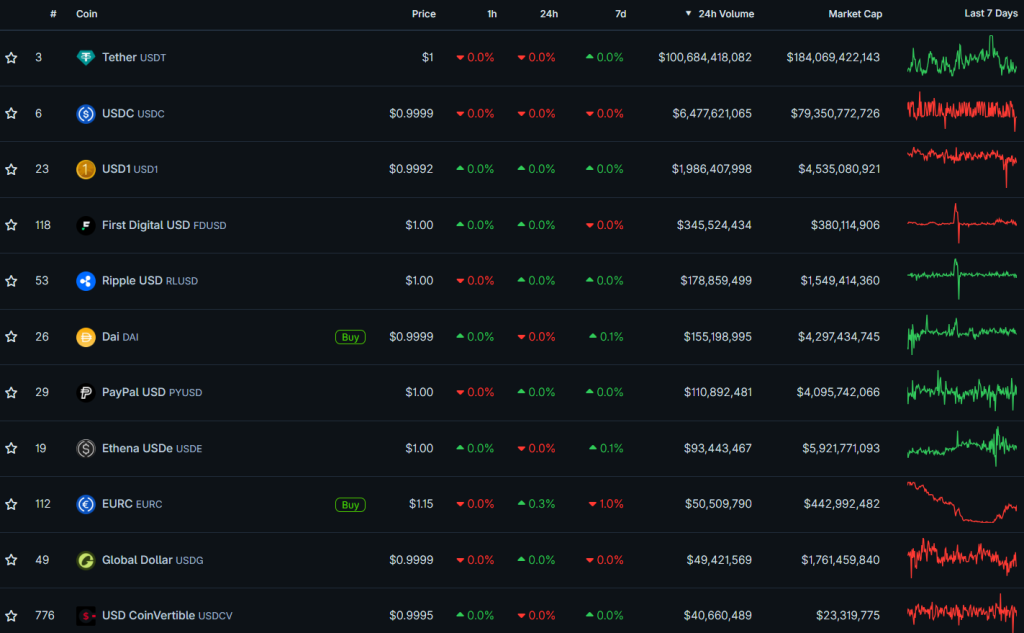
Despite the launch of USDS, DAI remains in demand. At the time of writing, its 24-hour trading volume exceeds $155m.


The token still appeals to purists for whom the principled absence of a freeze function outweighs the marketing or yield attractions of newer projects.
7. PayPal USD (PYUSD)
Launch year: 2023
Issuer: PayPal, Paxos
Market cap: ~$4.1bn
The payments giant’s coin is a bridge between mainstream e-commerce and crypto. The asset is fully backed by US dollar deposits, short-term Treasuries and cash equivalents. Within two months of launch, it was integrated into the popular Venmo app.
In April 2024, PayPal announced cross-border payments and remittances via Xoom with a Pay with Crypto feature supporting more than 100 assets. In late 2025, YouTube enabled US creators to receive payouts in PYUSD.
It is the only top-ten stablecoin underpinned by a ready-made Web2 user base with little experience of Web3 tools.
8-9. Global Dollar (USDG)
Launch year: 2024
Issuer: Global Dollar Network (Paxos, Robinhood, Kraken)
Market cap: ~$1.8bn
USDG issuance is regulated under the Monetary Authority of Singapore’s standards, with backing in fiat deposits and US Treasuries.
Its main distinction is revenue-sharing among network participants (not end-users). An organisation’s cut depends on its contribution to the token’s growth. Aggressive incentives for partners often push USDG’s market cap ahead of the nearby USDf in the rankings.
Consortium members have offered attractive terms to retail users. In apps such as Robinhood, for instance, USDG transactions carry zero fees. That has turned the token into a potent B2B tool that financially motivates a switch away from Tether and Circle.
8-9. Falcon USD (USDf)
Launch year: 2025
Issuer: Falcon Finance
Market cap: ~$1.7bn
This overcollateralised stablecoin competes with USDe and offers yields from secondary financial operations.
USDf employs dual minting: Classic Mint (collateralised with an equivalent amount of USDT or USDC) and Innovative Mint. In the latter, the user posts a larger amount in volatile assets. For example, minting 100 USDf requires $130–140 in BTC or ETH to provide a buffer against market swings. This has reduced the risk of cascading liquidations and improved the asset’s stress resilience.
To earn yield, base USDf is staked in exchange for the income-bearing derivative sUSDf. That token accrues returns generated through delta-neutral mechanisms and arbitrage.
10. Ripple USD (RLUSD)
Launch year: 2024
Issuer: Ripple Labs
Market cap: ~$1.5bn
Ripple Labs’ “stablecoin” is 100% backed by dollar assets and short-term US Treasuries. Liquidity is provided by market-makers B2C2 and Keyrock. RLUSD also targets payments, RWA and DeFi.
In January 2025, Ripple entered into a partnership with the decentralised oracle network Chainlink to speed RLUSD’s integration into DeFi. At the time of writing, RLUSD’s 24-hour trading volume stands at $178m.