



Trader predicts Bitcoin’s ‘death’ as miners pivot to AI
Ran Neuner says AI hosting’s higher returns are “killing” Bitcoin mining.
AI hosting brings Bitcoin miners nearly eight times the revenue of mining. Trader Ran Neuner said such a disparity is “killing” the Bitcoin network.
AI has killed Bitcoin forever.
It became Bitcoin mining’s biggest competitor.
Not another crypto.
AI.
Because both industries compete for the same thing:
electricity.And right now, AI is willing to pay much more for it.
Bitcoin mining revenue per MW:
$57 – $129AI data… pic.twitter.com/gN23lvRSl2
— Ran Neuner (@cryptomanran) March 15, 2026
He argued that both industries compete for the same power capacity, yet AI companies are prepared to pay more. Revenue for digital-gold miners is $57-129 per megawatt, while data centres for neural networks yield $200-500 for the same load.
As evidence of the trend, Neuner cited several corporate examples:
- Core Scientific received a loan of $500m from Morgan Stanley to build AI data centres;
- MARA Holdings notified the SEC of its intention to sell part of its bitcoin reserves to pivot to AI;
- Hut 8 signed a $7bn agreement with Google to build AI infrastructure;
- Cipher Mining reduced its hashrate to service neural networks;
- Bitmain co-founder Jihan Wu has left mining entirely for AI.
“If I were a miner, the choice would be obvious. That is why more participants are leaving the network,” the expert said.
He also pointed to a fall in hashrate — the metric is down 14.5% from its October peak. The exit of miners raises the risk of a 51% attack, Neuner believes. Previously such episodes were smoothed by difficulty recalculation, but today the shortage of energy worsens the situation.
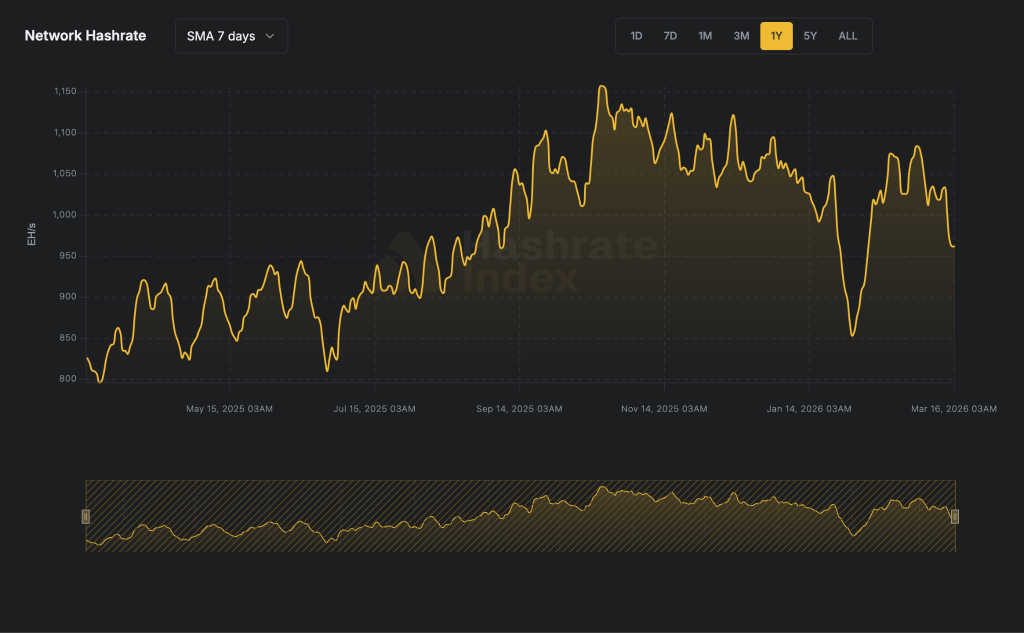
In his view, digital gold can compete with AI only on one condition — if its price rises.
“I hope Bitcoin prints one green candle. Maybe because of war, maybe because of regulation,” he concluded.
Counterarguments
Crypto pioneer and Blockstream CEO Adam Back disagreed with Neuner’s conclusions. He said that mining difficulty will adjust and will push out only the least efficient players.
What happens to Bitcoin is simple: tick tock, next block! Difficult adjusts downwards, least efficient and AI switchers move out and Bitcoin mining profitability converges to AI profitability. QED.
— Adam Back (@adam3us) March 15, 2026
“Tick tock, next block! Difficulty falls, those who switched to AI leave, and mining profitability converges with AI profitability,” he wrote.
Analyst Willy Woo took a similar view. He stressed that in this context the price of electricity is not decisive — it affects only competition among Bitcoin miners.
“How much the Bitcoin network is willing to pay for its security is determined by the price of BTC and the use of the blockchain. […] Study Bitcoin’s difficulty adjustment mechanism — it is a fundamental cornerstone for understanding BTC,” the expert said.
Investor Fred Krueger explained that when AI offers better economics, miners will switch off until network difficulty falls and mining returns to profitability. This is Bitcoin’s normal operating cycle, he noted.
ESG specialist Daniel Batten also argued that AI’s expansion depends on digital gold. Miners, he said, can harness underused energy, balance power systems and run legacy equipment on cheap electricity.
Nonsense
It’s the other way around: the evidence tells us that AI is dependent upon Bitcoin for its expansion
For example, bitcoin mining can be used alongside AI for strategic advantages including
— monetizing energy during AI datacenter construction
— using forward-purchased…— Daniel Batten (@DSBatten) March 15, 2026
In March, Wintermute analysts said the traditional mining model is no longer relevant. They argue that to survive, Bitcoin miners will either have to switch to AI hosting or learn to manage their bitcoin reserves as working capital.
Рассылки ForkLog: держите руку на пульсе биткоин-индустрии!