



TRON runs hot: how to cut USDT transfer fees
In January 2025 Justin Sun said that the TRON team was working on feeless USDT transactions, but did not specify a timeline for implementing the idea.
According to GasFeesNow, fees for USDT transfers on TRON remain the highest. In this article, together with the G-24 wallet team, we explain how to cut costs by up to 60% when sending USDT (TRC-20).
Myth and reality
Tether issued its first stablecoins in 2014 on the Omni protocol running atop Bitcoin. Owing to sluggish transactions, the company later added support for other networks.
The stablecoin arrived on Ethereum in 2018 and on TRON in 2019. Ethereum led by outstanding supply, but in August 2022 TRON overtook it. Only by late 2024 did Ethereum retake first place, albeit by a narrow margin.
“The popularity of ERC-20 or TRC-20 largely depends on the region. For example, in the countries of the Global South and in Eastern Europe, USDT is used predominantly on the TRON network,” G-24 representatives note.
Tether’s chief, Paolo Ardoino, attributed this to the Ethereum community’s insufficient focus on building a stablecoin ecosystem and real payment solutions. In 2024 he posted on X, without naming Ethereum and TRON but clearly alluding to them.
“Recently I get this question a lot: why is USDT so popular on blockchain Y?”
“Answer: while the rest of the crypto industry spent eight years executing the plan to scale blockchain Z (rollups, etc.), while giving priority to DeFi, lambos, degens, dog, horse, camel, monkey tokens, and so on, blockchain Y remained the only accessible and fast payment solution for people in developing countries who could not afford to pay $5 in fees. As a result, tens of thousands of payment providers invested huge resources in integrating with blockchain Y, and this first-mover advantage is deeply rooted in many businesses.
Moreover, today blockchain Z features many competing L2 solutions, which makes choosing the right option a difficult task. Having options is a plus in itself, but in this case timing and focus play a key role,” he said.
On the other hand, fee-cutting measures on L2s after the Dencun hard fork, and on Ethereum’s mainnet through raising the gas limit, came somewhat late. As a result, TRON captured a significant share of the market despite frequent criticism of the project’s founder, Justin Sun.
“TRON has long monetised the network’s popularity. One might assume that rising transaction costs are due to protocol limits, but in reality this is part of the platform’s strategy, and claims of cheap transactions diverge from reality,” G-24 believes.
In September 2024 Sun said TRON’s fees had been cut by 50%. Yet Untron founder Alex Hook noted that USDT transfer costs remained high.
Hook explained that when sending USDT to an address that had not previously held these tokens, gas consumption doubles. As a result, transfers on TRON have always required ~32,000 or ~65,000 energy depending on whether the recipient already holds the stablecoin.
“Now, since the energy (gas) price was reduced 2x, users should pay less for the same USDT transfers. Say, $1-2 instead of $2-4. However, proposal 95 included a 2x increase in gas costs for certain smart contracts, including USDT,” Hook noted.
He concluded that if before the update users paid 32,000/65,000 energy for USDT transfers, afterward the cost doubled to 65,000/130,000.
Ways to save on USDT fees
Tether’s close link with TRON makes shifting to more economical blockchains difficult.
Of course, swapping the stablecoin via centralised exchanges or cross-chain bridges is possible, but it forces companies and everyday users into trade-offs.
“TRC-20 has taken root and in effect become the standard for USDT — it is supported by everyone who works with Tether. Most exchangers offer the best rates precisely on this network. At present, fees for sending USDT on Ethereum are already lower than on TRON, but exchanges are in no hurry to cut them. TRC-20’s popularity is sustained by inertia and users’ habit of working with already familiar tools,” G-24 representatives comment.
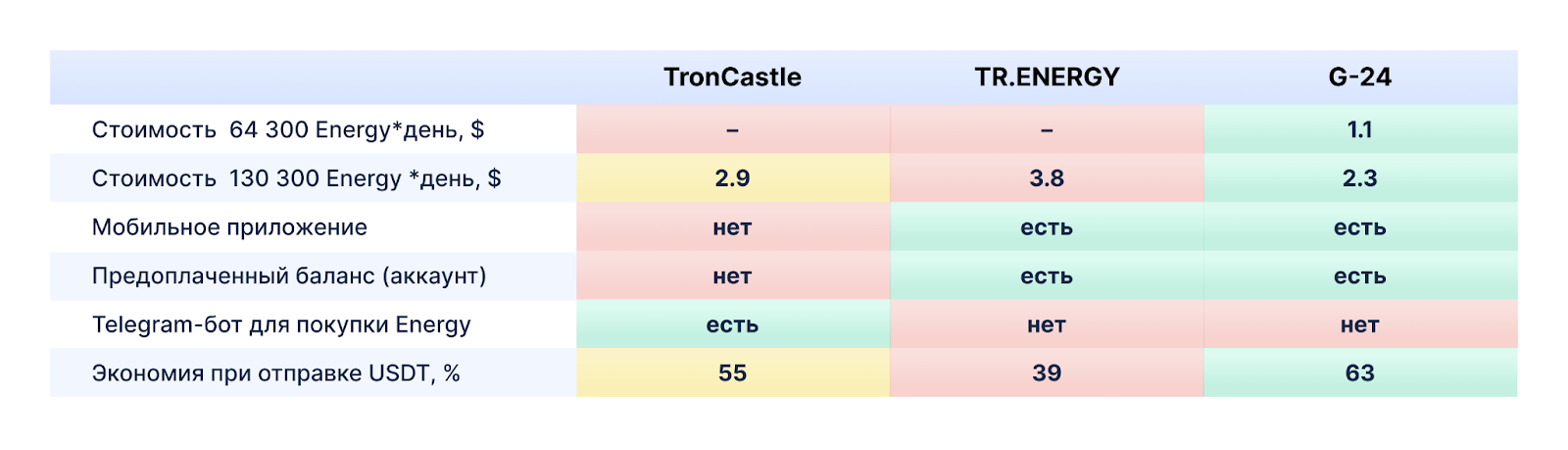
Thus, exchange services have concluded that a mass user shift to other blockchains is unlikely in the near term, so it is more effective to reduce fees within TRON than to integrate alternative solutions. And since developers are in no rush to lower the cost of USDT transactions, third-party energy vendors such as TronCastle, TR.ENERGY and G-24 have emerged. They let ordinary wallet users avoid burning (spending) TRX when sending USDT.
“Today we can confidently say that this approach has paid off. Strong demand for such services is evidenced by competition among dozens of projects in TRON’s energy market. G-24’s advantage is that we sell not just energy but a ready-made bundle that includes Energy + Bandwidth.
In addition, a user with a prepaid balance in the wallet can buy energy in just two clicks for about $1. For that amount they receive 345 Bandwidth and 64,300 Energy, which is enough for one USDT transaction,” G-24 representatives note.
They say that buying energy via the G-24 app reduces commission costs by up to 63%. To support this, they provide a comparative table of energy prices at TronCastle, TR.ENERGY and G-24.
Conclusions
The TRON network has long ceased to be cheap, yet it remains the main option for USDT transfers. Justin Sun managed to “seize the throne” just as stablecoins were surging in popularity and their capitalisation was growing by tens of billions of dollars a year.
TRON will likely remain in high demand in the near future, despite the rise of more economical alternatives such as Solana. Users of non-custodial wallets can cut the cost of USDT (TRC-20) transactions with energy-purchase services, for example G-24.
Рассылки ForkLog: держите руку на пульсе биткоин-индустрии!