




The U.S. Treasury released a report on risks associated with stablecoins. The agency identified stablecoins as a threat to investors and market integrity, and called for stringent regulatory restrictions.
Today, Treasury joined colleagues from the President’s Working Group (PWG) on Financial Markets, @FDICgov and @USOCC to issue a report on stablecoins.
Read more: https://t.co/7blQTYYJAU
— Treasury Department (@USTreasury) November 1, 2021
In terms of risk, the document refers to the “banking panic” and the excessive opacity of the reserves backing stablecoins.
The report was prepared by the President’s Working Group on Financial Markets (PWG). Its members urged Congress to treat stablecoin issuers as depository institutions with mandatory deposit insurance, placing them on a par with banks. Organizations not meeting such stringent requirements would, in that case, be prohibited from issuing stablecoins.
Oversight, according to PWG, should be conducted at both the level of such an institution and at the level of the holding company that owns it.
The report notes the need to restrict the affiliation of issuers with other commercial entities (likely most relevant to the Bitfinex–Tether tandem).
3) Stablecoin issuers must «comply with activities restrictions that limit affiliation with commercial entities.»
— Rob Blackwell (@robblackwellAB) November 1, 2021
Jerry Brito, the executive director of the lobbying group Coin Center, emphasized that the report’s definitions of stablecoins and risks are effectively applicable to the activities of payment systems such as PayPal, for which no separate legislation was required.
4/ One thing that I still find very amusing is that the way they describe what stablecoins are, and what risks they pose, is identical to how one would describe PayPal or similar. I don’t see how they distinguish it, yet there’s no legislation recommended for payments apps. pic.twitter.com/nvQk0z0rEU
— Jerry Brito (@jerrybrito) November 1, 2021
Any regulatory gaps should be closed by the Treasury, the Fed, the SEC and the CFTC, the authors of the report concluded. The PWG insisted that the SEC and CFTC should participate in regulating certain stablecoins.
Another potential regulator is the Financial Stability Oversight Council (FSOC), created under the Dodd-Frank Act after the 2008 financial crisis. FSOC could designate certain stablecoin-related activities as systemically important if Congress does not respond. However PWG did not explicitly recommend this, so experts currently consider such a development unlikely.
In the absence of Congressional action, the PwG recommends FSOC take action. «Such steps may include designation of certain activities conducted within a stablecoin arrangement as, or as likely to become, systemically important payment, clearing and settlement activities.»
— Rob Blackwell (@robblackwellAB) November 1, 2021
According to lawyer Jake Chervinsky, swift action by Congress should not be expected in principle, not to mention laws on stablecoins.
«The report acknowledges that federal regulators lack the authority to implement all of these various recommendations. In short, nothing drastic will change in the near term. And that’s a good thing, because the document contains many incorrect formulations,» he wrote on Twitter.
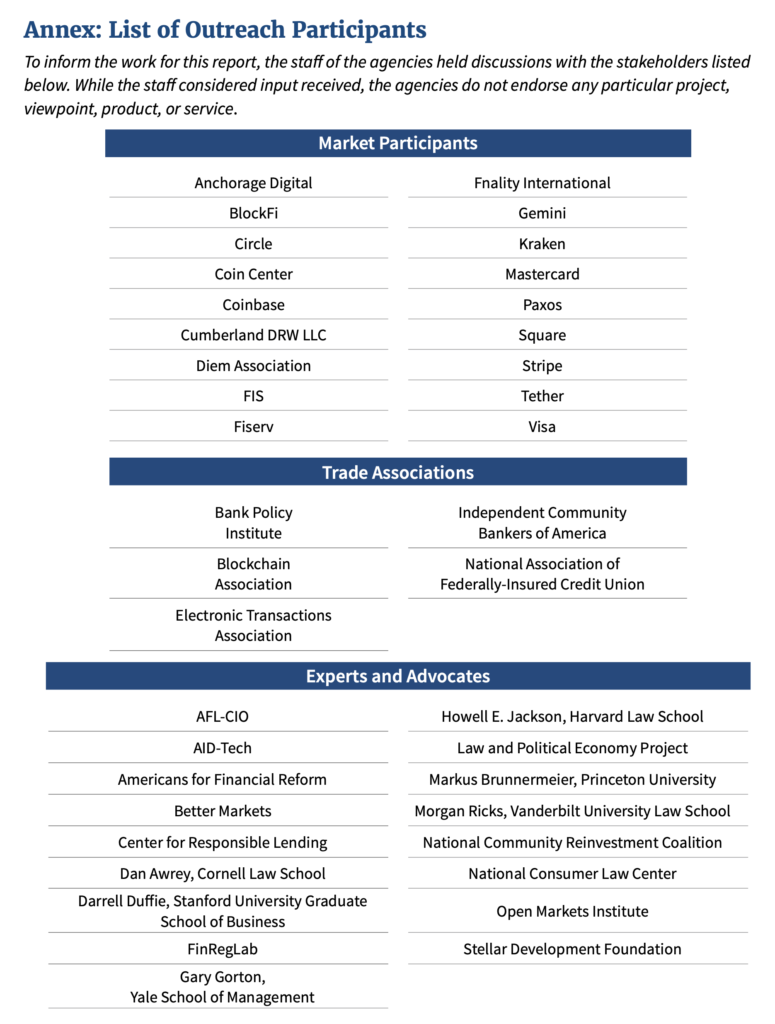
In PWG consultations participated Tether, Circle, Paxos, Coinbase, Coin Center, Diem Association, Gemini and others.


Circle backed the call for Congress. Circle CEO Jeremy Allaire welcomed the industry’s conceptual reception but questioned some passages in the document. They say that various entities involved in stablecoin operations should meet risk-management standards. This would be impossible for validators or miners in a decentralized network.
Allaire stressed that Web3 infrastructure should be treated in law as equivalent to DNS and Internet providers, and not to payment institutions.
Circle itself said in August that it intends to obtain a banking license to conduct banking activities, even as the company is under SEC investigation.
We previously announced our efforts to apply for a national digital currency bank charter under Federal Reserve, OCC/Treasury and FDIC supervision. 3/22
— Jeremy Allaire (@jerallaire) November 1, 2021
As noted in January 2021, ex-Fed chair Janet Yellen, known for her critical stance toward Bitcoin, became head of the U.S. Treasury. In July she urged the rapid creation of a stablecoin regulatory framework, and in September the first fragments of the final document appeared.
In October, the Office of Foreign Assets Control (OFAC) within the Treasury published guidance for cryptocurrency industry participants on compliance with U.S. sanctions.
Subscribe to ForkLog news on Telegram: ForkLog Feed — the full news stream, ForkLog — the most important news, infographics and opinions.